

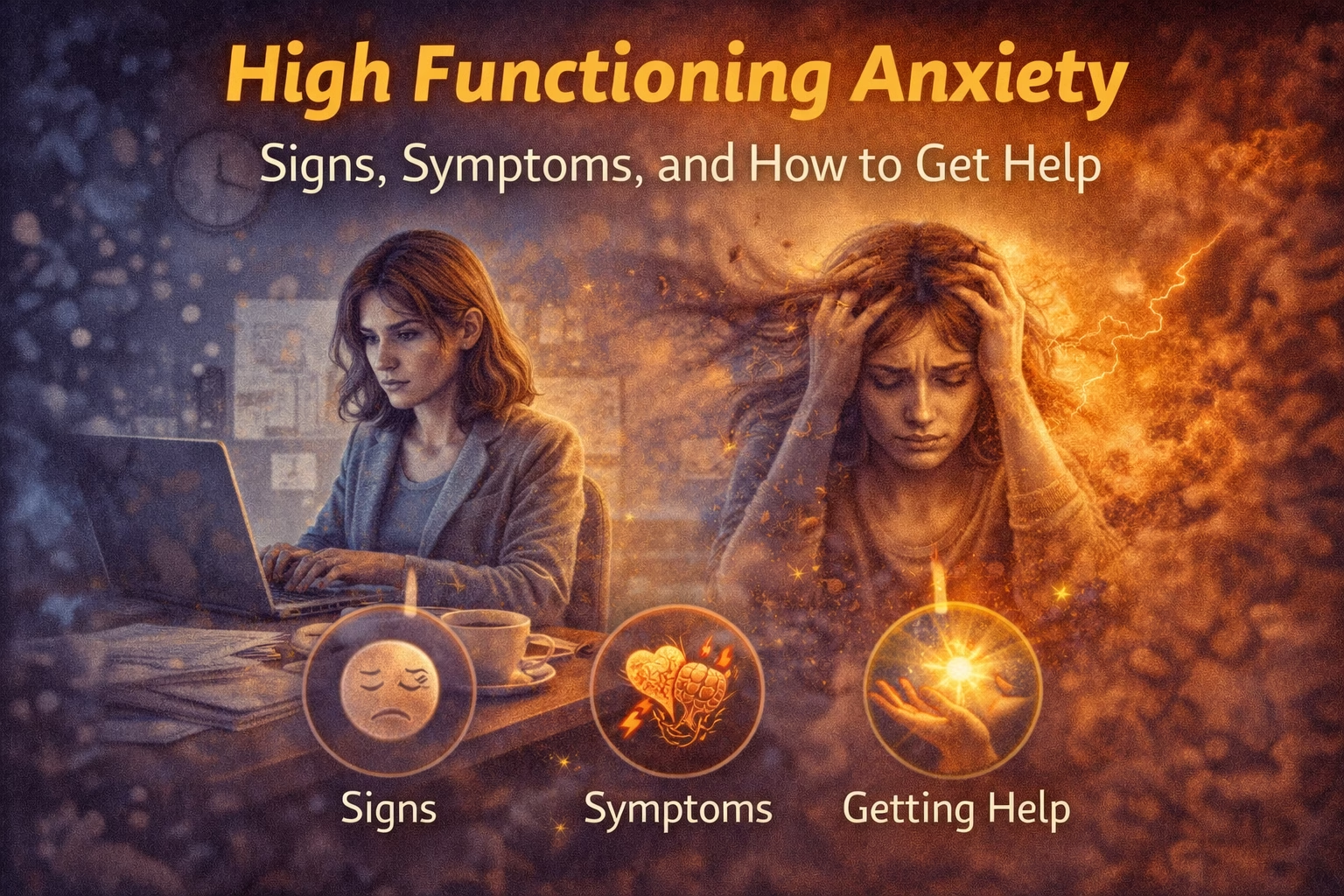
To everyone around you, you look like you have it together. You meet your deadlines. You show up. You are reliable, organized, and often the person others lean on. But inside, there is a constant hum of worry, a relentless inner critic, and a deep fear that at any moment something will go wrong — or that people will realize you are not as capable as you appear.
This is high functioning anxiety. It is one of the most common — and most commonly missed — forms of anxiety, precisely because the people who have it look fine. Often better than fine. That is also what makes it so exhausting to live with.
High Functioning Anxiety: What Shows and What Stays Hidden
✓ Calm under pressure
✓ Always prepared, never lets things slide
✓ Helpful, selfless, hard to say no to
✓ Appears to have everything under control
✓ Fear of failure despite evidence of success
✓ Difficulty relaxing or being present
✓ Inner critic that never goes quiet
✓ Exhaustion from performing “okay” all the time
Feel free to share or embed this infographic with credit to darinkingcounselingllc.com
What Is High Functioning Anxiety?
High functioning anxiety describes a pattern in which a person experiences the internal symptoms of anxiety — chronic worry, overthinking, fear of failure, self-doubt — while maintaining a high level of external functionality in work, relationships, and daily life. The Mayo Clinic describes it as anxiety that fuels achievement rather than avoidance: people with high functioning anxiety do not pull back from life’s demands — they white-knuckle their way through them.
High functioning anxiety is not a formal diagnosis in the DSM-5, the diagnostic manual used by mental health professionals. It is most closely related to Generalized Anxiety Disorder (GAD), which the National Institute of Mental Health estimates affects approximately 6.8 million American adults. However, many people with high functioning anxiety do not meet the full threshold for a GAD diagnosis — their symptoms are real and significantly disruptive, but their external functioning masks the internal distress.
The result is a person who appears successful, capable, and even admirable from the outside — and is suffering privately. Many go years without recognizing their anxiety as anxiety at all, because their experience of it looks nothing like the stereotype.
A useful image: The Mayo Clinic describes high functioning anxiety as being like a duck on a pond — appearing calm on the surface while paddling frantically underneath. That internal effort is real, exhausting, and invisible to everyone else.
Signs of High Functioning Anxiety
High functioning anxiety often does not look like anxiety at all from the outside. The signs that matter most are the ones happening internally — and the behavioral patterns that develop as ways of managing the internal experience.
Mental and Emotional Signs
| Sign | What It Looks Like | How It Gets Misread |
|---|---|---|
| Chronic overthinking | Replaying conversations, anticipating problems, worst-case scenario thinking | “They’re just thorough” or “very detail-oriented” |
| Perfectionism | Standards that can never quite be met; no task feels fully done | “They have high standards” or “they’re ambitious” |
| Fear of failure | Deep dread of making mistakes despite a track record of success | “They’re driven” or “they care about quality” |
| Difficulty saying no | Taking on too much because refusal triggers anxiety about disappointing people | “They’re so helpful” or “a team player” |
| Need for reassurance | Seeking confirmation that things are okay even when they are | “They’re conscientious” or “communicative” |
| Inability to fully relax | Free time triggers guilt, restlessness, or a sense that something is being neglected | “They’re just a workaholic” |
| Catastrophizing | A minor problem becomes evidence of a larger impending disaster | “They’re dramatic” or “anxious about nothing” |
Physical Signs
The body carries high functioning anxiety even when the mind is managing to function. Physical signs include chronic muscle tension (particularly in the jaw, neck, and shoulders), headaches, difficulty falling or staying asleep, digestive issues, fatigue despite adequate rest, rapid heartbeat, and a persistent low-level sense of physical unease. The Cleveland Clinic notes that these physical symptoms are often the first place high functioning anxiety becomes impossible to ignore — particularly when stress levels increase.
These physical patterns connect directly to how chronic anxiety dysregulates the nervous system over time. Our posts on cortisol and chronic stress and the parasympathetic and sympathetic nervous systems provide the biological framework for why the body holds anxiety even when the mind is coping.
Why High Functioning Anxiety Goes Unrecognized
There are several reasons high functioning anxiety is consistently underdiagnosed and undertreated.
First, anxiety is commonly understood as something that causes avoidance and impaired functioning. When someone with high functioning anxiety is excelling at work, maintaining relationships, and appearing in control, neither they nor the people around them typically flag it as anxiety. The behavior that anxiety drives — overpreparation, overperformance, never saying no — looks like success, not suffering.
Second, many people with high functioning anxiety have normalized their internal experience to such a degree that they genuinely do not recognize it as anxiety. The constant worry feels like being conscientious. The inability to relax feels like being motivated. The inner critic feels like quality control. It is just how their mind works — and because it has always been this way, it does not occur to them that it could be different.
Third, there is a real cultural reward for the behaviors high functioning anxiety drives. Being highly productive, always prepared, never letting things slip, always available — these are valued. The anxiety underneath is invisible, and the outcomes it produces are praised.
Note: High functioning anxiety frequently co-occurs with people-pleasing, perfectionism, and the kind of chronic guilt that makes it hard to rest or prioritize yourself. If you recognize yourself in multiple of these patterns, they may all be part of the same underlying picture.
What Drives High Functioning Anxiety
High functioning anxiety rarely develops from nowhere. It is most commonly rooted in early experiences that taught the nervous system that vigilance, performance, and anticipation of problems were necessary for safety or love.
Environments in which a child’s worth was conditional on achievement, where mistakes had significant consequences, where a parent’s emotional stability depended on the child’s behavior, or where unpredictability made hypervigilance necessary — all of these can produce an adult who is excellent at anticipating problems and performing under pressure, and who cannot turn that system off. The anxiety became functional. It served a purpose. It kept things safe. The problem is that it does not know when to stop.
This is why high functioning anxiety connects so directly to abandonment fears, shame, and childhood trauma. The anxiety is not irrational — it was rational in its original context. What treatment does is help the nervous system recognize that the original context no longer applies.
How High Functioning Anxiety Is Treated
Cognitive Behavioral Therapy (CBT)
CBT is one of the most well-researched treatments for anxiety disorders. It works by identifying the distorted thought patterns — worst-case scenario thinking, all-or-nothing thinking, catastrophizing — that sustain anxiety, and systematically replacing them with more accurate, balanced perspectives. For high functioning anxiety specifically, CBT also addresses the behaviors that maintain the anxiety: the over-preparation, the reassurance-seeking, the inability to delegate.
EMDR Therapy
For high functioning anxiety rooted in early experiences, EMDR therapy addresses the underlying traumatic memories and nervous system patterns that drive the anxiety rather than only managing symptoms at the surface. EMDR is particularly useful when high functioning anxiety is entangled with trauma history, perfectionism driven by fear of consequences, or people-pleasing with abandonment roots.
Nervous System Regulation
High functioning anxiety keeps the nervous system in a chronic state of low-grade sympathetic activation. Learning to regulate this — through breathwork, movement, grounding, and other parasympathetic activation techniques — is a critical component of lasting improvement. Our guide on nervous system reset techniques provides practical tools, and our post on how therapy helps with anxiety explains what the treatment process looks like.
Addressing the Underlying Patterns
Sustainable relief from high functioning anxiety often requires addressing what is underneath it — the beliefs about worthiness, the fear of failure’s consequences, the inability to rest without guilt. This is deeper work, and it is the kind of work that therapy at its best facilitates. If you are wondering where to start, our posts on how to know when it’s time to start therapy and feeling nervous about starting therapy address the most common hesitations.
Related reading: Anxiety vs. panic attacks · How therapy helps with anxiety · Nervous system reset · People-pleasing · Shame vs. guilt · Cortisol and chronic stress · Trauma and panic attacks
Frequently Asked Questions
What is high functioning anxiety?
High functioning anxiety describes significant internal anxiety — chronic worry, perfectionism, fear of failure — while maintaining high external functionality. It is not a formal DSM-5 diagnosis but is closely related to Generalized Anxiety Disorder. Unlike typical anxiety, it drives overachievement rather than avoidance, which is why it is frequently missed entirely.
What are the signs of high functioning anxiety?
Chronic overthinking, perfectionism, inability to feel satisfied with work, fear of failure despite success, difficulty saying no, constant need for reassurance, inability to relax, catastrophizing, muscle tension, headaches, sleep problems, and digestive issues. Outwardly, people with high functioning anxiety often look organized and high-achieving. If you suspect anxiety is also affecting your physical health, see our post on cortisol and chronic stress.
Is high functioning anxiety a real condition?
Yes. While not a formal DSM-5 diagnosis, it is a real and clinically recognized pattern of experience. The symptoms are genuine, the suffering is real, and it responds well to treatment. The National Institute of Mental Health estimates 6.8 million American adults are affected by Generalized Anxiety Disorder — and many more experience anxiety at a subclinical but still significant level.
What causes high functioning anxiety?
Most commonly rooted in early experiences that made vigilance and performance feel necessary for safety — conditional worth, consequences for mistakes, or parental instability that required the child to manage carefully. Childhood trauma, people-pleasing, and perfectionism are frequently intertwined.
How is high functioning anxiety treated?
CBT addresses distorted thought patterns. EMDR therapy is effective for anxiety with trauma roots. Nervous system regulation addresses the physiological component. See our post on how therapy helps with anxiety for a detailed overview of what treatment looks like in practice.
Can you have anxiety and still be successful?
Yes — this is the defining feature of high functioning anxiety. Many people with this pattern are outwardly successful precisely because anxiety drives overpreparation and perfectionism. But the internal cost is significant: chronic stress, exhaustion, and an inability to enjoy achievements or rest. Success does not protect against anxiety. In high functioning anxiety, it often masks it.
Looking fine on the outside doesn’t mean you have to feel this way on the inside.
Darin King, LPC works with adults navigating anxiety, perfectionism, and the exhaustion of always holding it together. Telehealth available statewide across Pennsylvania.
See more from Darin King Counseling on Google