

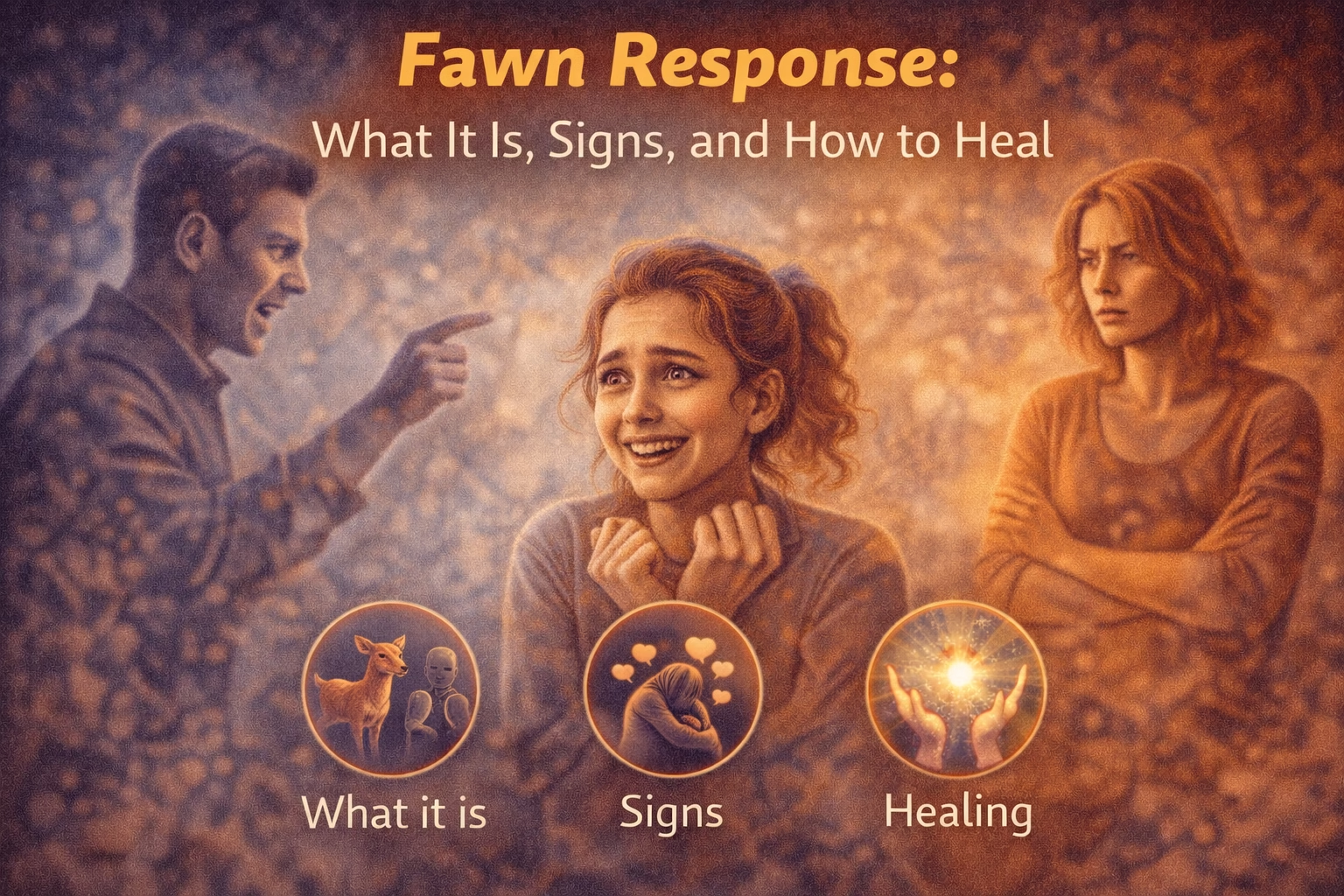
You automatically agree with people even when you don’t. You apologize before the other person has finished speaking. You can read a room in seconds and adjust yourself accordingly — scanning for what is needed, what would help, what might prevent conflict. In a dangerous situation, your first impulse is not to fight or flee. It is to become as agreeable, as useful, as non-threatening as possible.
This is the fawn response — a trauma survival strategy that disguises itself as kindness, agreeableness, and social competence. And for many people, it was genuinely adaptive. It worked. The problem is that it does not stop, even when the danger has long since passed.
The Four Trauma Responses: Fight, Flight, Freeze, Fawn
✓ Flight: Escape or avoid the threat
✓ Freeze: Immobilize when escape is impossible
✓ All three activate in response to perceived danger
✓ Primarily address external threat directly
✓ Manages danger through compliance rather than confrontation or escape
✓ Develops when fighting, fleeing, or freezing are not options
✓ Most common when the threat is a person you depend on
✓ Becomes habitual and automatic over time
Feel free to share or embed this infographic with credit to darinkingcounselingllc.com
What Is the Fawn Response?
The fawn response — also called the fawn trauma response or appease response — is a survival strategy in which a person responds to perceived threat by becoming agreeable, accommodating, and compliant in order to manage the threat and reduce the likelihood of harm. The term was coined by trauma therapist Pete Walker in his work on complex PTSD, and it is now widely recognized in trauma-informed clinical practice.
The fawn response is the fourth survival response alongside the better-known fight, flight, and freeze responses. All four are governed by the autonomic nervous system and are essentially involuntary — the body selects the response based on what it has learned is most likely to produce safety. Fawning develops most commonly in environments where the source of threat is also the source of care: an abusive or emotionally volatile parent, a partner who becomes dangerous when challenged, or any relationship in which maintaining the peace requires constant self-suppression.
The American Psychological Association recognizes that trauma responses — including appeasement behaviors — are adaptive mechanisms that develop in response to real threat. The fawn response is not weakness, compliance, or a character trait. It is a learned survival strategy that was, at some point, the smartest thing your nervous system could do.
The key distinction: Kindness and generosity are values you choose from a place of genuine care. The fawn response is a reflex driven by fear — the automatic suppression of your own needs, opinions, or feelings in order to manage someone else’s emotional state and keep yourself safe. The difference is whether you have a choice.
Fight, Flight, Freeze, Fawn: Understanding All Four Responses
Fight
The fight response mobilizes aggression — physical or verbal — to confront or neutralize the perceived threat. In acute danger, this is the response that allows people to defend themselves. In chronic stress patterns, it can show up as anger, irritability, or combativeness that feels disproportionate to current circumstances.
Flight
The flight response mobilizes escape — physically removing yourself from danger, or in chronic patterns, avoidance, overworking, or constant busyness as a way of staying ahead of whatever feels threatening. Our post on how trauma affects the nervous system explains how these responses become chronic patterns rather than acute reactions.
Freeze
The freeze response immobilizes when neither fighting nor fleeing feels possible. In acute situations, this is the deer-in-the-headlights response. In chronic form, it becomes functional freeze — going through the motions while internally numb and disconnected.
Fawn
The fawn response manages threat through appeasement — making yourself agreeable, useful, and non-threatening enough that the source of danger is satisfied and the threat reduces. It is the response that develops most naturally when the threat is a person you are dependent on and cannot fight, flee from, or freeze in front of without consequence.
Signs of the Fawn Response
| Sign | How It Presents | The Fear Underneath |
|---|---|---|
| Automatic agreement | Saying yes or agreeing before you’ve even processed your own view | Disagreement is unconsciously coded as dangerous |
| Difficulty saying no | Requests feel like demands; refusal triggers significant anxiety | Saying no risks disapproval, anger, or loss of relationship |
| Hypervigilance about others’ moods | Constantly scanning for signs of displeasure or upset in others | Early warning of displeasure was necessary for survival |
| Over-apologizing | Apologizing reflexively, before you know if you’ve done anything wrong | Preemptive appeasement to neutralize potential threat |
| Self-abandonment | Giving up your preferences, opinions, and needs to accommodate others | Your own needs were unsafe to have; the other person’s comfort was the priority |
| Difficulty with conflict | Conflict triggers a flood of anxiety; you will do almost anything to end it | Conflict was dangerous or unpredictable in early relationships |
| Feeling responsible for others’ emotions | Other people’s bad moods feel like your responsibility to fix | Managing others’ emotional states was a survival task in childhood |
| Resentment without expression | Accumulating unexpressed resentment from chronic self-suppression | Expressing dissatisfaction felt dangerous; agreement was the only safe option |
What Causes the Fawn Response?
The fawn response develops most commonly in environments where a child was repeatedly exposed to a caregiver who was emotionally volatile, threatening, or unpredictable, and where the child could not safely fight back or leave. In this environment, fawning — becoming agreeable, helpful, cheerful, and compliant — was the child’s best available strategy for reducing danger and maintaining connection.
This is why the fawn response is so closely linked to growing up with emotionally immature parents, abandonment trauma, emotional neglect, and disorganized attachment. In each of these environments, the child’s needs and authentic self were either dangerous to express or simply irrelevant. The fawn response was the adaptation.
The National Institute of Mental Health recognizes that complex trauma — particularly repeated interpersonal trauma in childhood — produces lasting changes in how the nervous system responds to threat, including the development of automatic appeasement and compliance behaviors.
The Fawn Response and People-Pleasing
The fawn response is the nervous system’s version of people-pleasing — but understanding that distinction matters. People-pleasing can sometimes be a conscious choice, a value, or a social strategy. The fawn response is involuntary: it activates before conscious processing, driven by the nervous system’s threat detection system rather than by deliberate decision.
Many people who identify as people-pleasers are actually living in a chronic fawn state — their people-pleasing is not a personality trait but a trauma response running on automatic. Our dedicated posts on people-pleasing, why you might be a people pleaser, and signs of a people pleaser explore this distinction in depth.
Note: The fawn response often produces a specific emotional pattern: you suppress your authentic responses in the moment to manage the interaction, then experience resentment, emptiness, or shame afterward — both at the person you fawned toward and at yourself for doing it. This cycle is a strong signal that what looks like kindness is actually survival behavior.
How to Heal the Fawn Response
Recognize it as a trauma response, not a personality trait
The first step is separating the fawn response from your identity. You are not inherently a pushover, a doormat, or someone without a spine. You are someone whose nervous system learned that appeasement was the safest available option. That was true once. It does not have to be true now.
Build the capacity to tolerate others’ displeasure
At the root of the fawn response is a nervous system that experiences others’ disapproval or anger as genuinely dangerous. Healing involves gradually learning — through practice and therapeutic support — that other people’s negative emotional responses are survivable. That you can disappoint someone and still be okay. That conflict does not have to mean catastrophe.
Reclaim your own wants, opinions, and needs
Many people in chronic fawn states have lost access to their own preferences — they have suppressed them for so long that they genuinely do not know what they want. Part of healing is the slow, deliberate process of reconnecting with your own experience: what you actually think, feel, want, and need, independent of what others expect.
Trauma-informed therapy
EMDR therapy processes the specific memories and nervous system patterns that produced the fawn response — addressing the original experiences that taught the body that appeasement was necessary for safety. Attachment-based therapy addresses the relational patterns directly. Our posts on how to stop being a people pleaser and nervous system reset provide practical starting points.
Related reading: People-pleasing · Signs of a people pleaser · How to stop being a people pleaser · Functional freeze · How trauma affects the nervous system · Adult children of emotionally immature parents · Abandonment trauma in relationships
Frequently Asked Questions
What is the fawn response?
A trauma survival strategy in which a person responds to perceived threat by becoming agreeable, accommodating, and compliant to manage or neutralize the danger. The fourth trauma response alongside fight, flight, and freeze. It develops when the source of threat is also the source of care — fighting or fleeing is too dangerous, so appeasement becomes the survival strategy.
What are the signs of the fawn response?
Automatic agreement before knowing your own view, difficulty saying no, hypervigilance about others’ moods, over-apologizing, self-abandonment in favor of others’ preferences, extreme discomfort with conflict, feeling responsible for others’ emotional states, and accumulated unexpressed resentment.
What is the difference between fawning and people-pleasing?
People-pleasing can be a conscious choice. The fawn response is involuntary — it activates before conscious processing, driven by the nervous system’s threat detection system. Many who identify as people-pleasers are living in chronic fawn. Our posts on people-pleasing and why you might be a people pleaser explore this distinction.
What causes the fawn response?
Most commonly: growing up with an emotionally volatile or threatening caregiver where fighting or leaving was unsafe. Also linked to emotionally immature parents, emotional neglect, and abandonment trauma.
Can the fawn response be healed?
Yes. Through recognizing it as a trauma response, gradually tolerating others’ displeasure, and reconnecting with your own needs. EMDR therapy processes the underlying experiences. Our post on how to stop being a people pleaser provides practical starting steps.
Survival mode was never supposed to be permanent. You can learn to exist without it.
Darin King, LPC specializes in trauma-informed therapy for fawn response, people-pleasing, and attachment wounds across Pennsylvania. Telehealth available statewide.
See more from Darin King Counseling on Google