

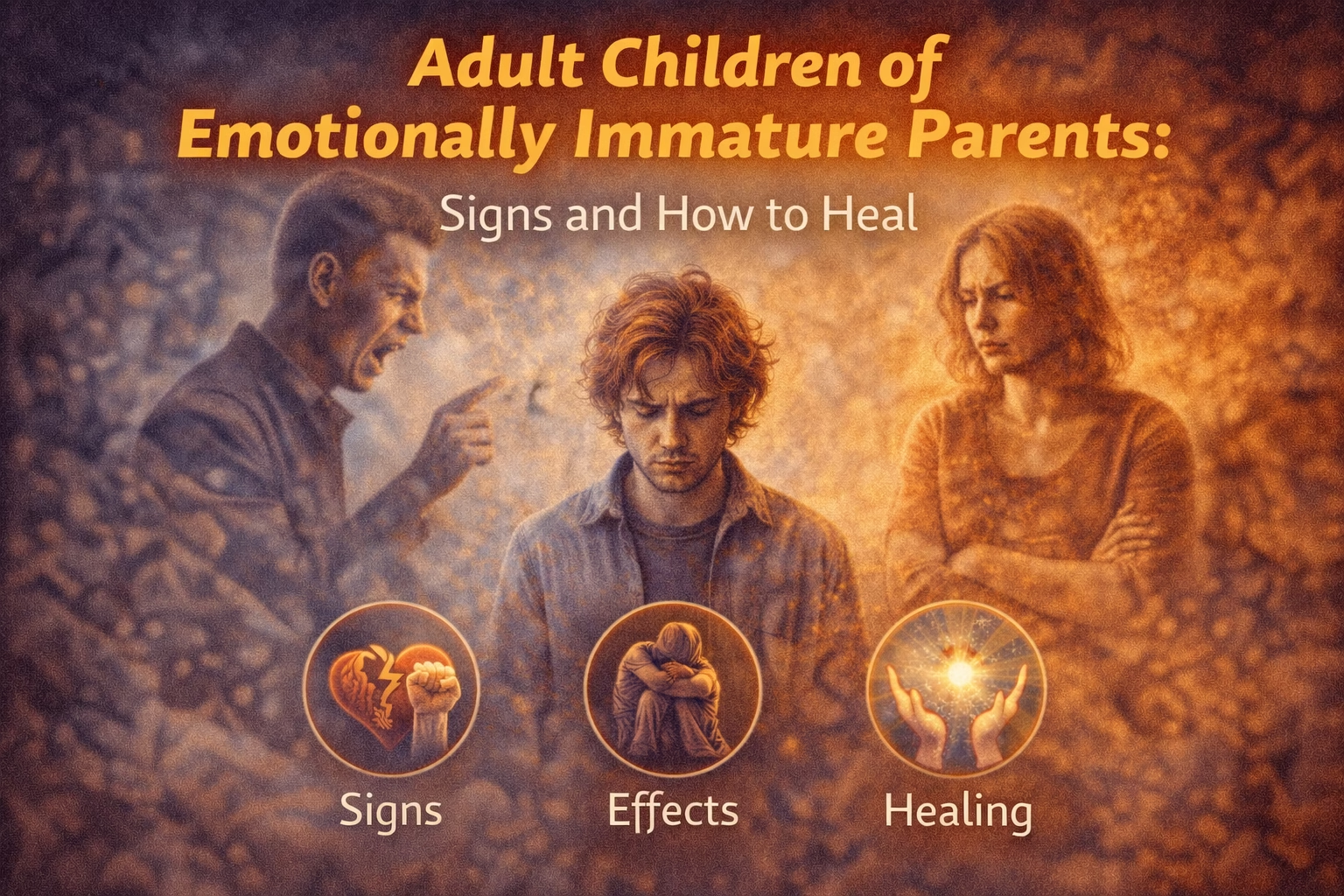
Your parent may have worked hard, provided for you materially, and told you they loved you. They may have also been unable to take responsibility for their behavior, dismissed your feelings, needed you to regulate their emotions, made everything about themselves, or responded to your emotional needs with irritation or distance.
Both things can be true. And both matter. The term “emotionally immature parents” is not an accusation — it is a description of a specific pattern of parenting that, regardless of intention, leaves lasting marks on the children who grew up inside it.
Signs of Emotionally Immature Parents
✓ Unable to tolerate their children’s difficult emotions
✓ Made the child responsible for their emotional state
✓ Responded to vulnerability with dismissal or irritation
✓ Needed to be the center of the family’s emotional life
✓ Excessive sense of responsibility for others’ emotions
✓ Chronic self-doubt and inner critic
✓ Difficulty feeling truly seen or known in relationships
✓ Guilt when prioritizing yourself
Feel free to share or embed this infographic with credit to darinkingcounselingllc.com
What Are Emotionally Immature Parents?
Emotionally immature parents are adults who, despite their chronological age, have limited capacity for emotional self-regulation, genuine empathy, and the kind of consistent, responsive caregiving that children need to develop securely. The concept was most prominently articulated by clinical psychologist Dr. Lindsay Gibson in her widely read work, and it resonates deeply with people who grew up feeling somehow unseen — loved, perhaps, but not truly known.
Emotional immaturity in parents is not synonymous with malice or abuse, though it can overlap with both. It describes a deficit in emotional development — the capacity to tolerate difficult emotions (their own and others’), to take responsibility for their behavior, to respond to a child’s emotional needs with attunement rather than irritation, dismissal, or role reversal.
The American Psychological Association recognizes that parental emotional availability — the degree to which a parent is attuned, responsive, and able to support a child’s emotional development — is one of the strongest predictors of a child’s long-term mental health and attachment security. When that availability is significantly limited by the parent’s own emotional immaturity, the effects are real, lasting, and frequently invisible to everyone involved — including the child.
Important note: Emotionally immature parents are often products of their own upbringing. Many were themselves raised without adequate emotional attunement and simply replicated the only relational model they knew. Understanding this is not about excusing the impact — it is about understanding its roots, which matters for healing. This is the mechanism through which generational trauma is transmitted.
Types of Emotionally Immature Parents
Dr. Lindsay Gibson describes four primary types of emotionally immature parents, though most real-world parents combine elements of several:
Emotional parents are driven by their own feelings above all else, are highly reactive, and create an atmosphere of emotional unpredictability. The child learns to manage the parent’s emotional state as a primary survival task.
Driven parents are focused on achievement, productivity, and external outcomes to a degree that leaves little room for emotional connection. The child experiences a parent who is there but not present emotionally.
Passive parents avoid conflict and emotional engagement, allowing the other parent’s dysfunction to go unchecked, and providing no counterbalancing secure presence for the child.
Rejecting parents are openly dismissive of their children’s emotional needs and sometimes of the children themselves — making the child feel like a burden, an inconvenience, or someone whose emotions are simply too much.
How Emotionally Immature Parents Affect Adult Children
Difficulty Identifying Your Own Needs
When you grew up in a household where your emotional needs were secondary to your parent’s — or were actively discouraged — you may have learned not to have needs, or at least not to be aware of them. This can produce adults who are excellent at identifying and meeting others’ needs while having remarkable difficulty with their own. The connection to people-pleasing is direct: when a child’s safety depended on managing the parent’s emotional state, other-focus becomes survival behavior.
Chronic Guilt and Shame
Many adult children of emotionally immature parents carry a persistent, low-grade sense that they are somehow wrong, too much, or not enough — without being able to clearly articulate why. Shame develops when the message received is not “you did something wrong” but “something about you is fundamentally problematic.” Chronic guilt is also extremely common, particularly in people who have begun to set limits with parents and feel the weight of what that costs.
Difficulty with Authentic Relationships
When your early relational model did not include genuine emotional attunement — being truly seen and known — intimacy in adult relationships can feel unfamiliar, exposing, or frightening. Many adult children of emotionally immature parents report feeling deeply lonely even in relationships, because the kind of connection they are capable of has been shaped by early experiences of emotional unavailability. The connection to emotional neglect and disorganized attachment is direct.
Excessive Sense of Responsibility for Others
If you were effectively a caregiver to your parent’s emotional state — managing their moods, anticipating their reactions, making yourself smaller to avoid triggering them — you likely carry this pattern into adulthood. You may feel responsible for how other people feel, guilty when you disappoint or inconvenience anyone, and unable to set limits without significant anxiety. This is the core of what it means to have been parentified as a child — having adult emotional responsibilities placed on a child’s developing nervous system.
Inner Critic and Self-Doubt
The internal voice of an emotionally immature parent often becomes internalized. The dismissals (“you’re too sensitive”), the minimizations (“that’s not a big deal”), and the unreasonable standards get absorbed into how you talk to yourself. Adults who grew up this way frequently describe a relentless inner critic that mirrors their parent’s voice — demanding, dismissive, or never quite satisfied.
| Effect | How It Shows Up | Underlying Pattern |
|---|---|---|
| Difficulty identifying needs | Not knowing what you want; prioritizing others automatically | Needs were suppressed or punished early; other-focus was rewarded |
| Chronic guilt | Guilt at setting limits; guilt for having needs; guilt for not doing enough | Being held responsible for parent’s emotional state created permanent guilt circuitry |
| People-pleasing | Difficulty saying no; over-apologizing; excessive accommodation | Managing others’ emotional states was a survival behavior |
| Relational loneliness | Feeling unseen or unknown even in relationships | Genuine attunement was not modeled; intimacy feels unfamiliar |
| Harsh inner critic | Relentless self-criticism; difficulty feeling adequate | Parent’s dismissiveness or demanding standards became internal voice |
| Anxiety about conflict | Avoiding disagreement at significant personal cost | Conflict in childhood was dangerous or escalated unpredictably |
Note: Adult children of emotionally immature parents often struggle to name their experience as significant because there was no obvious abuse. They may minimize what happened (“my parents did their best”), feel guilty for having negative feelings about parents who were also loving in many ways, or have difficulty believing that what occurred qualifies as something worth addressing in therapy. It does.
How to Deal with Emotionally Immature Parents
If your parents are still in your life, managing the relationship with an emotionally immature parent requires a set of skills most adult children were never given — because they were the ones doing the emotional management in childhood.
The core shift is moving from trying to change or fix the parent (which is not possible and was never your job) to managing your own responses, expectations, and limits within the relationship. This means lowering expectations for emotional attunement (accepting that this parent is unlikely to suddenly become capable of meeting your emotional needs), setting clear behavioral limits around what is and is not acceptable in your interactions, and having internal boundaries about not taking responsibility for their emotional state.
This is genuinely difficult work — particularly because the guilt and loyalty that adult children of emotionally immature parents carry can make limits feel like abandonment or betrayal. Our posts on guilt complex and people-pleasing address these specific barriers directly.
Healing as an Adult Child of Emotionally Immature Parents
Healing requires both understanding and experience. Understanding the pattern — naming what happened, recognizing how it shaped you, and separating the internalized parent voice from your own — is the cognitive work. But the experiential work is equally necessary: having the experience of genuine emotional attunement, being truly seen and responded to, in a therapeutic relationship.
Trauma-informed therapy — including EMDR therapy — addresses the specific memories, beliefs, and nervous system patterns that developed in response to emotional immaturity in parents. This is not about blame. It is about accurately understanding what happened, releasing what you have been carrying that was never yours, and building the emotional capacities that were not given to you in childhood. Our post on what therapy helps with provides a broader overview, and how to know when it’s time to start addresses the most common hesitations.
Related reading: Did I grow up in a dysfunctional family system? · Do I have childhood trauma? · Emotional neglect · Generational trauma · People-pleasing · Guilt complex · Shame vs. guilt · Abandonment trauma in relationships
Frequently Asked Questions
What are emotionally immature parents?
Adults who have limited capacity for emotional self-regulation, genuine empathy, and the responsive caregiving children need. They may struggle to tolerate difficult emotions, take responsibility for their behavior, or respond to vulnerability with attunement. Emotional immaturity often reflects their own unprocessed history — the mechanism behind generational trauma.
What are the signs of having emotionally immature parents?
Parents who made their emotions central, could not tolerate your difficult emotions, could not take responsibility for mistakes, responded to vulnerability with dismissal or irritation, needed you to manage their emotional state, or were unpredictably warm or cold. Our post on growing up in a dysfunctional family system explores related patterns.
How does this affect you as an adult?
Common effects: difficulty identifying your own needs, chronic guilt, people-pleasing, difficulty with authentic intimacy, excessive responsibility for others’ feelings, relentless inner critic, and a sense of never being truly known. These are adaptive responses to childhood environment that persist without support.
Can you heal from having emotionally immature parents?
Yes. Healing involves naming what happened, understanding how it shaped you, and having the experience of genuine attunement — often for the first time in the therapeutic relationship. EMDR therapy and attachment-based approaches are particularly effective. See our post on what therapy helps with.
How do you deal with emotionally immature parents as an adult?
The core shift is from trying to change the parent to managing your own responses and expectations. Lower expectations for attunement, set behavioral limits, and develop clarity about not being responsible for their emotional state. The guilt this triggers is real and worth exploring in therapy.
You were never responsible for managing your parent’s emotional world. Healing starts with knowing that.
Darin King, LPC specializes in trauma-informed therapy for childhood wounds, attachment patterns, and the lasting effects of emotionally immature parenting. Telehealth available statewide across Pennsylvania.
See more from Darin King Counseling on Google