

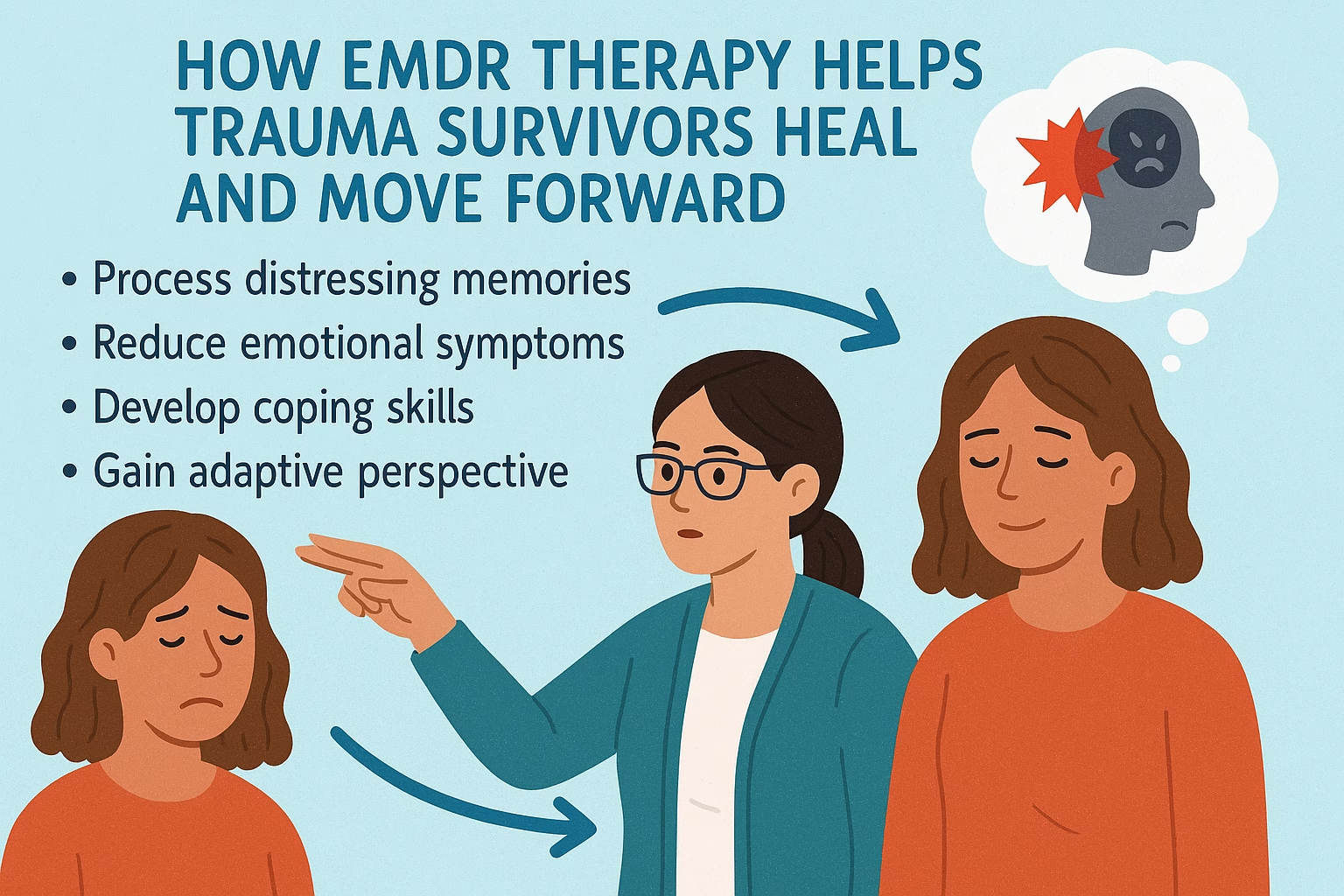
If you’ve been researching trauma therapy, you’ve almost certainly come across EMDR. Eye Movement Desensitization and Reprocessing is one of the most extensively researched and widely recommended trauma treatments in the world — endorsed by the World Health Organization, the American Psychiatric Association, and the Department of Veterans Affairs. But for many people, how it actually works remains mysterious. What are the eye movements doing? Why does it help when talking about trauma hasn’t? And what does a session actually feel like?
This guide answers all of those questions — explaining how EMDR therapy works from both a practical and neurological perspective, what to expect in sessions, and why it is so effective for so many people.
How EMDR Therapy Works: The 8 Phases at a Glance
✓ Building trust and therapeutic relationship
✓ Learning stabilization and grounding skills
✓ Identifying target memories and negative beliefs
✓ Establishing a safe place resource
✓ Installation — strengthening positive beliefs
✓ Body scan — releasing physical tension
✓ Closure and re-evaluation between sessions
✓ Measuring progress and completing treatment
Feel free to share or embed this infographic with credit to darinkingcounselingllc.com
What Is EMDR Therapy?
EMDR — Eye Movement Desensitization and Reprocessing — is a structured, evidence-based psychotherapy developed by Francine Shapiro in the late 1980s. It was originally developed for PTSD and has since been researched and applied across a wide range of trauma-related conditions.
The World Health Organization recommends EMDR therapy as a first-line treatment for PTSD in adults and children. The American Psychiatric Association also recognizes EMDR as an effective treatment for trauma. It is one of the most extensively researched psychotherapies in existence, with over 30 randomized controlled trials supporting its effectiveness.
Key point: EMDR is not a fringe or experimental therapy. It is a mainstream, evidence-based treatment with decades of rigorous research behind it — endorsed by major health organizations around the world. What makes it distinctive is not just that it works, but how it works: by directly accessing and reprocessing the neurological roots of trauma rather than just managing symptoms.
What Conditions Does EMDR Treat?
While EMDR was originally developed for PTSD, research has expanded its application significantly. EMDR is used effectively for:
- PTSD and Complex PTSD — the original and most researched application. Read more about PTSD counseling and CPTSD therapy.
- Childhood trauma — abuse, neglect, attachment wounds. Read our guide on signs of childhood trauma in adults.
- Anxiety disorders — particularly anxiety with trauma roots. See anxiety counseling in Pittsburgh.
- Depression — especially depression connected to adverse life experiences
- Abandonment trauma — processing early relational wounds. Read about abandonment trauma in relationships.
- Dissociation — including depersonalization and derealization. Learn about what dissociation feels like.
- Narcissistic abuse recovery — processing the traumatic memories from abusive relationships. Read about therapy for narcissistic abuse.
- Grief and loss
- Phobias and panic — including trauma-related panic. Read about trauma and panic attacks.
How EMDR Therapy Works: The Neuroscience
To understand how EMDR works, it helps to understand how traumatic memories are stored differently from ordinary memories.
How Traumatic Memory Is Different
Ordinary memories are processed by the hippocampus — which places them in time, integrates them into the broader autobiographical narrative, and stores them as past events. Traumatic memories, however, are often stored in a fragmented, unprocessed state — without the normal time-stamping that would mark them as past. They remain “hot” in the nervous system, ready to activate the threat response the moment a related trigger is encountered.
This is why flashbacks feel so present, why trauma responses can be triggered by seemingly minor cues, and why simply talking about trauma — while potentially helpful — doesn’t always produce the neurological change needed for lasting relief. Read more about how trauma changes the brain and how trauma affects the nervous system.
What Bilateral Stimulation Does
EMDR uses bilateral stimulation — most commonly side-to-side eye movements, but also alternating taps or auditory tones — while the client briefly holds a traumatic memory in mind. The bilateral stimulation is thought to activate the brain’s natural information processing system — the same system that processes experiences during REM sleep — allowing the traumatic memory to be reprocessed and integrated rather than remaining stuck.
The National Institute of Mental Health recognizes EMDR as one of the evidence-based treatments for PTSD, supported by decades of research demonstrating its effectiveness in producing measurable neurological change.
When EMDR works, the traumatic memory becomes less emotionally charged — it moves from feeling vivid, present, and threatening to feeling like something that happened in the past. The negative beliefs connected to it (“I am helpless,” “I am not safe,” “It was my fault”) naturally shift toward more adaptive ones. This is not something the client forces — it emerges from the processing itself.
The 8 Phases of EMDR Therapy
Phase 1: History Taking and Treatment Planning
The therapist takes a thorough history — understanding your background, your trauma experiences, your current symptoms, and your goals for treatment. Together you identify the target memories that will be processed in later phases.
Phase 2: Preparation
Before any trauma processing begins, the therapist ensures you have sufficient stabilization and coping resources. This phase involves building the therapeutic relationship, learning grounding and self-regulation techniques, and establishing a “safe place” resource you can access during and between sessions. See our guide on nervous system reset techniques for tools used in this phase.
This preparation phase is particularly important for complex trauma — adequate stabilization must be in place before processing begins. There is no rushing this phase.
Phase 3: Assessment
For each target memory, the therapist helps you identify the specific image that represents the worst moment, the negative belief associated with it (e.g., “I am powerless”), the desired positive belief (e.g., “I can handle this now”), the emotions and body sensations it produces, and a baseline distress rating.
Phase 4: Desensitization
This is the core processing phase. You hold the target memory in mind — the image, the negative belief, the emotions — while following the therapist’s bilateral stimulation. After each set, you report what came up — images, thoughts, emotions, body sensations — and the therapist guides the next set. This continues until the distress associated with the memory has significantly reduced.
Phase 5: Installation
The positive belief identified in assessment is strengthened and linked to the target memory through continued bilateral stimulation — until it feels fully true rather than just intellectually agreed with.
Phase 6: Body Scan
You scan your body for any remaining tension or discomfort related to the target memory. If any is found, additional processing is done until the body is clear.
Phase 7: Closure
Every session ends with closure — stabilization techniques to ensure you leave the session in a regulated state, regardless of whether processing is complete. Your therapist will also provide guidance on what to do if processing continues between sessions (which it often does).
Phase 8: Re-evaluation
At the beginning of subsequent sessions, the therapist checks on the previous target memory, any new material that has emerged between sessions, and progress toward treatment goals.
| Phase | What Happens | Goal |
|---|---|---|
| 1. History Taking | Thorough assessment of history, trauma, and goals | Identify treatment targets and develop a plan |
| 2. Preparation | Building stabilization skills and therapeutic relationship | Ensure sufficient resources before processing begins |
| 3. Assessment | Identifying components of target memory | Establish baseline for processing |
| 4. Desensitization | Processing target memory with bilateral stimulation | Reduce distress associated with memory to neutral |
| 5. Installation | Strengthening positive belief linked to memory | Replace negative belief with adaptive one |
| 6. Body Scan | Checking for remaining physical tension | Ensure complete processing in the body |
| 7. Closure | Stabilization at end of session | Leave session in regulated state |
| 8. Re-evaluation | Checking progress at start of next session | Confirm processing held and plan next steps |
What an EMDR Session Actually Feels Like
Many people are surprised by how different EMDR feels from traditional talk therapy. Here is what clients commonly report:
- The processing often happens quickly — material that has been stuck for years can shift significantly within a single session
- The bilateral stimulation creates a dual focus of attention — aware of the present moment and the past memory simultaneously — that feels different from being flooded by a traumatic memory
- New associations, images, emotions, and insights often emerge spontaneously during processing — the therapist doesn’t direct where the processing goes
- Physical sensations — tension, warmth, trembling — are common as trauma is released from the body
- After successful processing, the memory feels different — less vivid, less emotionally charged, more like something that happened rather than something happening
For information about what to expect after sessions, see our guide on EMDR side effects — including what is normal and when to contact your therapist.
Note: The Substance Abuse and Mental Health Services Administration lists EMDR among its evidence-based trauma interventions. EMDR is available via telehealth — research supports that online delivery is equally effective for most clients. Learn more about telehealth therapy in Pennsylvania.
EMDR at Darin King Counseling
EMDR therapy in Pennsylvania is available via telehealth across the state. Whether you’re in Pittsburgh or anywhere in Pennsylvania, you can access specialized EMDR treatment from the comfort and safety of your own home — which research suggests may actually support the therapeutic process by keeping you in a familiar, regulated environment during sessions.
Related reading: Our guides on EMDR side effects, Complex PTSD vs PTSD, and how trauma affects the nervous system provide essential context for understanding EMDR therapy and what to expect from the process.
Frequently Asked Questions
How does EMDR therapy work?
EMDR uses bilateral stimulation — typically side-to-side eye movements — while the client briefly holds a traumatic memory in mind. This activates the brain’s natural information processing system, allowing traumatic memories stored in a fragmented state to be reprocessed and integrated. When successful, the memory loses its emotional charge and negative beliefs naturally shift toward more adaptive ones.
How many EMDR sessions does it take?
It varies significantly. Single-incident trauma may resolve in 6-12 sessions. Complex or childhood trauma typically takes longer. Your therapist will develop a treatment plan based on your specific history. Learn more about what to expect from EMDR therapy in Pennsylvania.
Is EMDR therapy painful or retraumatizing?
EMDR is specifically designed to avoid retraumatization. The preparation phase ensures stabilization resources are in place before processing begins. Some sessions are emotionally intense — which is why understanding EMDR side effects and what to expect is important.
Can EMDR be done online?
Yes — EMDR is fully deliverable via telehealth with research supporting its effectiveness online. Bilateral stimulation is adapted using eye movements, audio tones, or tapping. Many clients find their familiar home environment actually supports the sense of safety important to the work. Learn more about telehealth therapy in Pennsylvania.
What is the difference between EMDR and regular talk therapy?
Talk therapy works through verbal processing and insight. EMDR directly accesses and reprocesses traumatic memories at a neurological level using bilateral stimulation. EMDR often produces faster and more lasting change for trauma-specific symptoms — particularly for PTSD, childhood trauma, and complex trauma histories. Read more about how trauma affects the nervous system to understand why.
EMDR doesn’t just help you cope with trauma — it helps your brain finish processing it.
Darin King, LPC specializes in EMDR therapy for trauma in Pennsylvania. Telehealth available statewide.
See more from Darin King Counseling on Google