

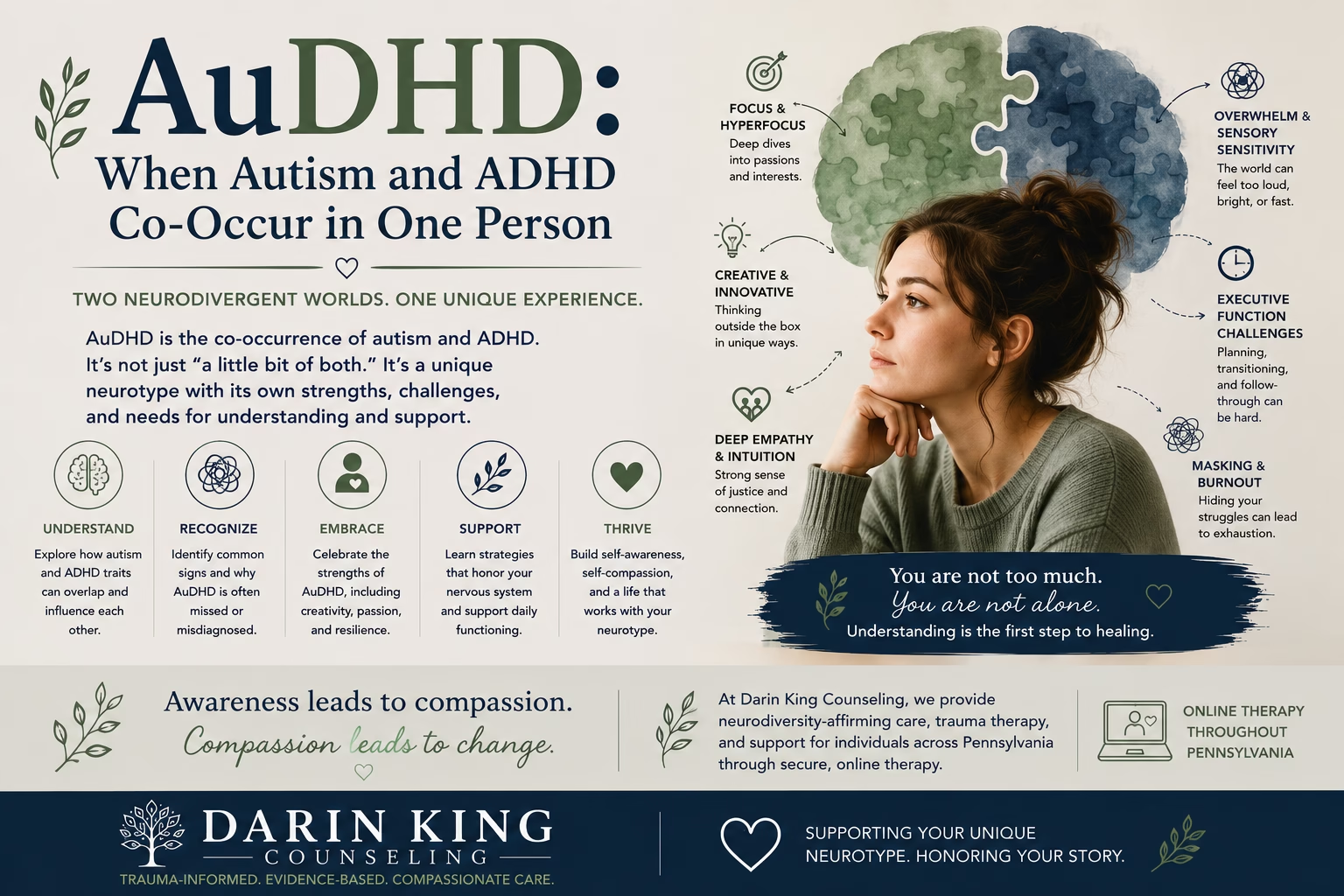
AuDHD is the informal term for the co-occurrence of autism (ASD) and attention-deficit/hyperactivity disorder (ADHD) in the same person. For decades, the two conditions were considered mutually exclusive — the original DSM criteria explicitly prevented clinicians from diagnosing both. That changed with the DSM-5 in 2013, and the research that has followed suggests the overlap is significantly more common than previously assumed. People living with AuDHD often describe years of confusing self-recognition: parts of the ADHD framework fit, parts of the autism framework fit, and neither alone explained the whole picture. The label is recent. The experience is not.
In my work with clients who recognize themselves in the AuDHD pattern, the moment of naming often produces a particular kind of relief — different from getting either single diagnosis. People who had been treating only one condition often understand, suddenly, why interventions for one were insufficient on their own. Both conditions present together in ways that interact, sometimes amplifying each other, sometimes pulling in opposite directions. Understanding the interaction is what makes effective support possible.
AuDHD at a Glance
How autism and ADHD interact in one nervous system
Where they overlap
- Executive function difficulties
- Sensory processing differences
- Emotional regulation challenges
- Social differences and exhaustion
- Higher rates of anxiety and depression
- Frequent burnout cycles
Where they pull in opposite directions
- Autism craves routine; ADHD craves novelty
- Autism focuses deeply; ADHD shifts rapidly
- Autism prefers predictability; ADHD chases stimulation
- Autism orients to detail; ADHD scans the big picture
- Autism plans; ADHD improvises
How it shows up
- Restlessness that craves structure
- Hyperfocus on novelty, then loss of interest
- Sensory overwhelm paired with sensory seeking
- Burnout from masking both conditions
- Identity confusion before diagnosis
- Specific patterns that neither label alone explains
What helps
- Accurate identification of both conditions
- Treatment that addresses the interaction, not just one piece
- Lifestyle design that honors both needs
- Trauma-informed support (high co-occurrence)
- Community with other AuDHD people
- Self-understanding without shame
Feel free to share or embed this infographic with credit to darinkingcounselingllc.com
What Is AuDHD?
AuDHD — sometimes written as AutiDHD or autism-plus-ADHD — is the informal term used in the neurodiversity community for people who meet criteria for both autism spectrum disorder and attention-deficit/hyperactivity disorder. The term originated within neurodivergent communities online and has gradually been picked up by clinicians and researchers. It is not a separate diagnosis. It refers to the lived experience of having both conditions present at the same time, in the same person.
What is significant about the term is the recognition that the two conditions interact. AuDHD is not just autism with ADHD layered on top, or ADHD with autism layered on top. The interaction produces a specific presentation that often looks different from either condition presenting alone. People with AuDHD frequently describe themselves as not fitting cleanly into either community’s typical description — too restless for autism, too detail-oriented for ADHD, too contradictory for the simple frameworks.
The clinical recognition is recent. Until 2013, the DSM-IV explicitly stated that ADHD could not be diagnosed in someone with autism. The DSM-5 removed that prohibition, and research since then has documented the overlap repeatedly. Estimates of the co-occurrence rate vary widely depending on the population studied, but the broad picture is consistent: a substantial minority of autistic people meet ADHD criteria, and a substantial minority of people with ADHD meet autism criteria. Both numbers are higher than chance would predict. The two conditions are connected at the neurodevelopmental level in ways researchers are still working to understand.
For background on the broader autism and ADHD literature, see organizations like CHADD for ADHD and the Autism Research Institute for autism. For more on related experiences, see our posts on ADHD stimming, rejection sensitive dysphoria, and ADHD paralysis.
Why the Two Conditions Were Considered Mutually Exclusive
The original DSM rules barring dual diagnosis came from a clinical assumption that turned out to be wrong — namely, that the attentional difficulties seen in autism could fully account for the attentional symptoms otherwise classified as ADHD. The assumption was reasonable at the time. Autistic people often struggle with attention, particularly in ways related to social and sensory factors. Clinicians assumed there was no need for a separate ADHD diagnosis.
What clinical experience and research since 2013 have shown is that the attentional difficulties in autism and the attentional difficulties in ADHD are not the same thing. They have different mechanisms, respond to different interventions, and create different functional impacts. A person can have both, and recognizing both leads to better outcomes than recognizing only one.
The diagnostic shift has produced a wave of late-in-life recognition. Many adults — particularly women, people of color, and people whose presentations did not match the stereotyped versions of either condition — went undiagnosed for decades. They are now coming to clinical attention, often with a sense that they finally have language for an experience they have been living their whole lives.
Where Autism and ADHD Overlap
Several features show up in both conditions and create a recognizable common ground. People with AuDHD often experience these in a magnified or compounded way.
Executive function difficulties
Both conditions involve differences in executive function — the brain’s ability to plan, sequence, initiate, sustain, and shift between tasks. People with AuDHD often experience executive function challenges from both directions: the ADHD difficulty with sustained attention and task initiation, combined with the autistic difficulty with task-switching and unstructured situations. The compound effect can be substantial.
Sensory processing differences
Both conditions involve sensory differences, though they often manifest differently. Autistic people typically experience sensory hypersensitivity — sounds, lights, textures, and smells registering as more intense or overwhelming than they do for neurotypical people. People with ADHD often experience a mix of hypersensitivity and sensory seeking — drawn to stimulation but also overwhelmed by it. AuDHD frequently produces both patterns in the same person, sometimes shifting between them depending on energy and context.
Emotional regulation challenges
Both conditions involve emotional dysregulation, though the specific patterns differ. ADHD often produces rapid, intense emotional waves that pass quickly. Autism often produces a slower buildup to overwhelm that can result in a meltdown or shutdown. AuDHD can produce both patterns — sometimes the quick ADHD wave, sometimes the slower autistic buildup, sometimes a confusing combination of both at once.
Social differences and exhaustion
Both conditions affect social experience, though differently. Autism often involves differences in reading social cues, processing social information, and engaging in typical social rituals. ADHD often involves difficulty with social regulation — interrupting, missing social timing, energy levels mismatched to context. AuDHD typically involves both. The combination produces particularly significant social exhaustion, since the person is often masking both conditions simultaneously.
Higher rates of anxiety and depression
Both autism and ADHD are associated with elevated rates of anxiety, depression, and trauma. AuDHD compounds these risks. Years of unrecognized neurodivergence, accumulated negative feedback, social difficulties, and masking exhaustion produce mental health consequences that are often misdiagnosed and treated as primary conditions rather than as downstream effects.
Burnout cycles
Both communities recognize a pattern of burnout — periods of significantly reduced functioning following extended stress or masking. AuDHD burnout is particularly intense because the person has been managing two conditions simultaneously, often without recognition or support.
Where Autism and ADHD Pull in Opposite Directions
The interesting and challenging feature of AuDHD is that the two conditions sometimes pull against each other. This creates internal tensions that single-condition frameworks do not capture.
Routine vs. novelty
The autistic part of the brain often craves predictability, routine, and the comfort of the familiar. The ADHD part of the brain often craves novelty, stimulation, and change. Living with both produces a peculiar tension — needing routine to function, then becoming restless or understimulated within the routine, then needing routine again after the novelty seeking produces chaos.
Deep focus vs. attention shifting
Autism often involves the capacity for sustained, deep focus on areas of interest — sometimes for hours. ADHD often involves rapid attention shifting and difficulty sustaining focus on tasks that lack inherent interest. AuDHD can produce both: hyperfocus on areas of intense interest (often autistic special interests) combined with significant difficulty focusing on anything else.
Predictability vs. stimulation
The autistic system often functions best with predictable, low-stimulation environments. The ADHD system often functions best with stimulation, variety, and external scaffolding. The compromise — environments and routines that are predictable in some ways and stimulating in others — has to be specifically designed. Default environments often serve neither need well.
Detail vs. big picture
Autism often involves detail-oriented processing — noticing specifics that others miss, working in granular accuracy. ADHD often involves big-picture orientation — seeing connections, generating ideas, missing details. AuDHD can integrate both, producing creative thinking that combines pattern recognition with detail precision. It can also produce conflicts: getting stuck in detail when the big picture is what is needed, or skipping detail when accuracy is what is needed.
Planning vs. improvisation
Autism often involves a preference for planning, sequencing, and knowing what comes next. ADHD often involves comfort with — or sometimes a preference for — improvisation and last-minute work. AuDHD typically wants the security of a plan and the freedom to deviate from it, which can be hard to organize without external support.
How AuDHD Often Shows Up
Beyond the conceptual frameworks, AuDHD has a recognizable lived texture that people often identify even before they know the term. Common features:
- Restless but craving structure — high energy that needs containment, but containment that quickly feels suffocating
- Hyperfocus that comes and goes — intense periods of deep work on a topic, followed by complete loss of interest, sometimes never returning
- Sensory profile that shifts — easily overwhelmed some days, sensory-seeking on others, sometimes both at once
- Identity confusion before diagnosis — “I thought I had ADHD but I love routine,” “I thought I was autistic but I’m so restless”
- Specific intensity — strong reactions to perceived rejection, intense passions, deep commitments alongside difficulty following through
- Specific kinds of social exhaustion — wanting connection, struggling with the specific demands of socializing, exhausted afterward in ways that don’t match neurotypical norms
- Late recognition — many people, particularly women, reach mid-life before either condition is identified
- Strong intuitive resonance with both communities — feeling at home in both ADHD spaces and autistic spaces, often more than in either alone
The Trauma Connection
AuDHD and trauma have a complicated, well-documented relationship. People with either autism or ADHD are at elevated risk of traumatic experiences for several reasons: difficulty advocating for themselves in childhood, being misunderstood by adults, being targets of bullying and exclusion, being misdiagnosed and inappropriately treated, and growing up in environments that did not accommodate their neurodevelopmental needs. The compound risk for AuDHD people is significant.
The result is that many AuDHD adults are working with both the original neurodivergence and a layer of trauma responses built on top of it. Sometimes the trauma is misidentified as the primary condition. Sometimes the neurodivergence is misidentified as a trauma response. The reality is usually both, intertwined.
Effective support typically addresses both. For more on the trauma side, see how trauma affects the nervous system and complex PTSD vs. PTSD.
Why AuDHD Often Goes Recognized Late
The late-recognition story is common enough to be its own pattern. Several factors contribute:
- Diagnostic prohibition until 2013. Clinicians literally were not allowed to diagnose both, so people who had both fell through the cracks.
- Masking. Many AuDHD people, particularly women and people of color, develop strong masking abilities — performing neurotypicality at significant cost. This hides the underlying patterns from clinicians and even from the person themselves.
- Symptom canceling. Autistic features can suppress some ADHD presentations, and vice versa. The person ends up with a confusing mixed profile that does not fit clean diagnostic criteria for either alone.
- Female and adult presentations were under-researched for decades. Both autism and ADHD were primarily studied in young boys with stereotypical presentations. People with different profiles were missed.
- Co-occurring conditions getting the diagnostic attention. Many AuDHD adults are first diagnosed with anxiety, depression, PTSD, or borderline personality disorder — conditions that often develop secondarily — without the underlying neurodevelopmental picture being recognized.
Late recognition is not failure. It is the consequence of clinical history catching up to lived reality. The recognition itself, whenever it comes, opens new possibilities.
What Doesn’t Work
- Treating only one condition. ADHD treatment without attention to autism, or autism treatment without attention to ADHD, often produces partial improvement that plateaus. The interaction needs to be in the picture.
- Trying to be either more autistic or more ADHD. Some people, after recognizing AuDHD, try to lean fully into one identity. This usually fails because the other set of needs is still operating. Both need acknowledgment.
- Generic neurotypical productivity advice. Strategies designed for neurotypical executive function often actively backfire for AuDHD brains. The advice has to fit the actual nervous system.
- Masking harder. The exhaustion of masking both conditions is significant. Attempting to mask more effectively rather than reducing the load typically leads to burnout.
- Pathologizing every difference. AuDHD comes with real challenges. It also comes with capacities — creative thinking, pattern recognition, deep specialization, novel solutions — that have their own value. Treating the whole package as a problem to be fixed misses the picture.
What Actually Helps
Accurate identification of both conditions
For many AuDHD adults, the most useful first step is comprehensive assessment by clinicians familiar with both conditions and the way they present together. This is not always easy to access; many clinicians are trained in one but not the other. Finding someone with experience in both makes a significant difference in the accuracy of the picture.
Treatment that addresses the interaction
Effective support typically involves several layers working together. For ADHD, medication evaluation with a prescriber, ADHD-informed coaching or therapy, and lifestyle support. For autism, environmental accommodation, sensory regulation, and support around social and processing demands. For the interaction, integrated work that honors both sets of needs simultaneously.
Therapy that addresses the trauma layer
Most AuDHD adults are working with some layer of trauma response built up over years of unrecognized neurodivergence. Therapy that addresses the trauma — EMDR, IFS, somatic work — is often essential to the broader recovery. See our pages on EMDR therapy in Pennsylvania, IFS therapy, and somatic therapy.
Lifestyle design that honors both needs
Over time, building a life that works with AuDHD rather than against it makes the biggest difference. This usually involves some combination of routines with built-in flexibility, sensory accommodation, work that allows for both hyperfocus and variety, social arrangements that fit your actual capacity, and unmasking in safe contexts. The work is highly individual — there is no single template.
Community with other AuDHD people
One of the most powerful supports is connection with other people who share the pattern. Online communities, support groups, and friendships with other AuDHD adults provide both practical strategies and the recognition that the experience is real and shared. Many adults report that finding the community changed their relationship to their own neurodivergence as much as any clinical intervention.
Self-understanding without shame
For people who spent decades being told they were lazy, dramatic, too sensitive, too much, or not enough, the inner work of releasing that internalized shame is significant. AuDHD is not a personal failing. The brain you have is workable. Building the inner relationship to your own neurodivergence is often the precondition for the external supports actually helping.
What Recovery Looks Like
“Recovery” is not quite the right word for AuDHD — there is no underlying condition to recover from. What changes with appropriate work is real and significant:
- The pattern becomes namable rather than confusing
- Both sets of needs get acknowledged rather than fought against
- Energy and capacity increase as masking decreases
- Burnout cycles become less frequent and less severe
- The trauma layer eases with appropriate therapy
- Co-occurring anxiety and depression often improve significantly
- Self-acceptance replaces internalized shame
- Life gets designed to fit the brain rather than fight it
- The capacities that come with AuDHD become more available
This is achievable. Most AuDHD adults who pursue comprehensive support — clinical, lifestyle, and community — over one to several years experience significant improvement in quality of life. The underlying neurodivergence does not change. The relationship to it does.
Frequently Asked Questions
What is AuDHD?
AuDHD is the informal term for the co-occurrence of autism spectrum disorder (ASD) and attention-deficit/hyperactivity disorder (ADHD) in the same person. The term originated in neurodivergent communities online and has been picked up by clinicians and researchers. It is not a separate diagnosis. It refers to the lived experience of having both conditions present at the same time, which produces a distinct presentation that often looks different from either condition presenting alone. Until 2013, the DSM-IV prohibited diagnosing both in the same person; the DSM-5 removed that restriction.
How common is AuDHD?
Estimates vary widely depending on the population studied, but the broad picture is consistent: a substantial minority of autistic people meet ADHD criteria, and a substantial minority of people with ADHD meet autism criteria. Both numbers are higher than chance would predict. Research suggests the two conditions are connected at the neurodevelopmental level in ways researchers are still working to understand. Specific prevalence numbers are not yet settled in the literature, but the co-occurrence is clearly common rather than rare.
How is AuDHD different from having just autism or just ADHD?
AuDHD is not simply the sum of autism and ADHD. The two conditions interact, producing a distinct presentation. People with AuDHD often experience features of both, sometimes in compounded forms (executive function difficulties from both directions, multiple kinds of sensory overload), and sometimes in apparently contradictory patterns (craving both routine and novelty, both deep focus and rapid attention shifts). The interaction creates needs and challenges that single-condition frameworks do not fully capture.
Why was AuDHD not recognized for so long?
Several factors. The DSM-IV explicitly prohibited dual diagnosis, so clinicians could not formally identify both conditions until 2013. Many AuDHD people, particularly women and people of color, develop strong masking abilities that hide the underlying patterns. Autistic features can suppress some ADHD presentations and vice versa, producing mixed profiles that do not fit clean diagnostic criteria for either alone. Female and adult presentations of both conditions were under-researched for decades. And many AuDHD adults were first diagnosed with secondary conditions like anxiety, depression, or PTSD without the underlying neurodevelopmental picture being recognized.
What does AuDHD feel like from the inside?
Common features include restlessness paired with a craving for structure, hyperfocus that comes and goes, a sensory profile that shifts between overwhelm and seeking, identity confusion before diagnosis, strong reactions to perceived rejection alongside difficulty following through on commitments, specific kinds of social exhaustion, and a sense of fitting partially into both ADHD and autistic communities but fully into neither. Many AuDHD people describe internal tensions where one part of them craves predictability while another part craves change, often in the same situation.
What kind of therapy helps with AuDHD?
The most effective support usually involves several layers working together. For the ADHD piece, medication evaluation with a prescriber, ADHD-informed coaching, and lifestyle support around executive function. For the autism piece, sensory regulation, environmental accommodation, and support around social and processing demands. For the trauma layer that most AuDHD adults carry, therapy that addresses the trauma directly — EMDR, IFS, somatic work. For the integration, work with a clinician familiar with both conditions and the way they interact. Self-understanding, community with other AuDHD people, and lifestyle design that honors both sets of needs are also significant pieces of the picture.
Can adults be diagnosed with AuDHD?
Yes. Many people are now being recognized as AuDHD in adulthood, sometimes after decades of partial recognition or misdiagnosis. The diagnostic process typically involves assessment by clinicians familiar with both autism and ADHD in adults — which can be harder to access than pediatric assessment, since adult assessment is a more specialized area. Late recognition is common and not a failure; it reflects the recent emergence of the clinical framework rather than anything about the person.
Two conditions, one nervous system, a life that can fit both
AuDHD is one of the most under-recognized presentations in adult mental health — and one of the most workable when both conditions are accurately identified and supported. The work involves more than learning the label. It involves treatment that honors both sets of needs, addresses the trauma layer most AuDHD adults carry, and supports a life designed to fit the brain rather than fight it.
I work with adults across Pennsylvania — including Pittsburgh, Greensburg, Irwin, and Ruffsdale — using an integrated approach that addresses neurodivergence, trauma, attachment, and nervous-system regulation. EMDR, IFS, and somatic work are central to how I practice.
See more from Darin King Counseling on Google