

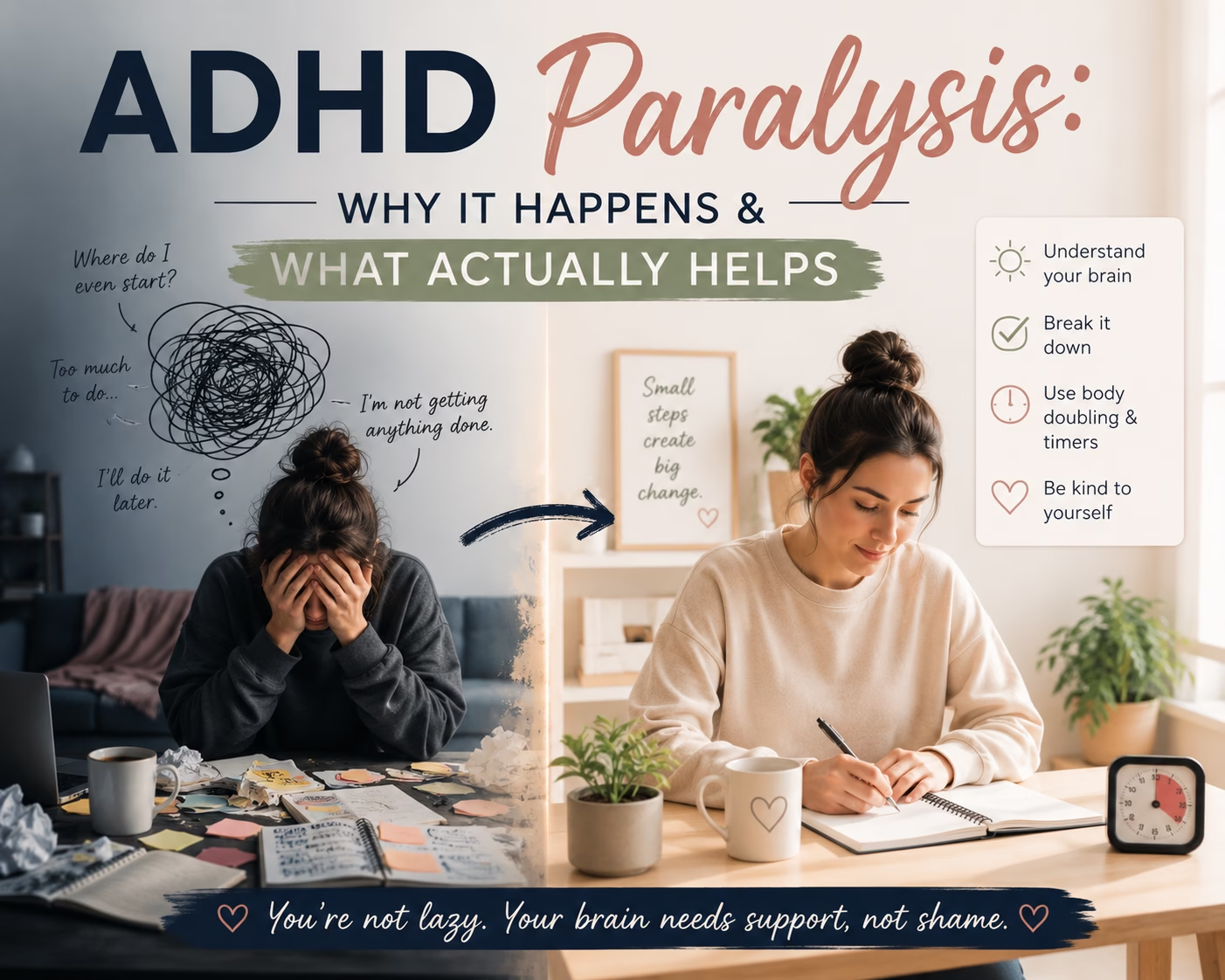
ADHD paralysis is the state in which a person with ADHD becomes unable to start, continue, or finish a task — not because they don’t care, not because they’re lazy, but because the brain has stalled in a way that willpower cannot override. The person may stare at a screen for hours, knowing exactly what they need to do, unable to make their body do it. They may pace the room. They may scroll on their phone. They may feel a kind of horrified helplessness as the day disappears. ADHD paralysis is not a character flaw. It is a recognizable neurological pattern that responds to specific kinds of work.
In my work with clients with ADHD, paralysis is one of the most quietly painful experiences they describe. The shame is often as significant as the paralysis itself. People judge themselves harshly for what their brain is doing without their consent, then add a layer of self-criticism on top, which deepens the freeze. Understanding what paralysis actually is — and what kinds of intervention actually shift it — interrupts that cycle.
ADHD Paralysis at a Glance
What it is, what triggers it, and what helps
What it looks like
- Unable to start a task you intended to do
- Stuck in place, scrolling, pacing, staring
- Time disappears without productive movement
- Body feels stuck even when you “want” to move
- Increasing distress as the paralysis continues
Common triggers
- Too many tasks to choose from
- Tasks with unclear first steps
- High-stakes or high-pressure work
- Tasks involving boring administrative detail
- Emotional overwhelm or RSD activation
- Accumulated avoidance of one task
What it feels like inside
- Wanting to start but unable to
- Body feels heavy or frozen
- Thoughts loop without producing action
- Time perception distorts
- Shame builds as the paralysis continues
- Often a sudden release at the end of the day
What actually helps
- Naming the state — “I’m in paralysis”
- Reducing decisions to one tiny next step
- Body movement to shift state
- External structure and support
- Working with ADHD treatment, not just willpower
- Self-compassion to interrupt the shame loop
Feel free to share or embed this infographic with credit to darinkingcounselingllc.com
What Is ADHD Paralysis?
ADHD paralysis is the term used to describe a recognizable pattern in which someone with ADHD becomes unable to initiate, continue, or complete tasks — even ones they want to do, even ones they know are important, even ones the consequences of not doing are stacking up around them. The brain has stalled. The body has stalled. The person remains conscious of what needs to happen and conscious of their inability to make it happen, which produces a particular kind of suffering that is often invisible from the outside.
The phenomenon is not officially named in the DSM-5, but it maps closely to well-documented features of ADHD: executive function difficulties, working memory limitations, emotional dysregulation, and dopamine-system differences that affect motivation and task initiation. CHADD and ADDitude, two of the most respected ADHD-focused resources, both describe the pattern in detail. The term “ADHD paralysis” emerged from the ADHD community itself, which often names experiences before formal clinical literature catches up to them.
Several variations are commonly distinguished:
- Task paralysis — unable to start or continue a specific task
- Choice paralysis — unable to choose between options, leading to no choice at all
- Mental paralysis — thoughts loop without producing action; the mind is busy without being productive
Most people with ADHD experience all three at different times.
What ADHD Paralysis Feels Like From the Inside
The inner experience is often more painful than the outer behavior suggests. From the outside, paralysis can look like the person is fine — sitting at a desk, scrolling on a phone, watching a show. From the inside, the experience is closer to being trapped behind glass while watching the day disappear.
Common features of the inner experience:
- A clear sense of what needs to be done, often with a sense of urgency, paired with complete inability to begin
- The body feels heavy, stuck, or frozen — as though the limbs have lost their connection to the will
- An urge to do something, anything — often satisfied by low-effort substitution like scrolling, eating, or watching
- Time perception distorts; an hour can pass without registering
- A background buzz of distress that grows louder as the paralysis continues
- Shame that builds and feeds the paralysis: “I should be able to do this, why can’t I, what’s wrong with me”
- Sometimes a sudden release at the end of the day when the window for action has closed
The cruel irony is that the more important the task, the more likely the paralysis. Tasks with real stakes — deadlines, evaluations, conversations with consequences — often trigger paralysis more reliably than low-stakes work. This makes intuitive sense once you understand the mechanism: high stakes activate the nervous system, and an activated nervous system is more vulnerable to overwhelm, not less.
What Triggers ADHD Paralysis
Paralysis can arise from many different triggers, often layering together. Knowing your specific patterns helps you intervene earlier.
Too many options or tasks
The ADHD brain often struggles with choice. When too many things need attention at once, the system can lock up rather than choose one. A long to-do list, multiple competing priorities, or simply a complex decision can trigger the freeze.
Tasks with unclear first steps
A task without a clear concrete first action is much more likely to trigger paralysis than one with an obvious starting point. “Work on the report” tends to freeze the system; “open the document and type the first sentence” tends not to.
High-stakes or high-pressure work
Counterintuitively, the more important the task, the more vulnerable the system is to freezing. Pressure activates the nervous system, and an activated system has even less executive function available than usual.
Boring administrative detail
The dopamine system in ADHD often does not deliver enough engagement for tasks that lack inherent interest. Boring tasks — paperwork, expense reports, scheduling, follow-up emails — are particularly prone to paralysis.
Emotional overwhelm or RSD activation
When emotions are running high, executive function decreases. A conflict, a difficult feedback session, or an episode of rejection sensitive dysphoria can leave the system unable to engage normal tasks for hours afterward. See our post on rejection sensitive dysphoria for more on this related pattern.
Accumulated avoidance
A task that has been avoided for too long develops a kind of gravitational pull. The longer it sits, the harder it becomes to approach. Eventually the avoidance itself feels overwhelming, which makes the task even more paralyzing.
Physical and environmental factors
Poor sleep, hunger, dehydration, sensory overload, and disorganized environments all reduce available executive function. ADHD paralysis is more likely when the system is already depleted.
The Nervous-System Layer
Most discussions of ADHD paralysis focus on executive function. The executive function piece is real and important, but it does not capture the whole picture. ADHD paralysis is also a nervous-system phenomenon — and recognizing this opens additional paths to intervention.
When the ADHD brain encounters an overwhelming task — too big, too unclear, too emotionally loaded, or too important — the autonomic nervous system often responds by shifting state. Sometimes it activates upward into anxiety and racing thoughts that produce action without direction (cleaning the kitchen when you should be writing). Sometimes it shifts downward into a kind of shutdown or freeze, which produces the classic paralysis presentation.
This shutdown response is similar to — though not identical to — the functional freeze response described in trauma literature. For more on the broader pattern, see our posts on functional freeze, dorsal vagal shutdown, and window of tolerance.
Understanding the nervous-system layer matters because it changes what interventions are likely to help. Pure cognitive strategies — making lists, breaking tasks down — only work when the nervous system has the capacity to execute them. When the system is in shutdown, the list-making produces another item to be paralyzed about. State change has to come first.
The Shame Loop
One of the most damaging features of ADHD paralysis is the shame that accumulates around it. Most people with ADHD have a lifetime of being told they are lazy, unmotivated, capable of better, or just not trying hard enough. They have internalized these messages even when they no longer hear them externally. When paralysis hits, the inner voice often becomes brutal.
The shame deepens the paralysis. Shame is itself a nervous-system activator (or shutdown trigger, depending on the person), and a nervous system that is dysregulated has even less executive function available. So the cycle becomes: paralysis → shame about paralysis → deeper paralysis → more shame.
Interrupting this loop is one of the most useful pieces of work in ADHD recovery. The shame is almost always more destructive than the original paralysis. Self-compassion is not indulgence — it is a functional necessity for breaking the cycle.
What Doesn’t Work
- Willpower and pushing through. ADHD paralysis is not a failure of willpower. Trying to muscle through it usually deepens the freeze and adds exhaustion. The system needs a different intervention than effort.
- Long, detailed to-do lists. A 20-item list can itself become paralyzing. The ADHD brain often needs one specific next action, not a comprehensive plan.
- Self-shaming. Calling yourself lazy, useless, or broken does not produce action. It deepens the nervous-system shutdown that is the root of the paralysis.
- Productivity systems that require a lot of upfront work to set up. Most elaborate productivity systems require the very executive function that is unavailable during paralysis. Simple beats sophisticated.
- Waiting until you “feel like it.” The dopamine that produces feeling like it often does not arrive. Waiting for it can mean waiting indefinitely. Action sometimes has to come first, with feeling following.
- Treating ADHD paralysis as a separate problem from ADHD. The paralysis is a symptom of the underlying condition. Treating ADHD comprehensively — often including medication evaluation — usually reduces paralysis frequency and intensity significantly.
What Actually Helps in the Moment
Name the state
The first move is recognition: “I’m in paralysis.” This does not solve the paralysis, but it creates a small separation between the person and the state. From inside the state, you cannot do much. From a tiny step outside it — observing it rather than being it — small interventions become possible.
Reduce to one tiny action
The instinct in paralysis is to think bigger — to plan the whole project, to organize all the tasks, to make a comprehensive list. This almost always backfires. The intervention that works is reducing scope dramatically: not “work on the report” but “open the document.” Not “do the dishes” but “carry one cup to the sink.” The brain is looking for an entry point, not a map.
Shift state with the body
Because paralysis is partly nervous-system shutdown, body-based interventions often help. Standing up. Walking around the room. Stepping outside for two minutes. Cold water on the face. A few jumping jacks. These do not feel like productivity, but they change the state the brain is operating from. After a state shift, the executive function that was unavailable often becomes available.
External structure and support
The ADHD brain often does better with external structure than internal. Body doubling (working alongside someone else), accountability check-ins, scheduled appointments, and external deadlines all provide the external scaffolding that internal executive function is not delivering. None of this is cheating. It is working with the brain you have.
Talk to someone
Brief contact with another person — even a short text exchange — can shift state in ways that solo strategies cannot. The nervous system uses other nervous systems for regulation. A two-minute call to a friend can be more productive, paradoxically, than two more hours of trying to start.
Lower the stakes
If the task has stakes that are activating you, see if you can reduce them. Do an ugly first draft. Do the task badly on purpose. Promise yourself you will revise later. The goal is to get past the threshold of starting, not to do the task perfectly.
What Helps Over Time
Comprehensive ADHD treatment
For most adults with ADHD, comprehensive treatment significantly reduces paralysis frequency and intensity. This usually includes evaluation for medication with a prescriber, ADHD-informed coaching or therapy, and lifestyle support (sleep, movement, nutrition). The goal is not just to reduce specific paralysis episodes but to give the brain more underlying executive function capacity day to day.
Therapy that addresses underlying patterns
Paralysis often co-occurs with other patterns — trauma, anxious attachment, perfectionism, accumulated shame from years of unrecognized ADHD. Therapy that addresses these underlying layers reduces the load the system is carrying, which makes paralysis less frequent. Modalities like EMDR, IFS, and somatic work all address these layers. See our pages on EMDR therapy in Pennsylvania, IFS therapy, and somatic therapy.
Building self-compassion
The shame loop is itself a major contributor to chronic paralysis. Building the capacity to respond to paralysis with curiosity rather than self-attack reduces the secondary dysregulation that compounds the primary problem. This is gradual work but produces meaningful change over time.
Designing environments that work with your brain
Over time, learning to design your physical and digital environments to support rather than fight your ADHD brain reduces paralysis triggers. Visual organization, reduced choice loads, predictable routines, and minimized friction for important tasks all help.
Working with people who understand ADHD
Therapists, partners, employers, and friends who understand how ADHD actually works can be enormous supports. People who do not understand it often pile on the shame that makes paralysis worse. Building relationships and work situations with people who get it changes what is possible.
The Co-Occurrence Picture
ADHD paralysis rarely shows up in isolation. It commonly co-occurs with several other patterns that complicate the picture and sometimes need their own treatment:
- Anxiety and chronic stress — high baseline activation reduces executive function reserves, making paralysis more likely
- Depression — overlapping shutdown patterns that can be hard to distinguish
- Trauma history — nervous-system patterns that intersect with ADHD shutdown
- Rejection sensitive dysphoria — emotional waves that consume executive function and trigger paralysis afterward
- Perfectionism — high standards that raise the stakes on every task and make starting harder
- Sleep difficulties — both a cause and effect of ADHD; further reduces executive function
- Substance use — often used to self-medicate ADHD symptoms but typically deepens long-term dysregulation
Effective treatment usually addresses several of these at once. Working on ADHD alone, without attending to the other layers, often produces partial improvement that plateaus.
What Recovery Looks Like
People often hope that treating ADHD will eliminate paralysis entirely. That is not usually what happens. What does happen, with consistent work, is real and significant:
- Paralysis becomes less frequent and shorter in duration
- You recognize it sooner and intervene earlier
- The shame loop loses its grip
- You develop reliable techniques that work for your particular pattern
- You build environments and relationships that support rather than fight your brain
- Recovery from paralysis episodes takes minutes or hours rather than days
- The underlying executive function reserves are higher day to day
- Life expands beyond what paralysis had been constraining
This is achievable. Most adults with ADHD who pursue comprehensive treatment over one to several years experience significant reduction in paralysis as part of broader improvement in executive function and emotional regulation. The brain you have is workable. It just needs to be worked with, not against.
Frequently Asked Questions
What is ADHD paralysis?
ADHD paralysis is a recognizable pattern in which someone with ADHD becomes unable to start, continue, or finish a task — even one they want to do, even one they know is important. The brain has stalled in a way that willpower cannot override. The phenomenon is not officially named in the DSM-5, but it maps closely to well-documented features of ADHD including executive function difficulties, working memory limitations, and dopamine-system differences. Common variations include task paralysis (unable to start a task), choice paralysis (unable to decide between options), and mental paralysis (thoughts looping without producing action).
Is ADHD paralysis just procrastination?
No. Procrastination is a chosen delay — putting something off in favor of something else more rewarding in the moment. ADHD paralysis is not a choice. The person often desperately wants to do the task and is unable to make their body act on that wanting. The distinction matters because the responses differ. Procrastination can be addressed through scheduling and motivation work. ADHD paralysis usually requires nervous-system regulation, dramatically reduced task scope, comprehensive ADHD treatment, and addressing the shame loop that compounds it.
What triggers ADHD paralysis?
Common triggers include too many options or tasks to choose from, tasks with unclear first steps, high-stakes or high-pressure work, boring administrative detail, emotional overwhelm (including RSD episodes), accumulated avoidance of one task, and physical factors like poor sleep, hunger, or sensory overload. Counterintuitively, the more important the task, the more vulnerable the system often is to freezing — pressure activates the nervous system, and an activated system has even less executive function available than usual.
How is ADHD paralysis different from depression?
The two can look and feel similar but have different roots. ADHD paralysis is typically task-specific and intermittent — the person can usually engage some activities while being unable to engage others. Depressive shutdown is typically pervasive, sustained, and accompanied by other features like persistent low mood, loss of pleasure, and changes in sleep and appetite. The two can coexist, particularly when ADHD has gone untreated for years. Accurate assessment matters because the treatment paths differ.
What helps in the middle of an ADHD paralysis episode?
Several things help in the moment. First, name the state — “I’m in paralysis” — which creates a small separation between you and the experience. Second, reduce the task to one tiny action: not “work on the report” but “open the document.” Third, shift state with the body — stand up, walk, step outside, cold water on the face. Fourth, talk to someone briefly if possible; the nervous system uses other nervous systems for regulation. Fifth, lower the stakes by allowing the work to be imperfect. Willpower-based pushing through usually deepens the freeze and adds exhaustion.
Does ADHD medication help with paralysis?
For most adults with ADHD, comprehensive treatment including medication evaluation significantly reduces paralysis frequency and intensity. Medication is not the whole picture, and it is not right for every person — that conversation belongs with a qualified prescriber. But for many people, addressing the underlying ADHD with appropriate medical support gives the brain more executive function capacity day to day, which makes paralysis less frequent and shorter when it does occur. Therapy that addresses the underlying patterns and lifestyle support (sleep, movement, structure) work alongside medication for the most durable results.
How long does it take to reduce ADHD paralysis?
Some interventions produce noticeable change quickly — within weeks of starting comprehensive ADHD treatment, many people report fewer and shorter paralysis episodes. Deeper change, where the underlying patterns shift and paralysis no longer dominates the relationship to work and tasks, typically takes one to several years of consistent work. The pace depends on whether co-occurring conditions like anxiety, trauma, depression, or substance use also need attention, and on the quality of the supports the person can put in place around their brain.
Your brain is workable. It just needs to be worked with.
ADHD paralysis is one of the most quietly painful experiences for adults with ADHD — and one of the most workable with the right approach. The work involves more than learning techniques. It involves comprehensive ADHD treatment, addressing the nervous-system patterns underneath the paralysis, building self-compassion that breaks the shame loop, and designing a life that works with your brain rather than against it.
I work with adults across Pennsylvania — including Pittsburgh, Greensburg, Irwin, and Ruffsdale — using an integrated approach that addresses ADHD, attachment patterns, trauma, and nervous-system regulation. EMDR, IFS, and somatic work are central to how I practice.
See more from Darin King Counseling on Google