

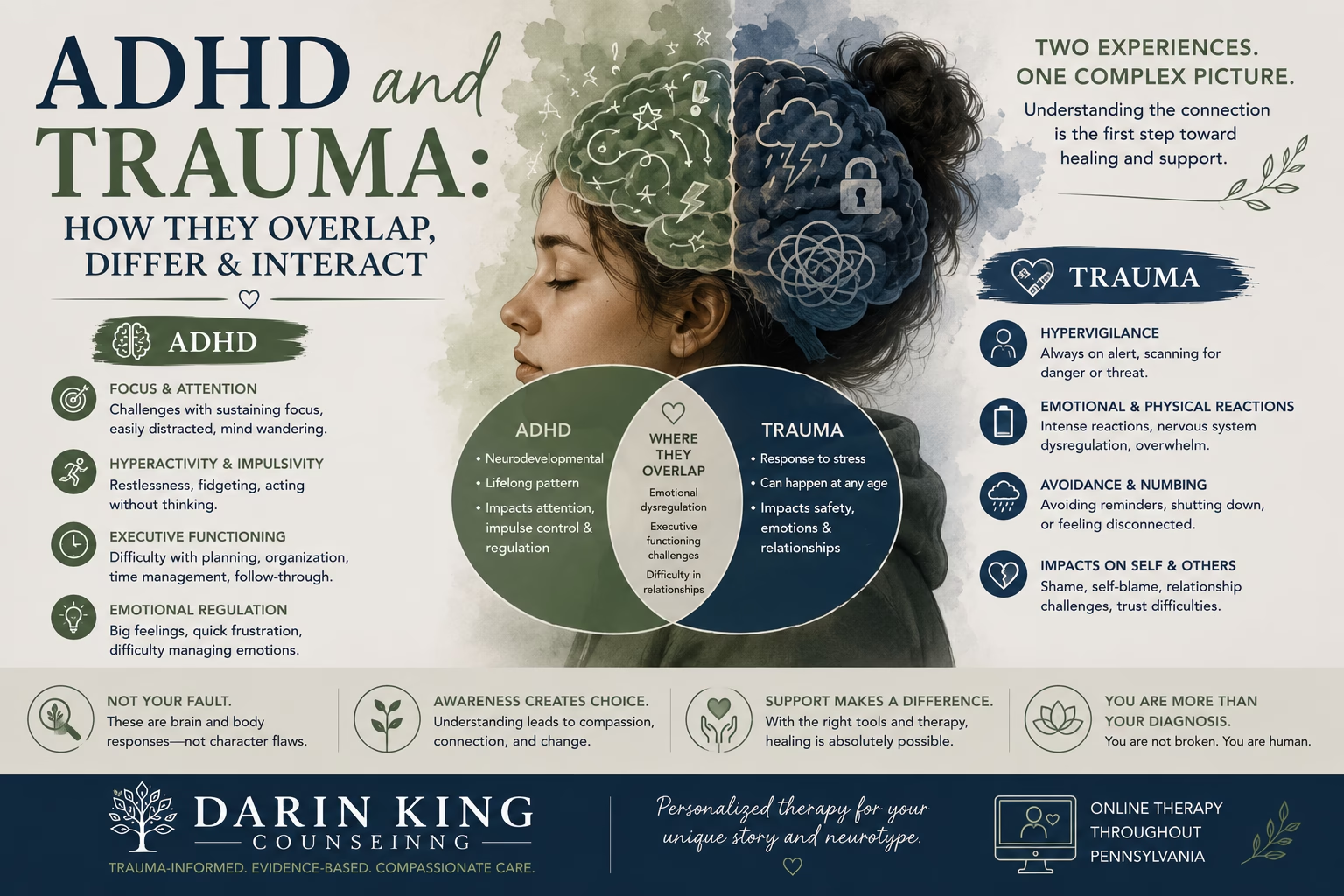
ADHD and trauma have a relationship that most people — including many clinicians — underestimate. They look similar. They feel similar from the inside. They share several core features (emotional dysregulation, hypervigilance, executive function difficulties, sleep disruption), and they routinely get confused for each other. They also commonly co-occur in the same person, often without either being fully recognized. Untangling what is ADHD, what is trauma, and what is the interaction between them is one of the more important pieces of work for adults whose lives have not responded to single-condition treatment.
In my work with clients, this confusion is one of the most common reasons people arrive after years of incomplete or unsuccessful treatment. They were treated for trauma without ADHD being recognized. They were treated for ADHD without trauma being addressed. Or they were treated for one condition when the actual picture involved both. Getting the picture right changes what is possible.
ADHD and Trauma at a Glance
How they overlap, how they differ, and how they interact
Where they overlap
- Emotional dysregulation
- Hypervigilance and difficulty focusing
- Sleep disruption
- Difficulty with relationships
- Sensitivity to rejection
- Restlessness and dissociation
Where ADHD is the better fit
- Lifelong from early childhood
- Pattern shows up across many contexts
- Family history of ADHD
- Stimulant medication helps
- Executive function difficulties without clear traumatic origin
Where trauma is the better fit
- Symptoms began after an identifiable event or period
- Pattern is more context-specific
- History of significant adversity
- Trauma-focused therapy produces shifts
- Strong somatic/body component
When both are present
- Each condition amplifies the other
- ADHD increases risk of trauma
- Trauma worsens ADHD symptoms
- Single-condition treatment plateaus
- Integrated treatment works better
Feel free to share or embed this infographic with credit to darinkingcounselingllc.com
Why ADHD and Trauma Get Confused
The two conditions share a striking number of surface features. Both involve emotional dysregulation. Both involve difficulty with sustained attention. Both involve hypervigilance, in different forms. Both involve sleep difficulties. Both produce challenges in relationships, work, and self-image. Both can produce dissociation, restlessness, and difficulty being present in the body.
The overlap is significant enough that the same person can be told they have ADHD by one clinician and PTSD by another, both with reasonable evidence. Without careful history-taking and an understanding of how the two conditions differ at the developmental level, the confusion is genuinely difficult to resolve.
Several specific symptoms commonly look like one but might be the other:
- Difficulty concentrating can be ADHD’s attention regulation difference, or trauma’s hypervigilance and dissociation
- Restlessness can be ADHD’s motor hyperactivity, or trauma’s sympathetic activation
- Sleep problems can be ADHD’s delayed sleep phase and racing mind, or trauma’s hyperarousal and nightmares
- Emotional intensity can be ADHD’s emotional dysregulation, or trauma’s reactivity to triggers
- Rejection sensitivity can be ADHD-linked RSD, or trauma’s attachment wounds
- Procrastination and task paralysis can be ADHD’s executive function difficulty, or trauma’s freeze response
- Dissociation and “spacing out” can be ADHD’s attention shifting, or trauma’s dissociative defense
The clinical work of distinguishing these requires looking at developmental history, the specific quality of each symptom, what makes them better or worse, and whether they respond to ADHD-focused or trauma-focused interventions. For more on the trauma side, see our posts on how trauma affects the nervous system and complex PTSD vs. PTSD.
How ADHD Increases Risk of Trauma
ADHD is associated with elevated rates of traumatic experience for several well-documented reasons. The connection is not that ADHD causes trauma in a direct sense. It is that having ADHD increases exposure to environments and experiences that can be traumatizing — particularly in childhood, when the nervous system is still developing and protective resources are limited.
Childhood adversity from unrecognized ADHD
Many children with ADHD experience years of accumulated negative feedback — being told they are lazy, careless, disruptive, or not trying hard enough — long before the underlying condition is recognized. Some research suggests children with ADHD receive thousands more corrective and critical comments than their neurotypical peers by the time they are ten. This is not trauma in the single-incident sense, but the cumulative load on a developing nervous system can produce trauma-like effects.
Higher exposure to specific kinds of risk
ADHD is associated with elevated rates of accidental injury, school discipline, social exclusion, peer rejection, bullying, and family conflict. None of these is universal, but the elevated risk is documented across multiple studies. Each of these can be a source of traumatic experience.
Increased vulnerability to abuse
Children with ADHD — particularly those who are emotionally dysregulated or socially struggling — are at higher risk of being targeted for emotional, physical, and sexual abuse, both by peers and by adults. This is not the child’s fault. It is a feature of how the environment responds to a child whose nervous system is presenting as different.
Adult patterns that compound the picture
In adulthood, ADHD is associated with elevated rates of relational instability, financial stress, substance use, and accident risk — each of which can be a vector for additional adverse experience. The compound effect over a lifetime can be substantial.
Medical and institutional trauma
Many adults with ADHD experienced significant trauma from how they were treated by educational, medical, and family systems. Years of misdiagnosis, dismissal, inappropriate interventions, and being treated as the problem rather than as someone struggling with a real condition leave residues.
How Trauma Affects ADHD Symptoms
The relationship runs in the other direction as well. Trauma, especially developmental and complex trauma, affects the same brain systems that ADHD affects — the prefrontal cortex, the limbic system, the autonomic nervous system, the dopamine system. The result is that trauma can intensify or mimic ADHD symptoms in significant ways.
Trauma can mimic ADHD
Children and adults with significant trauma histories often present with attention difficulties, hyperactivity, impulsivity, emotional dysregulation, and executive function challenges that look very much like ADHD. Some of these people have ADHD as well. Some do not — what looks like ADHD is actually trauma’s effect on the same brain systems. Distinguishing these is important because the treatment approaches differ.
Trauma intensifies existing ADHD
When ADHD and trauma coexist, the trauma typically intensifies the ADHD presentation. The chronic stress load reduces available executive function. The nervous-system dysregulation amplifies emotional reactivity. The defensive patterns add a layer to the underlying ADHD pattern. Treatment that addresses the ADHD without addressing the trauma often produces partial improvement that plateaus.
Trauma reshapes how ADHD shows up
The specific pattern of ADHD presentation can shift significantly based on trauma history. Some traumatized people with ADHD develop intense masking and people-pleasing as defensive strategies; their ADHD presents as anxious, perfectionistic, and chronically over-functioning. Others develop avoidance and shutdown patterns; their ADHD presents as paralyzed, withdrawn, and hard to mobilize. The underlying ADHD is the same. The expression differs based on how the nervous system organized itself around adversity.
The Interaction Effect
When both ADHD and trauma are present in the same person, they do not just add together — they interact in ways that produce a distinct presentation. Some recognizable features:
- Executive function difficulties from both directions — ADHD’s task initiation and sustained attention challenges, plus trauma’s freeze response and shutdown
- Intense emotional dysregulation — ADHD’s emotional waves combined with trauma’s reactivity to triggers
- Multiple kinds of hypervigilance — ADHD’s distractibility and scanning, plus trauma’s threat monitoring
- Compounded rejection sensitivity — ADHD-linked RSD plus trauma’s attachment wounds (see our post on rejection sensitive dysphoria)
- Layered sleep difficulties — ADHD’s delayed sleep phase and racing mind, plus trauma’s hyperarousal and nightmares
- Significant burnout cycles — capacity reduced by both conditions, with longer recovery times
- Co-occurring anxiety, depression, and substance use at higher rates than either condition alone
The integrated picture is what most clinicians who specialize in adult mental health see in their offices, even when one or both conditions go formally unrecognized. The work of identifying both, accurately, is what allows treatment to actually move.
How the Two Conditions Differ at the Developmental Level
Despite the overlap, ADHD and trauma have meaningfully different developmental signatures. Several markers help distinguish them.
Onset and course
ADHD is a neurodevelopmental condition — it is present from early childhood, though it may not be recognized until later. Symptoms are typically observable by age twelve, even if they are not labeled as ADHD until adulthood. Trauma symptoms typically begin after a traumatic experience or period. Developmental trauma can begin very early, but it is still tied to environmental experience rather than to a brain difference present from birth.
Pervasiveness
ADHD symptoms typically show up across multiple contexts — at home, at school, at work, in relationships. They are pervasive features of how the brain works. Trauma symptoms are often more context-specific, particularly tied to triggers, situations, or relationships that resemble the original adverse experiences.
Family pattern
ADHD has a strong genetic component. People with ADHD often have first-degree relatives with ADHD. A family history of recognizable ADHD-like patterns supports the ADHD picture. Trauma can run in families through generational transmission, but the mechanism is environmental rather than genetic.
Response to stimulant medication
This is not a definitive diagnostic test, but it is informative. People with ADHD often respond well to stimulant medication — focus improves, executive function increases, hyperactivity decreases. People whose symptoms are primarily trauma-driven often do not respond well to stimulants and sometimes worsen on them. Stimulant medication is not a perfect diagnostic tool, but the response often gives useful clinical information.
Response to trauma-focused therapy
People whose presentation is primarily trauma-driven typically respond to trauma-focused therapy (EMDR, somatic work, trauma-informed talk therapy) in ways that include reduction in attention, focus, and emotional regulation symptoms. People whose presentation is primarily ADHD-driven may also benefit from these therapies but typically experience less direct symptom reduction without ADHD-specific support.
What Doesn’t Work
- Treating one condition while ignoring the other. When both are present, single-condition treatment often produces partial improvement that plateaus. The interaction needs to be in the picture.
- Assuming all attention difficulties are ADHD. Some are. Some are not. Trauma’s effect on attention is significant and well-documented, and treating it as ADHD when it is not can lead to inappropriate interventions.
- Assuming all attention difficulties are trauma. Some clinicians who specialize in trauma assume that any executive function difficulty is trauma-driven. ADHD is real, common, and often present alongside trauma. Missing it leaves people without the support they need.
- Treating trauma without recognizing ADHD’s effect on the therapy process. ADHD affects the experience of therapy itself — difficulty with sustained attention in sessions, between-session memory limitations, executive function challenges with implementation. Trauma therapy for someone with ADHD often needs to be adapted.
- Treating ADHD without recognizing trauma’s effect on regulation. ADHD treatment that ignores trauma often misses why the regulation strategies are not working. The nervous system is too dysregulated for cognitive ADHD strategies to land.
What Actually Helps
Comprehensive assessment by someone familiar with both
Accurate assessment matters. The clinician needs to be familiar with both adult ADHD and complex trauma, and willing to consider both as part of the picture. This kind of assessment is more available now than it used to be but still requires looking for someone with the specific expertise.
Integrated treatment
The most effective treatment usually addresses both conditions, in a sequence and combination that fits the individual. For some people, stabilizing ADHD symptoms first (often including medication) creates the executive function capacity needed for trauma work. For others, processing the trauma first reduces nervous-system dysregulation enough for ADHD interventions to land. For most, the work happens in parallel, with different pieces emphasized at different times.
Trauma-focused therapy
For the trauma layer, modalities like EMDR, IFS, and somatic work address the patterns directly. EMDR in particular has strong evidence for trauma work and can be adapted for ADHD presentations. See our pages on EMDR therapy in Pennsylvania, IFS therapy, and somatic therapy.
ADHD-informed support
For the ADHD layer, this usually includes medication evaluation with a prescriber, ADHD-informed therapy or coaching, and lifestyle supports around executive function. The medication conversation belongs with a qualified prescriber, and stimulants are not right for every person — but for many people, they significantly improve quality of life.
Nervous-system work
Both conditions affect the autonomic nervous system. Body-based practices that build nervous-system regulation — somatic exercises, polyvagal-informed work, breathwork, movement — support both ADHD and trauma recovery. See our posts on polyvagal theory explained simply and window of tolerance.
Addressing co-occurring conditions
Anxiety, depression, substance use, and sleep difficulties commonly co-occur with the ADHD-and-trauma combination and need their own attention. Treating these alongside the underlying picture often produces faster, more durable change than addressing any one piece alone.
Self-understanding and reduced shame
Years of being misunderstood, mistreated, or simply unrecognized leave a residue. Part of the work is shifting the inner relationship to your own neurological reality. The brain you have is workable. The trauma you have is processable. The shame that has accumulated around both is itself part of what needs to ease.
What Recovery Looks Like
When ADHD and trauma are both being addressed, change tends to come in layers. Some recognizable shifts:
- The trauma layer eases first for many people — flashbacks reduce, triggers become less intense, nervous system settles
- As trauma load decreases, ADHD symptoms become more clearly visible as ADHD rather than as confused mixed presentations
- Executive function improves both from ADHD-specific support and from reduced nervous-system load
- Emotional regulation improves significantly
- Sleep, focus, and energy all tend to improve as the system carries less defensive weight
- Relationships often improve as both the trauma reactivity and the ADHD-linked challenges become more workable
- Self-understanding deepens, replacing shame and confusion
- The original ADHD remains — it is a neurological feature — but it becomes one feature among many rather than the organizing principle of struggle
This is achievable. Most adults who pursue integrated treatment for ADHD and trauma over one to several years experience significant improvement across multiple domains. The work is real, durable, and worth the investment.
Frequently Asked Questions
Can ADHD and trauma be confused for each other?
Yes — and they often are. ADHD and trauma share several core features including attention difficulties, emotional dysregulation, hypervigilance, sleep problems, and difficulty with relationships. Without careful history-taking and an understanding of how the two conditions differ at the developmental level, the same person can reasonably be told they have one or the other by different clinicians. The clinical work of distinguishing them involves looking at developmental history, the specific quality of each symptom, what makes them better or worse, and how they respond to ADHD-focused versus trauma-focused interventions.
Does ADHD cause trauma?
Not directly. ADHD does not cause trauma in itself. However, having ADHD increases exposure to environments and experiences that can be traumatizing — particularly in childhood. Children with ADHD often experience years of accumulated negative feedback, social exclusion, peer rejection, bullying, family conflict, school discipline, and sometimes abuse. The compound load on a developing nervous system can produce trauma-like effects. The trauma comes from the environment’s response to ADHD, not from ADHD as a neurological condition.
Does trauma cause ADHD?
This is a more complicated question. Trauma can produce attention, focus, and executive function difficulties that look very much like ADHD, particularly when the trauma is developmental. Some research suggests that early adversity may affect the development of brain systems involved in attention and executive function. Whether this produces what should be called ADHD or what should be called trauma-related attention difficulties is debated. What is clearer is that early trauma significantly affects the same systems ADHD affects, and the resulting presentation can be very similar.
How do clinicians tell the difference between ADHD and trauma?
Several markers help. ADHD is typically present from early childhood and pervasive across contexts; trauma symptoms typically begin after identifiable experiences and are often more context-specific. ADHD has a strong genetic component, often visible in family history. Stimulant medication often helps ADHD-driven symptoms and sometimes worsens trauma-driven symptoms (though this is not a perfect diagnostic test). Trauma-focused therapy often produces clearer shifts in trauma-driven symptoms than in primary ADHD symptoms. None of these alone is definitive, but together they help build a more accurate picture.
What if I have both ADHD and trauma?
The combination is common, and integrated treatment usually works better than addressing either alone. The most effective approach typically involves comprehensive assessment by someone familiar with both, treatment that addresses both conditions in a sequence that fits the individual, trauma-focused therapy (EMDR, IFS, somatic work), ADHD-informed support including possible medication evaluation, nervous-system regulation work, and attention to co-occurring conditions like anxiety, depression, or substance use. Most people who pursue integrated treatment experience significant improvement.
Should I treat ADHD first or trauma first?
The answer depends on the individual. For some people, stabilizing ADHD symptoms first — often including medication — creates the executive function capacity needed for trauma work to be effective. For others, processing the trauma first reduces nervous-system dysregulation enough that ADHD interventions can land. For most people, the work happens in parallel, with different pieces emphasized at different times. A clinician familiar with both conditions can help determine the right sequence for your particular picture.
Can ADHD make trauma therapy harder?
It can. ADHD affects the experience of therapy itself — sustained attention in sessions, between-session memory, executive function for implementation of skills. Trauma therapy for someone with ADHD often needs to be adapted: shorter, more concrete pieces of work; more between-session reminders; recognition that the ADHD-driven difficulty with consistency is not resistance. A therapist who understands ADHD can make trauma therapy significantly more effective for someone who has both conditions.
Both conditions are real. Both are treatable.
The combination of ADHD and trauma is one of the most common — and most often missed — pictures in adult mental health. Treatment that addresses both is significantly more effective than treatment that addresses only one. The work involves accurate assessment, integrated care, and a clinician familiar with both conditions and the way they interact.
I work with adults across Pennsylvania — including Pittsburgh, Greensburg, Irwin, and Ruffsdale — using an integrated approach that addresses ADHD, trauma, attachment, and nervous-system regulation. EMDR, IFS, and somatic work are central to how I practice.
See more from Darin King Counseling on Google