

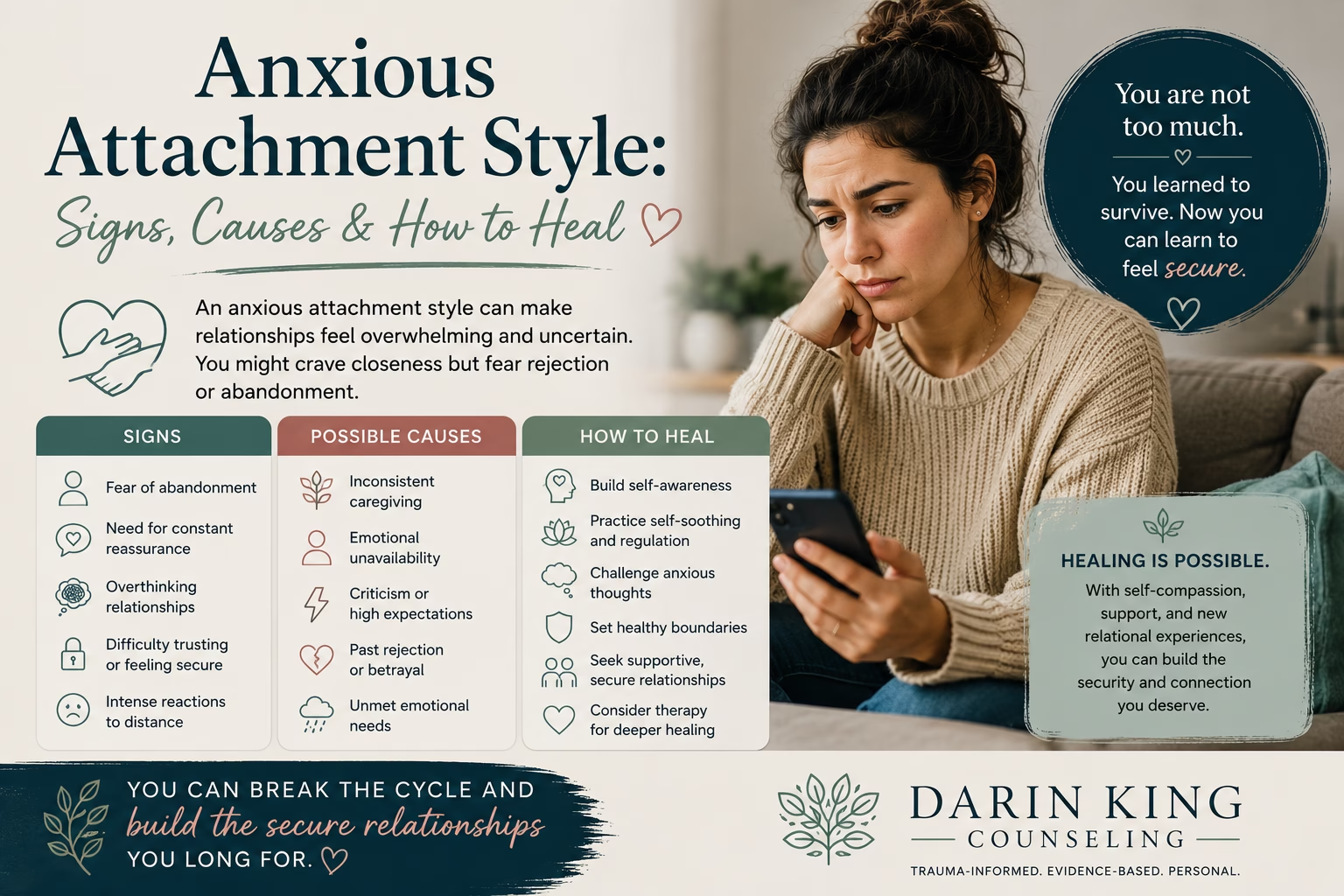
Anxious attachment style is a relationship pattern in which a person becomes hyperaware of any sign that connection is at risk — and responds with protest, pursuit, or self-abandonment to restore closeness. If you read texts twelve times trying to decode the tone, if a delayed response sends your stomach into freefall, if you find yourself shrinking your needs to keep the peace, you may be living inside an anxious attachment pattern. It is not a character flaw. It is a nervous system that learned, early on, that closeness was unpredictable and had to be earned moment by moment.
In my work with clients, the relief that comes from naming this pattern is often immediate. Anxious attachment is not weakness or neediness. It is a coherent adaptation to a relational environment where love felt conditional or inconsistent. Once we can see the pattern as adaptation rather than defect, the real work — building a sense of security from the inside — can begin.
Anxious Attachment at a Glance
What it looks like, where it comes from, and how it changes
How it shows up
- Hypervigilance to partner’s mood and tone
- Fear of abandonment, even in stable relationships
- Protest behaviors when feeling disconnected
- Self-silencing to maintain closeness
- Difficulty self-soothing when alone
Where it comes from
- Inconsistent caregiver responsiveness
- Parent who was warm one moment, withdrawn the next
- Emotional enmeshment or parentification
- Early loss or threat of abandonment
- Family system where love felt conditional
Inner experience
- “If they really knew me, they’d leave”
- “I’m too much for people”
- Chronic background anxiety in relationships
- Self-worth tied to partner’s responsiveness
- Difficulty trusting expressed care
What changes with work
- Nervous system learns to settle without external reassurance
- Capacity to tolerate normal relational distance
- Needs become expressible rather than hidden
- Self-worth uncouples from partner’s mood
- Earned security becomes possible
Feel free to share or embed this infographic with credit to darinkingcounselingllc.com
What Is Anxious Attachment Style?
Anxious attachment style — sometimes called anxious-preoccupied attachment — is one of the four primary attachment patterns identified in adult attachment research. People with anxious attachment tend to want closeness intensely, fear losing it, and develop strategies (often unconscious) for monitoring and maintaining connection. The pattern develops early, typically in response to a caregiver whose availability felt unpredictable, and it carries forward into adult romantic relationships, friendships, and family dynamics.
The original research on attachment came from John Bowlby and Mary Ainsworth in the 1960s and 70s, working with infants and caregivers. Later researchers, particularly Cindy Hazan and Phillip Shaver, extended the framework to adult romantic relationships. What they found is that the same internal models of connection that form in childhood tend to organize how we approach intimacy as adults — unless something happens to change them.
The Four Attachment Styles in Context
Anxious attachment is best understood alongside the other three patterns it sits beside:
- Secure attachment — comfort with closeness and independence; ability to seek support and offer it without losing self.
- Anxious attachment — strong desire for closeness paired with fear of losing it; tendency toward hypervigilance and protest.
- Avoidant attachment — discomfort with closeness; tendency to suppress needs and create distance under stress.
- Disorganized attachment — the most painful pattern, in which closeness is both desperately wanted and experienced as dangerous.
Most people lean toward one primary style but may show features of others depending on the relationship and the moment. For a deeper look at the related patterns, see our posts on disorganized attachment style and abandonment issues.
Signs of Anxious Attachment in Adults
Anxious attachment shows up across several domains of adult relational life. The list below is not diagnostic — it is a pattern map. Most people with anxious attachment will recognize themselves in some but not all of these.
In romantic relationships
- Reading every text, pause, and tone shift as data about whether you are still loved
- Strong reactivity to perceived withdrawal — even brief unavailability registers as threat
- “Protest behaviors” — repeated calls or texts, accusations, withdrawal-then-pursuit, attempts to provoke a response
- Tendency to suppress needs to keep the partner close, then resent it later
- Difficulty believing expressions of love when they come
- Pattern of feeling “too much” or “not enough” — often both
- Choosing partners who confirm the fear (inconsistent, emotionally unavailable, avoidant)
In friendships
- Tracking who initiated last and feeling hurt by perceived imbalance
- Reading silence as rejection rather than as the friend being busy
- Going out of your way to maintain connection even when reciprocity is low
- Strong response to a friend’s new closeness with someone else
In the body
- Chronic low-grade activation in the nervous system, especially around relationships
- Sleep disruption when relational tension is unresolved
- Gut and stomach symptoms tied to relational stress
- Difficulty settling when alone, even when nothing is wrong
In your inner world
- Self-worth that rises and falls with the perceived state of your relationship
- Inner critic that interprets any disconnection as proof you did something wrong
- Frequent rehearsal of conversations, especially ones that did not go as hoped
- Difficulty distinguishing between your feelings and the other person’s mood
Where Anxious Attachment Comes From
Anxious attachment typically develops in a relational environment where caregiver responsiveness was inconsistent — warm and present sometimes, withdrawn or unpredictable other times. The child cannot rely on a stable rhythm of connection, so the nervous system learns to stay alert. Closeness becomes something to monitor, work for, and hold onto.
This does not require overt neglect or abuse. Many anxiously attached adults grew up with parents who loved them, but whose own anxiety, depression, addiction, marital conflict, or work demands made their emotional availability erratic. The child learns: I have to read the room to know if I am safe to be myself. That reading-the-room becomes a lifelong reflex.
Other common origins include:
- Parentification — being made responsible, emotionally or practically, for a parent’s wellbeing
- Enmeshment — a family system without clear boundaries between members’ emotional states
- Conditional love — the felt sense that connection depended on performing well, being agreeable, or meeting parental needs
- Early loss or separation — death, divorce, a parent’s sudden unavailability through illness or absence
- Emotional neglect — a parent who was physically present but emotionally underresponsive
For a fuller picture of how these early environments shape adult life, see our posts on emotional neglect and adult children of emotionally immature parents.
What Anxious Attachment Feels Like From the Inside
People with anxious attachment often describe an inner state that is hard to convey to people who do not share it. A delayed text response does not register as a delayed text response — it registers as a small disaster that the nervous system must process. A partner who is distracted at dinner is not just distracted. The body reads withdrawal. Anxiety rises before the mind has named what is happening.
This is why advice like “just don’t worry about it” or “give them space” does not work. The worry is not happening at the level of conscious decision. It is happening in the body, in the nervous system, in the part of the brain that learned long ago that small disconnections precede larger ones. The person can know intellectually that nothing is wrong. The body still responds.
Common inner experiences include:
- A persistent background sense that the relationship is about to end
- Difficulty feeling settled even when things are going well
- An urge to do something — text, call, check, ask — to confirm the connection is intact
- Shame about the intensity of the response, followed by efforts to hide it
- A felt split between the self that wants closeness and the self that fears wanting it
Anxious Attachment and the Nervous System
Attachment patterns are not just psychological. They are nervous-system patterns. The anxiously attached person’s autonomic nervous system has been shaped by early experiences of unpredictable connection, and it carries those expectations forward into adult relationships.
What this means practically: anxious attachment cannot be resolved through cognitive insight alone. Reading articles like this one is useful — but real change requires the nervous system to have new experiences of stable, attuned connection over time. This is part of why therapy works for attachment patterns. The therapeutic relationship itself becomes a place where the nervous system can learn, slowly, that closeness can be both reliable and safe.
For the broader context on how the nervous system organizes around early experience, see how trauma affects the nervous system and the role of the sympathetic and parasympathetic nervous systems in mental health.
The Anxious–Avoidant Pairing
One of the most painful and common patterns in adult relationships is the pairing of an anxiously attached person with an avoidantly attached partner. The dynamic typically goes like this:
- The anxious partner senses distance and moves toward the avoidant partner, seeking reassurance.
- The avoidant partner experiences the pursuit as pressure and pulls back further to regulate themselves.
- The anxious partner reads the increased distance as confirmation of the original fear and pursues harder.
- The avoidant partner withdraws more.
- The cycle repeats, intensifying over time.
Neither person is doing this on purpose. Each is responding from their own attachment-shaped nervous system. The anxious partner cannot understand why their care produces withdrawal. The avoidant partner cannot understand why their need for space produces pursuit. Both end up feeling unloved, unseen, and misunderstood.
Couples counseling that specifically addresses attachment patterns can interrupt this cycle. Both partners need to understand what is happening at the nervous-system level, and both need to develop new responses. For more on this work, see our page on marriage and relationship counseling in Pennsylvania.
Anxious Attachment Is Not Permanent
One of the most important findings in attachment research is the concept of earned secure attachment. People who grew up with insecure attachment patterns can develop secure attachment in adulthood through a combination of self-understanding, corrective relational experiences, and often therapy. The brain remains capable of forming new patterns throughout life — this is well-established in neuroscience research on relational neuroplasticity.
Earned security does not mean never feeling anxious. It means that anxiety becomes one signal among many rather than the dominant organizing principle of relationships. It means the nervous system can settle more quickly. It means needs can be expressed directly. It means partner choice begins to shift, with more pull toward people who are actually emotionally available.
What Healing Anxious Attachment Looks Like
Real change in attachment patterns is gradual and layered. It is not a matter of deciding to stop being anxious. It is a matter of giving the nervous system new experiences over time, and developing the inner capacities that early environments did not have the chance to build.
Building self-attunement
Anxious attachment often coexists with a lifelong habit of attending to others’ inner states at the expense of one’s own. Healing involves learning to notice and name your own emotions, body sensations, and needs — first to yourself, then to others. This sounds simple. For someone who learned early that their own inner world was less important than the room around them, it is significant work.
Building tolerance for relational space
A central skill is the capacity to tolerate the normal ebb and flow of closeness in a healthy relationship without reading every dip as catastrophe. This is not done by suppressing the response. It is done by noticing the response, recognizing it as a familiar pattern, and giving the nervous system time to settle without acting on the urgency.
Updating internal models
Anxious attachment carries a set of internal beliefs: I am too much. Love is conditional. If I am fully myself, people leave. These beliefs were accurate in the original environment. They are usually not accurate in the present. Therapy helps surface these beliefs and create the kind of corrective experiences that allow new ones to form.
Choosing differently
People with anxious attachment often pair with avoidant partners — the dynamic is familiar, even when painful. Part of healing is developing the capacity to recognize when a person is emotionally available and to feel drawn to that availability rather than to the familiar push-pull. This shift in attraction is one of the slowest and most meaningful changes in attachment work.
How Therapy Helps With Anxious Attachment
Several therapeutic approaches address anxious attachment well, often in combination:
Attachment-based therapy
Approaches like Emotionally Focused Therapy (EFT) and attachment-informed individual work make the attachment pattern itself the focus, helping the person understand how their early environment shaped their current responses and creating new experiences of secure connection in the therapy relationship.
EMDR therapy
For people whose anxious attachment is rooted in identifiable early experiences — disrupted bonding, parental neglect, early loss — EMDR can help process the original experiences so they exert less force in the present. See our EMDR therapy in Pennsylvania page for more on how this work proceeds.
Internal Family Systems (IFS)
IFS works particularly well with the parts of the anxiously attached person — the part that needs reassurance, the part that feels shame for needing it, the part that suppresses needs to keep the peace. Getting to know these parts changes the inner conversation. See our IFS therapy page for more.
Somatic and nervous-system work
Because attachment lives in the body, body-based and nervous-system-aware approaches are often essential. The goal is not just to think differently about relationships, but to feel differently in them — and that change happens at the level of the autonomic nervous system.
Couples therapy
For people in committed relationships, especially with an avoidant partner, couples work that explicitly addresses attachment dynamics can be transformative. Both partners learn to recognize the cycle and respond to it differently.
What Doesn’t Work
- Trying to suppress the responses. Telling yourself to stop being anxious does not stop the nervous system from responding. It just adds shame to the original response.
- Cutting off all relationships to “work on yourself.” Attachment patterns change in relationship, not in isolation. Solo work is part of healing — it is not the whole.
- Reading endlessly without doing the relational work. Understanding the pattern is useful. Living differently is what changes it.
- Choosing avoidant partners and hoping they change. Pattern recognition without different choices keeps you in the same cycle.
- Generic talk therapy that does not address attachment directly. The pattern is specific. The work is more effective when the therapist is trained in attachment-informed approaches.
What Recovery Looks Like
People often imagine that healing anxious attachment means never feeling anxious in a relationship again. That is not what changes. What changes is the relationship to the anxiety, and the capacity to live and love from a more settled internal place.
- Anxiety still arises, but it passes through more quickly and feels less defining
- You can tolerate normal relational distance without spiraling
- Your self-worth stops rising and falling with your partner’s mood
- Needs become expressible rather than hidden
- Your nervous system can settle, even in the presence of relational uncertainty
- You begin to feel drawn to partners who are actually emotionally available
- The inner voice that said “you’re too much” softens and quiets
This is achievable. People develop earned secure attachment with appropriate work, often over a period of two to five years of consistent inner and relational effort. The change is real, durable, and worth the work.
Frequently Asked Questions
What is anxious attachment style?
Anxious attachment style — sometimes called anxious-preoccupied attachment — is a relational pattern in which a person strongly desires closeness, fears losing it, and develops strategies for monitoring and maintaining connection. It typically develops in response to a caregiver whose emotional availability was inconsistent during childhood. The pattern shows up in adulthood as hypervigilance to a partner’s mood, fear of abandonment, protest behaviors when feeling disconnected, and difficulty self-soothing when alone.
What causes anxious attachment?
Anxious attachment usually develops in a relational environment where caregiver responsiveness was unpredictable — warm and attuned sometimes, withdrawn or unavailable other times. The child learns that connection is precarious and must be actively maintained. Common contributing factors include parental anxiety or depression, parentification, enmeshment, conditional expressions of love, early loss or separation, and emotional neglect. Anxious attachment does not require overt abuse — it commonly develops in homes where the parent loved the child but was emotionally inconsistent.
Can anxious attachment be healed?
Yes. Attachment research consistently shows that insecure attachment patterns can shift toward secure attachment through a process called earned secure attachment. This typically involves a combination of self-understanding, corrective relational experiences, and therapy that addresses attachment directly. The brain remains capable of forming new relational patterns throughout life. Change is gradual and layered — usually a matter of years rather than weeks — but real and durable.
Why do anxiously attached people often end up with avoidant partners?
The pairing is common because each partner activates the other’s attachment system in familiar ways. The anxious partner is drawn to the avoidant partner’s apparent self-sufficiency and finds the pursuit-distance dynamic familiar. The avoidant partner is drawn to the anxious partner’s warmth and finds the pursuit confirming. Both nervous systems recognize the dynamic from earlier life. Without conscious work, the pattern intensifies over time, leaving both partners feeling unloved and misunderstood. Couples therapy that addresses attachment dynamics can interrupt and change this cycle.
Is anxious attachment the same as being needy or codependent?
No. Anxious attachment is a specific nervous-system-level pattern shaped by early experience with inconsistent caregivers. “Neediness” is a vague and often shaming label that does not capture the mechanism. Codependency is a related but distinct pattern with its own dynamics. Many anxiously attached people are highly competent and self-reliant in most areas of life — the pattern shows up specifically in close relationships, where the early nervous-system template is activated.
What kind of therapy works best for anxious attachment?
Several approaches work well, often in combination. Attachment-based individual therapy and Emotionally Focused Therapy (EFT) make the pattern itself the focus. EMDR can help process specific early experiences. Internal Family Systems (IFS) helps with the inner parts that drive the pattern. Somatic and nervous-system-informed approaches address the body-based component. For people in committed relationships, couples therapy that explicitly addresses attachment dynamics can be transformative. The most effective work usually integrates several of these approaches over time, with a therapist trained in attachment-informed clinical work.
How long does it take to develop earned secure attachment?
Meaningful change usually begins within the first several months of focused work — clients commonly notice they are catching their own patterns more quickly and responding with more choice. Substantial change, where the nervous system actually settles in close relationships and self-worth no longer rises and falls with a partner’s mood, typically takes two to five years of consistent work. The pace depends on the severity of the original attachment disruption, the quality of current relationships, and whether co-occurring conditions like trauma, depression, or anxiety also need attention.
You can build a more settled way of loving
Anxious attachment is one of the most painful relational patterns to live inside — and one of the most workable with the right approach. The work involves more than insight. It involves giving the nervous system new experiences, in relationship, over time, with someone who understands the pattern from the inside out.
I work with adults across Pennsylvania — including Pittsburgh, Greensburg, Irwin, and Ruffsdale — using an integrated approach that addresses attachment patterns at both the relational and nervous-system levels. EMDR, IFS, and attachment-informed individual and couples work are central to how I practice.
See more from Darin King Counseling on Google