

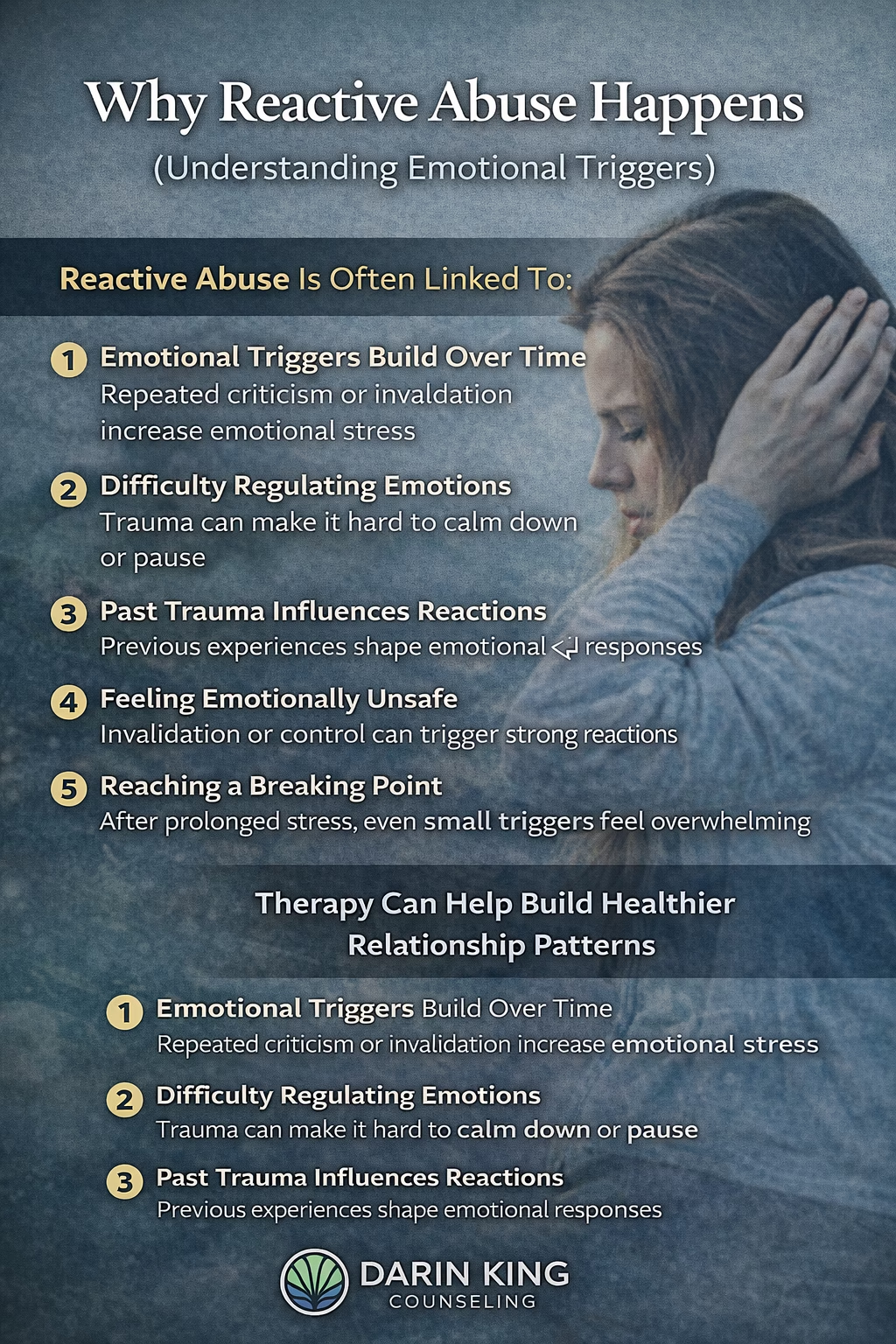
If you’ve ever found yourself behaving in ways that felt completely out of character — screaming, crying uncontrollably, or saying things you’d never normally say — only to have your partner point to that reaction as proof that you are the problem, you’ve experienced reactive abuse. And if you’ve ever wondered why it keeps happening, or why you can’t seem to stop reacting even when you know it’s being used against you — this guide is for you.
Understanding why reactive abuse happens is not just intellectually clarifying. It is one of the most important steps in breaking the cycle — because the dynamic is designed to keep you confused about what’s actually going on.
Why Reactive Abuse Happens: The Provocation Cycle
✓ Stays calm while escalating the provocation
✓ Waits for the victim to finally react
✓ Points to the reaction as evidence of abuse
✓ Uses the reaction to shift blame and maintain control
✓ Nervous system flooding — fight, flight, or freeze
✓ Losing control of emotional response
✓ Intense shame and confusion after reacting
✓ Beginning to believe they are the abusive one
Feel free to share or embed this infographic with credit to darinkingcounselingllc.com
What Is Reactive Abuse?
Reactive abuse occurs when an abuser deliberately provokes their victim — through taunting, gaslighting, boundary violations, relentless criticism, or emotional cruelty — until the victim finally reacts. That reaction is then pointed to as evidence that the victim is abusive, unstable, or “crazy.” The term is misleading because the reaction itself is not abuse — it is a trauma response to sustained mistreatment. Read our full guide on what reactive abuse is for a complete overview.
Key point: Reactive abuse doesn’t happen by accident. The provocation is deliberate. Understanding the specific reasons why abusers use this tactic — and why victims react despite their best efforts not to — is what demystifies the dynamic and begins to restore clarity.
Why Abusers Deliberately Provoke Reactive Abuse
Reactive abuse is a calculated tactic, not an accidental dynamic. Abusers — particularly those with narcissistic traits — provoke reactions for specific, strategic reasons:
1. To Shift the Narrative
By provoking a reaction and then pointing to it, the abuser successfully shifts the conversation from their behavior to the victim’s behavior. Suddenly the discussion is not about what the abuser did — it’s about how the victim “lost control.” The original provocation disappears from the story.
2. To Maintain Power and Control
Keeping a partner in a constant state of emotional reactivity is a form of control. A partner who is flooded, confused, and ashamed is not in a position to clearly assess the relationship or take action to change it. The reactive abuse dynamic keeps the victim perpetually destabilized.
3. To Manufacture Justification
The reaction gives the abuser apparent justification for their own behavior: “I wouldn’t act this way if you didn’t make me.” The victim’s reaction becomes the stated cause of the abuser’s mistreatment — inverting the actual sequence of events.
4. To Make the Victim Doubt Themselves
When victims react and then feel ashamed of how they reacted, they begin to doubt their own perception of what happened. The gaslighting that frequently accompanies reactive abuse — “I was just joking,” “you’re so sensitive,” “you’re the one who’s abusive” — compounds this self-doubt. Over time, victims may genuinely come to believe they are the problem.
5. To Use as Evidence
Some abusers record the victim’s reaction, share it with friends or family, or reference it in legal proceedings — using it as “proof” of the victim’s instability or abusiveness. This strategic documentation of provoked reactions is a particularly calculated form of the tactic.
6. To Deepen the Trauma Bond
The shame that follows a reactive outburst — combined with the abuser’s subsequent manipulation — often deepens the trauma bond rather than breaking it. The victim feels guilty, the abuser appears to be the injured party, and the victim redoubles their efforts to be “better” — which increases dependence and attachment.
Why Victims React — The Neuroscience
Understanding why victims react despite their best efforts not to requires understanding what sustained psychological abuse does to the nervous system. According to the National Institute of Mental Health, trauma and chronic stress significantly impair the prefrontal cortex — the part of the brain responsible for impulse control, emotional regulation, and rational assessment of threat.
When a person is subjected to sustained psychological abuse, their nervous system is chronically activated — living in a state of hypervigilance and stress. The prefrontal cortex becomes less effective at regulating the amygdala’s alarm response. The result is a nervous system that has been pushed so far past its regulatory capacity that, under sustained provocation, it finally gives way.
Read more about how trauma affects the nervous system — the same mechanisms that explain trauma responses explain why victims of reactive abuse cannot simply decide not to react.
| Stage | What’s Happening Neurologically | What It Feels Like |
|---|---|---|
| Sustained provocation | Cortisol and adrenaline build — HPA axis activating | Growing tension, frustration, anxiety |
| Escalation | Prefrontal cortex activity reduces — “thinking brain” going offline | Difficulty thinking clearly, feeling trapped |
| Flooding | Amygdala fully activated — fight, flight, or freeze response | Overwhelming emotion, loss of control |
| Reaction | Survival response expressed — the limit has been reached | Yelling, crying, shutting down, saying things not meant |
| Aftermath | Cortisol slowly drops — prefrontal cortex comes back online | Exhaustion, shame, confusion about what just happened |
Why Reactive Abuse Keeps Happening
Even when victims understand the dynamic, reactive abuse often continues. Here’s why:
The Nervous System Has Been Conditioned
Chronic exposure to abuse changes the nervous system’s baseline — it takes less provocation to trigger flooding as time goes on. The Substance Abuse and Mental Health Services Administration recognizes that prolonged psychological abuse produces genuine nervous system dysregulation that doesn’t resolve simply through understanding or willpower.
The Trauma Bond Makes Leaving Feel Impossible
The trauma bond created by the abuse cycle keeps victims attached even when they recognize what’s happening. The intermittent reinforcement of abuse followed by affection creates a powerful neurochemical attachment that feels like love.
Gaslighting Has Eroded Self-Trust
When victims have been systematically told that their perceptions are wrong, they lose confidence in their own assessment of situations — including their assessment of when provocation is happening and when their reaction is unjustified. This erosion of self-trust makes it harder to implement strategies to avoid reacting.
Isolation Has Removed Outside Perspective
Abusers frequently isolate their victims from friends and family who might provide reality-testing. Without outside perspectives confirming that the provocation is real and the dynamic is abusive, victims are left with only the abuser’s narrative — which always positions the victim’s reaction as the problem.
Note: If you recognize this dynamic in your relationship, the most important thing to understand is that you are not the problem. The provocation came first. Your reaction — however intense — was a nervous system response to sustained mistreatment, not evidence of your character. Read more about what reactive abuse is and how to heal from it.
How to Break the Cycle
Breaking the reactive abuse cycle requires both immediate strategies and longer-term support:
In the Moment
- Remove yourself physically before the provocation escalates past your regulatory capacity
- Recognize the escalation pattern — the earlier you can identify that provocation is beginning, the more choice you have
- Use grounding techniques to stay regulated. See our guide on nervous system reset techniques
Longer-Term
- Therapy for narcissistic abuse — specialized therapy addresses the specific dynamics, manipulation tactics, and trauma recovery needs of survivors
- EMDR therapy — EMDR processes the traumatic memories from the abusive relationship and helps regulate the nervous system
- Safety planning — if you are in an abusive relationship, working with a therapist to develop a safety plan is an important step
Related reading: Our guides on what is reactive abuse, reactive abuse vs emotional abuse, signs of reactive abuse, and therapy for narcissistic abuse complete the reactive abuse cluster.
Frequently Asked Questions
Why does reactive abuse keep happening even when I try to stop reacting?
Reactive abuse keeps happening because the provocation is deliberate and calibrated. Additionally, chronic abuse dysregulates the nervous system so it takes progressively less provocation to trigger flooding. Willpower alone is rarely enough because the prefrontal cortex — which regulates impulse control — is compromised by chronic stress. Therapy that addresses the underlying nervous system dysregulation is the most effective long-term solution.
Is reactive abuse my fault?
No — the provocation came first and was deliberate. Your reaction was a nervous system response to sustained mistreatment, not evidence of your character. The reaction does not erase or excuse the provocation that caused it. Read more about what reactive abuse is.
Why does the abuser stay calm while provoking me?
The abuser stays calm because they are in control of the provocation — they are not being triggered, they are triggering. Their calm is a deliberate contrast designed to make your reaction look irrational. It is evidence that the provocation is calculated rather than reactive.
How do I stop reacting to reactive abuse provocation?
Physical removal before escalation reaches your limit is the most effective in-the-moment strategy. Grounding techniques help regulate the nervous system. Longer-term, EMDR therapy and trauma-focused work build greater regulatory capacity. The goal is not to tolerate abuse — it’s to get safe.
Can couples therapy help with reactive abuse?
Standard couples therapy is generally not recommended when one partner is abusing the other — it can make the situation more dangerous. Individual trauma-focused therapy for the survivor is the most important first step. Telehealth therapy makes that support accessible from anywhere in Pennsylvania.
Your reaction doesn’t make you the abuser. Understanding why it happens is how you start to heal.
Darin King, LPC specializes in trauma, narcissistic abuse recovery, and EMDR therapy in Pennsylvania. Telehealth available statewide.
See more from Darin King Counseling on Google