

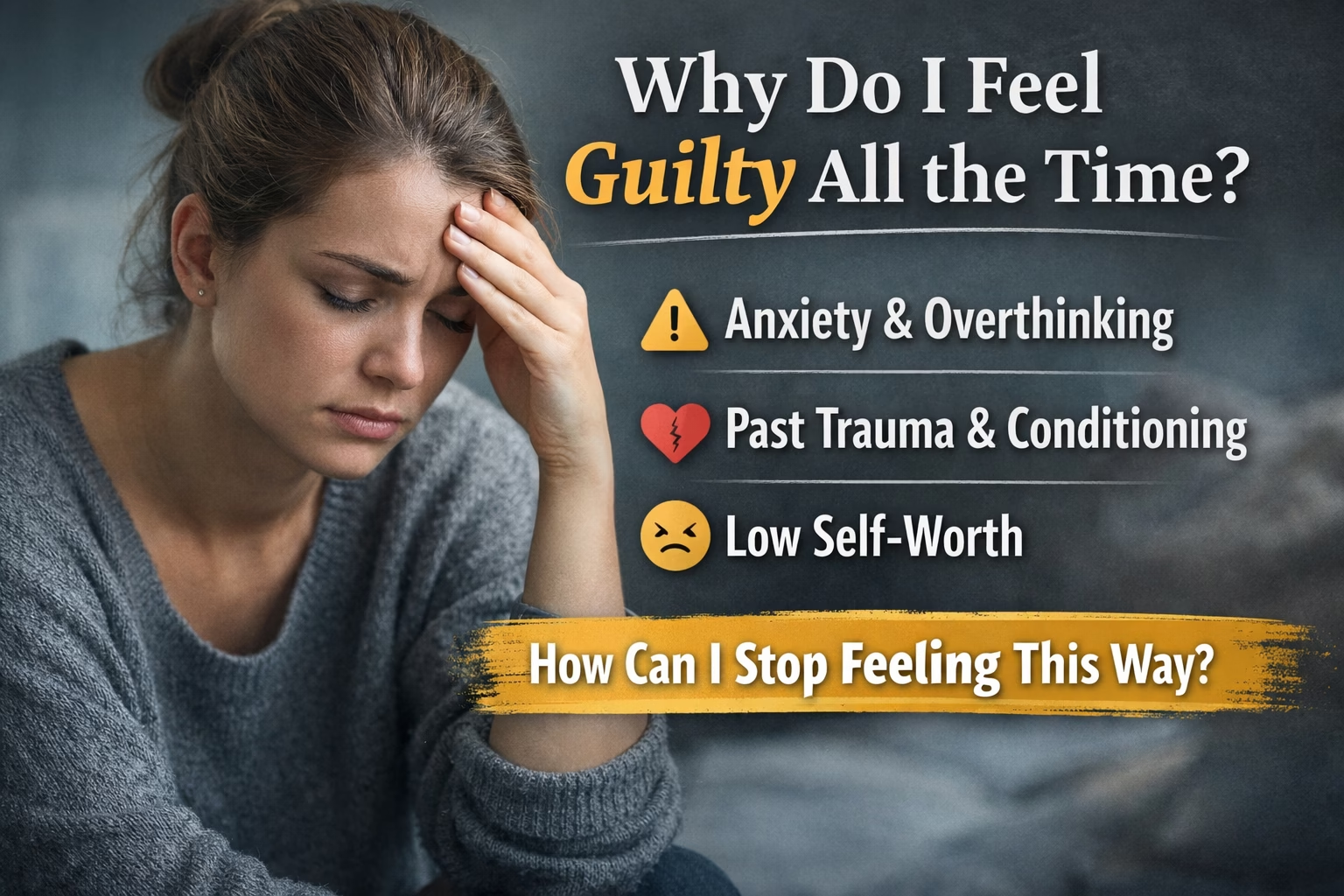
If guilt feels less like an occasional visitor and more like a permanent roommate — always there, always pointing inward, always finding something to latch onto — you are not alone. Chronic guilt is one of the most common experiences reported by people who seek therapy, and one of the most misunderstood. Most people assume that feeling guilty means they’ve done something wrong. But when guilt is constant, it usually means something very different.
This guide explores the most common reasons people feel guilty all the time, what chronic guilt is really telling you, and what actually helps — beyond simply trying harder to forgive yourself.
Why Do I Feel Guilty All the Time? Common Root Causes
✓ Being made responsible for others’ feelings
✓ Dysfunctional family roles (caretaker, scapegoat)
✓ Depression or anxiety amplifying guilt
✓ PTSD — survivor guilt or trauma-related guilt
✓ Cultural expectations of self-sacrifice
✓ Perfectionism and impossibly high standards
✓ People pleasing as a survival strategy
✓ Internalized critical or shaming voices
Feel free to share or embed this infographic with credit to darinkingcounselingllc.com
What Chronic Guilt Is Really Telling You
When guilt is occasional and proportionate — connected to specific actions that conflict with your values — it is functioning as it should. It signals that repair may be needed and motivates you to do better. But when guilt is constant, disproportionate, or not connected to any specific wrong, it is no longer functioning as a moral compass. It is functioning as a symptom.
According to the American Psychiatric Association, excessive or inappropriate guilt is a recognized symptom of depression, anxiety disorders, OCD, and PTSD. Chronic guilt is therefore not a character flaw or a sign that you are a particularly bad person — it is a signal that something in your mental health picture deserves attention.
Key reframe: Feeling guilty all the time does not mean you are always doing something wrong. It means your nervous system has been conditioned — by experience, by early relationships, or by mental health factors — to produce guilt as a default state. Understanding what conditioned that response is the key to changing it.
10 Reasons You Feel Guilty All the Time
1. You Were Made Responsible for Others’ Feelings as a Child
Children who grew up with emotionally volatile, mentally ill, or addicted parents often learned to monitor and manage their caregiver’s emotional state. If a parent’s mood was unpredictable, a child quickly learns to feel responsible for it — and to feel guilty when they can’t fix it. That learned hyperresponsibility becomes chronic guilt in adulthood: a constant sense that you are responsible for everyone around you, and always somehow failing in that responsibility.
2. Childhood Trauma or Abuse
Children who experience abuse frequently conclude that the abuse was their fault — a developmental mechanism that preserves the attachment relationship by attributing the cause of harm to the child rather than the caregiver. This misplaced guilt can persist for decades, showing up as a pervasive sense of being fundamentally at fault. Read more about signs of childhood trauma in adults.
3. You Grew Up as the Family Caretaker or Scapegoat
In dysfunctional family systems, certain children take on specific roles that generate chronic guilt. The caretaker feels guilty for not doing enough — for ever prioritizing themselves. The scapegoat feels guilty for simply existing — for being the designated cause of the family’s problems. Both roles install guilt as a permanent fixture.
4. Depression
The National Institute of Mental Health lists excessive guilt as one of the diagnostic criteria for major depressive disorder. Depression distorts thinking in specific ways — including producing feelings of worthlessness and inappropriate guilt that have no basis in reality. If your guilt is accompanied by persistent low mood, loss of pleasure, fatigue, or hopelessness, depression may be a significant driver. Depression counseling addresses this directly.
5. Anxiety
Anxiety amplifies guilt responses significantly. When the nervous system is chronically activated, it scans for threats — including social and moral threats. Small perceived social missteps become evidence of serious wrongdoing. The anxious mind runs worst-case scenarios about how you may have hurt or disappointed people. Anxiety counseling can help regulate the nervous system that is amplifying the guilt response.
6. PTSD and Trauma
Excessive guilt is a recognized feature of PTSD. Trauma survivors frequently carry guilt about the traumatic event itself — survivor’s guilt, guilt about their response to the trauma, or guilt about ongoing symptoms. The Substance Abuse and Mental Health Services Administration emphasizes that trauma-informed care addresses guilt as a trauma response rather than a character failing. Read more about Complex PTSD vs PTSD.
7. Religious or Cultural Conditioning
Religious environments that use guilt as a primary spiritual tool — where normal human experiences like doubt, sexuality, or self-assertion are framed as sinful — can produce deeply internalized guilt that persists long after a person has left the community. Read more about religious trauma and its connection to chronic guilt.
8. Perfectionism
Impossibly high standards — applied to yourself but rarely to others — generate a constant state of falling short, which produces chronic guilt. The perfectionist is always failing by their own standards, which means guilt is always present. Perfectionism is often rooted in childhood environments where love or approval was conditional on performance.
9. People Pleasing
People pleasing and chronic guilt are deeply intertwined. The people pleaser feels guilty any time they fail to prioritize someone else — any time they say no, have a need, or fail to prevent someone’s discomfort. The guilt drives the people pleasing, and the people pleasing reinforces the guilt by treating it as an accurate signal that must always be acted on.
10. Generational Patterns
Generational trauma can transmit guilt patterns across generations — families in which guilt is the primary emotional currency, where suffering is normalized, or where self-sacrifice is the expected expression of love. Growing up in these systems installs guilt as the baseline emotional experience.
| Root Cause | How It Generates Chronic Guilt | What Helps |
|---|---|---|
| Childhood hyperresponsibility | Learned to feel responsible for others’ feelings | Trauma therapy, IFS, boundary work |
| Childhood trauma/abuse | Misplaced guilt for abuse that wasn’t your fault | EMDR therapy, trauma-focused therapy |
| Depression | Cognitive distortion producing excessive guilt | Depression counseling, trauma therapy |
| Anxiety | Amplifies guilt responses to minor events | Anxiety counseling, nervous system regulation |
| PTSD | Survivor guilt, trauma-related self-blame | EMDR therapy, trauma-focused therapy |
| Religious conditioning | Internalized shame and guilt about normal human experiences | Religious trauma therapy, IFS |
| People pleasing | Guilt drives compulsive prioritization of others | Trauma therapy, boundary work, DBT |
The Difference Between Chronic Guilt and a Healthy Conscience
A healthy conscience produces guilt that is:
- Connected to specific actions
- Proportionate to the actual harm
- Resolved when the situation is addressed
- Motivating toward repair and positive change
Chronic guilt is:
- Persistent regardless of what you do
- Disproportionate or not connected to specific actions
- Resistant to resolution — even genuine repair doesn’t quiet it
- Motivating toward self-punishment and people pleasing rather than genuine repair
Understanding this distinction — explored in depth in our guide on shame vs guilt — is essential to recognizing that chronic guilt is not your conscience speaking. It is a conditioned response that deserves therapeutic attention.
Note: The CDC’s ACE research consistently shows that adverse childhood experiences significantly increase the risk of depression, anxiety, and PTSD in adulthood — all of which generate chronic guilt as a core feature. If chronic guilt has been part of your experience since childhood, early adverse experiences are likely part of the picture.
How to Stop Feeling Guilty All the Time
For a step-by-step framework for stopping chronic guilt, see our guide on how to stop feeling guilty. The short version:
- Identify the type of guilt — proportionate, disproportionate, or chronic background
- Separate guilt from shame — they require different approaches
- Check the facts — is this guilt giving you accurate information?
- Address what can be addressed — then practice releasing what has been resolved
- Challenge the underlying beliefs driving the guilt
- Address the deeper roots through trauma-focused therapy
Therapy for Chronic Guilt
EMDR therapy processes the specific memories that seeded chronic guilt. IFS therapy works with the guilt-carrying parts of the self. DBT therapy provides practical tools for checking the facts and tolerating guilt without acting on it. Trauma counseling in Pennsylvania is available via telehealth statewide.
Related reading: Our guides on signs of a guilt complex, how to stop feeling guilty, and shame vs guilt complete the picture of understanding and healing chronic guilt.
Frequently Asked Questions
Why do I feel guilty even when I haven’t done anything wrong?
Feeling guilty without a clear cause is almost always rooted in something deeper — early experiences that conditioned the nervous system to produce guilt as a default, underlying depression or anxiety, PTSD, or religious and cultural conditioning. Chronic guilt without a clear cause is a signal worth exploring with a trauma-informed therapist.
Is feeling guilty all the time a sign of anxiety?
Yes — anxiety is one of the most common drivers of chronic guilt. The anxious nervous system scans for threats including social and moral ones, amplifying guilt responses to minor perceived missteps. Anxiety counseling alongside trauma therapy typically produces significant improvement.
Can depression make you feel guilty all the time?
Yes — excessive guilt is a diagnostic criterion for major depressive disorder. Depression distorts thinking in ways that produce pervasive guilt and worthlessness. If chronic guilt is accompanied by persistent low mood, fatigue, or loss of pleasure, depression counseling is worth exploring.
Is chronic guilt a trauma response?
Yes — chronic guilt is frequently a trauma response. Childhood trauma in particular often produces lasting guilt as children conclude that harm done to them was their fault. EMDR therapy and trauma-focused approaches address this directly. Read more about signs of childhood trauma in adults.
Will therapy help me stop feeling guilty all the time?
Yes — therapy is highly effective for chronic guilt when it addresses root causes rather than just symptoms. Many people see meaningful improvement within months of consistent work. Telehealth therapy makes that support accessible from anywhere in Pennsylvania.
Feeling guilty all the time isn’t who you are — it’s what you learned. And it can be unlearned.
Darin King, LPC specializes in trauma, guilt, shame, and healing in Pennsylvania. Telehealth available statewide.
See more from Darin King Counseling on Google