

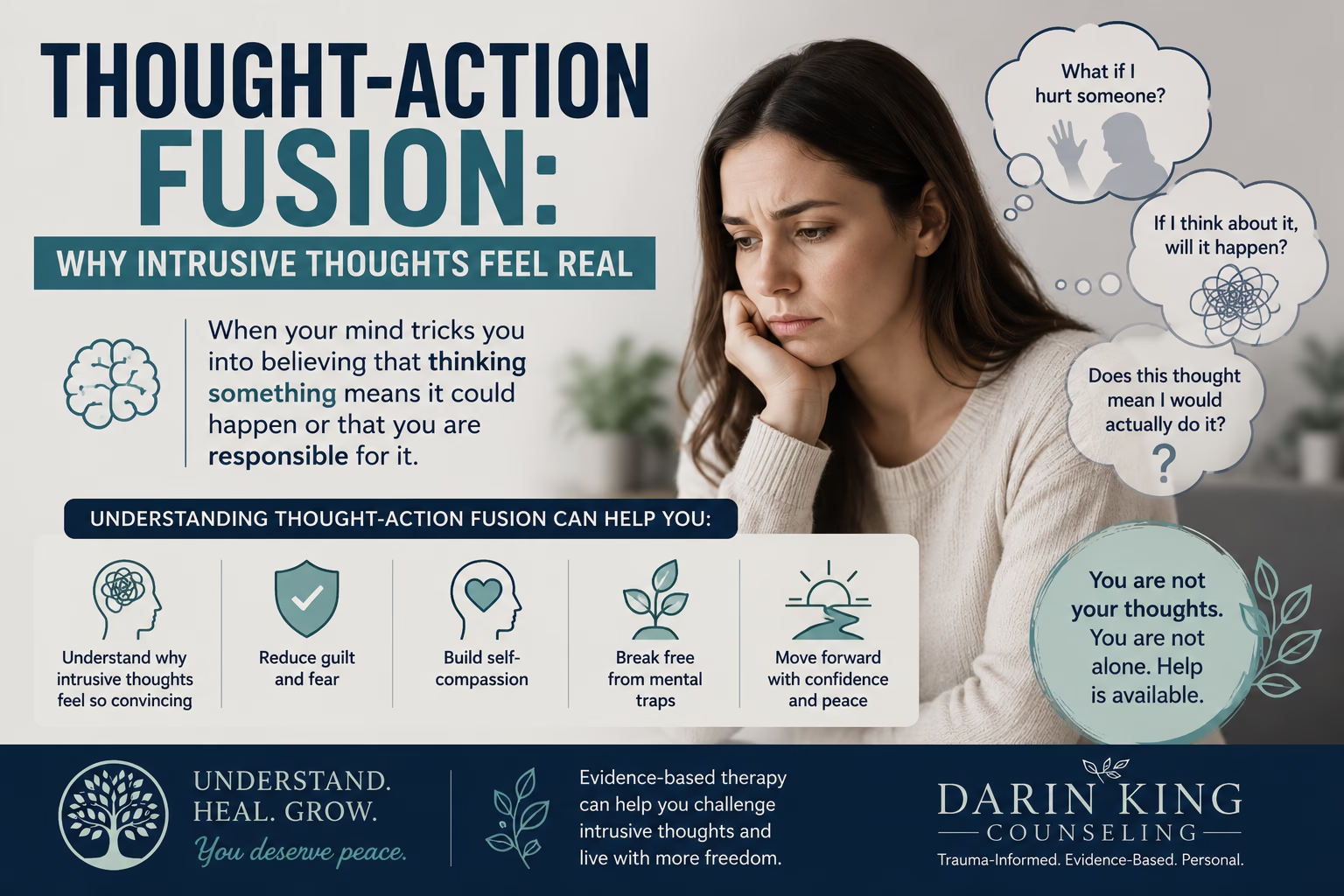
Thought-action fusion is the cognitive distortion at the heart of much OCD suffering — the belief that thinking something is morally equivalent to doing it, or that thinking about something can make it happen. If you’ve ever had an intrusive thought and felt as ashamed as if you’d actually done what the thought suggested, you’ve experienced thought-action fusion. It’s one of the most painful patterns in OCD, and one of the most treatable once it’s named.
In my work with OCD clients, naming thought-action fusion is often a turning point. Before the name, the person is convinced their thoughts reveal something terrible about who they are. After the name, they can begin to see the thoughts as a symptom — produced by the disorder rather than evidence about their character. That distinction changes everything about how recovery proceeds.
The Two Types of Thought-Action Fusion
Both fuel OCD — and both can be treated
- “Thinking it is as bad as doing it”
- Intrusive thought feels like proof of bad character
- Drives shame and self-condemnation
- Common in harm OCD and scrupulosity
- “Thinking it makes it more likely to happen”
- Magical or causal connection between thought and event
- Drives mental rituals and avoidance
- Common in fears about loved ones being harmed
- Compulsive mental review
- Trying to “undo” thoughts
- Avoiding triggers
- Constant reassurance-seeking
- ERP for intrusive thoughts
- Cognitive restructuring
- Acceptance-based work
- Reducing mental compulsions
Feel free to share or embed this infographic with credit to darinkingcounselingllc.com
What Is Thought-Action Fusion?
Thought-action fusion (TAF) is a cognitive distortion in which a person treats their thoughts as if they were equivalent to actions, or as if their thoughts could directly cause real-world events. It was first described in OCD research in the 1990s and has since become one of the most studied cognitive features of obsessive-compulsive disorder.
TAF has two distinct forms, both significant:
- Moral thought-action fusion is the belief that having a thought is morally equivalent to acting on it. If you have a violent thought, you must be a violent person. If you have a sexual thought about someone inappropriate, you must want to act on it. The thought itself becomes evidence of bad character.
- Likelihood thought-action fusion is the belief that thinking about something makes it more likely to happen. If you think about your mom getting in a car accident, somehow you’ve made that event more likely. The thought becomes a kind of magical cause.
Most people with OCD experience some combination of both. Both are treatable. Both feel deeply, painfully real to the person experiencing them.
Thought-action fusion is the engine behind most of the worst OCD suffering. The intrusive thought itself is not the problem — everyone has intrusive thoughts. The problem is the meaning the person assigns to the thought. TAF is what makes a fleeting weird thought feel like proof of who you really are.
The Connection to OCD
Thought-action fusion is one of the cognitive mechanisms that turns an ordinary intrusive thought into the cycle of obsession and compulsion we call OCD. Here’s how the process typically unfolds:
- An intrusive thought arrives. (“What if I pushed my baby down the stairs?”)
- TAF kicks in. The thought feels morally equivalent to wanting to do it, or feels like it could somehow make it happen.
- Anxiety spikes. The person feels horrified, ashamed, dangerous.
- Compulsions begin. Mental review, avoidance, reassurance-seeking — anything to make the thought go away or prove it isn’t true.
- Brief relief, then return. The cycle repeats, often more intensely each time.
Without TAF, the same intrusive thought would arrive and pass without significance. Most people have weird, dark, or disturbing thoughts occasionally — and most people simply notice them and move on. It’s the meaning-making that turns a thought into a torment. For more on the mental side of this cycle, see our pieces on OCD rumination and mental compulsions.
What Moral Thought-Action Fusion Looks Like
Moral TAF tends to show up around content that feels deeply incompatible with the person’s values. Some common presentations:
Harm OCD
Intrusive thoughts about harming others — children, partners, strangers, animals. The person doesn’t want to harm anyone. The thought arrives anyway, often in the most unwelcome moments. Moral TAF tells them: this thought means you might be a violent person. The result is intense shame and often complete avoidance of situations that trigger the thoughts.
Sexual OCD
Intrusive sexual thoughts — about wrong-age people, family members, same-sex or opposite-sex people in ways that conflict with the person’s identity, religious figures. Again, the thoughts are unwanted. Moral TAF interprets them as evidence of hidden desire or pathology.
Scrupulosity (Religious or Moral OCD)
Intrusive thoughts about blasphemy, sin, moral failure, or being secretly a bad person. The religious or ethical framework provides specific content for the moral TAF — “thinking this is a sin,” “having this thought means I’m damned.”
Relationship OCD
Intrusive thoughts about not loving a partner enough, finding someone else attractive, wanting to leave. Moral TAF interprets these thoughts as evidence about the true nature of the relationship rather than as ordinary mental noise.
What Likelihood Thought-Action Fusion Looks Like
Likelihood TAF often shows up around fears about loved ones, accidents, or catastrophic events. Some common presentations:
Magical responsibility
“If I think about my mom getting in a car accident, I might cause it to happen. I need to think a counter-thought to cancel it out.” The person ends up performing elaborate mental rituals to prevent feared outcomes.
Catastrophizing about thoughts
“What if just having this thought puts the idea out into the universe and it happens?” This is especially common in people from spiritual or religious backgrounds where the power of intention is emphasized in problematic ways.
Hyperresponsibility
The person feels responsible for preventing bad outcomes through mental work. If something bad happens, they may feel they caused it by not thinking the right thoughts.
Why TAF Is So Hard to Argue With From Inside
People with thought-action fusion often know intellectually that thoughts can’t cause events and that thinking something isn’t the same as doing it. They can articulate the rational position clearly. And yet the feeling of meaning, of moral weight, of magical responsibility persists.
This is because TAF operates at an emotional and somatic level, not a purely cognitive one. The body responds to the intrusive thought as if a real threat were present. The shame is bodily. The fear is bodily. Logic doesn’t reach the place where the response is generated.
This is why simply reading articles like this one rarely resolves TAF on its own — though understanding the mechanism is an important first step. The deeper work involves changing the relationship to thoughts at a level beneath conscious reasoning.
People with severe TAF often fear that their intrusive thoughts reveal hidden truths about who they are. Research consistently shows the opposite: the content of intrusive thoughts tends to be precisely opposite to the person’s values. People who care deeply about not harming others get harm thoughts. People who value sexual ethics get sexual intrusive thoughts. The disorder targets exactly what matters most to the person, which is why it produces such suffering.
The Treatment That Actually Works
Thought-action fusion is highly treatable with the right approach. The treatment isn’t to argue with the thoughts or prove they aren’t true — that just deepens engagement with the obsessive content. The treatment is to change the relationship with the thoughts entirely.
Exposure and Response Prevention (ERP)
ERP is the gold-standard treatment for OCD and for thought-action fusion specifically. The work involves intentionally bringing up the feared thoughts, sitting with the discomfort they produce, and not performing the compulsions (mental review, neutralization, avoidance) that have maintained the cycle. Over time, the thoughts lose their power. The person learns experientially — not just intellectually — that the thought is just a thought.
ERP for thought-action fusion is best done with a clinician trained specifically in OCD. Generic talk therapy can actually worsen TAF by inviting endless exploration of the content of the obsessive thoughts.
Acceptance and Commitment Therapy (ACT)
ACT pairs especially well with ERP for thought-action fusion. The core skill: acknowledging that intrusive thoughts will arise, allowing them to be present, and acting according to values rather than according to the urgency the thoughts create. ACT explicitly works on changing the relationship to thoughts rather than the content of thoughts.
Inference-Based CBT
Inference-based CBT targets the specific reasoning errors that produce OCD doubt, including thought-action fusion. It can be a useful alternative or supplement to ERP for some people, particularly those who haven’t responded fully to ERP alone.
Nervous System Regulation
Because TAF operates partly at a somatic and emotional level, addressing the underlying nervous system state often makes the cognitive work more effective. A nervous system that is chronically activated will respond to intrusive thoughts as if they were real threats. Working on regulation alongside ERP gives the cognitive work somewhere to land.
This is why our approach to OCD integrates trauma-informed and somatic work alongside evidence-based ERP — particularly for people whose OCD developed in the context of trauma. See dorsal vagal shutdown and how trauma affects the nervous system for the broader nervous system context.
What Doesn’t Work
- Arguing with the thoughts. Trying to prove to yourself that you’re not a bad person, that the feared thing won’t happen, that the thought is irrational — this is reassurance-seeking, which is a compulsion. It deepens the cycle.
- Suppressing the thoughts. Trying not to think about something makes it more present, not less. This is well-established psychological research.
- Avoiding triggers. Avoidance temporarily reduces the thoughts but reinforces the belief that the thoughts are dangerous and must be managed.
- Confessing the thoughts repeatedly. Telling a partner, friend, therapist, or priest about every intrusive thought to get reassurance is a compulsion. The relief is brief; the cycle deepens.
- Generic talk therapy that explores the content. A well-meaning therapist who explores the content of intrusive thoughts as if they were meaningful information about the person can inadvertently strengthen TAF.
What Recovery Looks Like
People often imagine recovery from thought-action fusion means never having an intrusive thought again. That’s not what recovery is. What changes:
- Intrusive thoughts still arise, but they pass through without sticking
- The thought no longer feels like evidence about who you are
- The body no longer responds to the thought as if a real threat were present
- The urge to perform mental rituals weakens significantly
- The shame that surrounded the thoughts dissolves
- You can function — and feel like yourself — even when intrusive content arises
This is achievable. People recover from severe thought-action fusion with appropriate treatment. The work is real, and the change is durable.
Frequently Asked Questions
What is thought-action fusion?
Thought-action fusion is a cognitive distortion central to OCD in which a person treats their thoughts as if they were equivalent to actions, or as if their thoughts could directly cause real-world events. It has two main forms: moral TAF (thinking it is as bad as doing it) and likelihood TAF (thinking it makes it more likely to happen). Both fuel OCD cycles by attaching unwarranted meaning and consequence to ordinary intrusive thoughts.
Is thought-action fusion the same as having intrusive thoughts?
No, but they’re connected. Intrusive thoughts are normal — most people experience them occasionally. Thought-action fusion is the cognitive distortion that turns intrusive thoughts into significant distress by treating them as morally meaningful or causally powerful. Without TAF, the same intrusive thought passes through without much effect. With TAF, it becomes the start of an OCD cycle.
Why do my intrusive thoughts feel so real?
Thought-action fusion operates at an emotional and somatic level, not just a cognitive one. The body responds to the intrusive thought as if a real threat were present, producing real anxiety, real shame, real urgency. Knowing intellectually that thoughts aren’t actions doesn’t reach the place where the response is being generated. This is why TAF requires more than reassurance to resolve — it needs experiential work like ERP that teaches the nervous system that the thoughts are not threats.
Does having a violent or sexual intrusive thought mean I want to do it?
No. Research consistently shows that the content of intrusive thoughts in OCD tends to be the opposite of what the person actually wants or values. People who deeply value not harming others get harm thoughts. People who care about sexual ethics get sexual intrusive thoughts. The disorder targets exactly what matters most to the person — which is precisely what makes the thoughts so distressing. The thoughts are symptoms of OCD, not revelations about character.
How is thought-action fusion treated?
The gold-standard treatment is Exposure and Response Prevention (ERP), which works by intentionally bringing up feared thoughts and not performing the compulsions that have maintained the cycle. Acceptance and Commitment Therapy (ACT) pairs well with ERP. For people with trauma history, integrating ERP with nervous system regulation and trauma-informed work often produces better and more durable results than ERP alone.
How long does it take to recover from thought-action fusion?
Most people working with an OCD-trained clinician see meaningful improvement within 3 to 6 months of consistent treatment. Substantial change typically takes 6 to 18 months. Full recovery — where intrusive thoughts arise and pass through without significant distress — is achievable and durable. The pace depends on severity, treatment quality, and whether there are co-occurring conditions like trauma or depression that also need attention.
Your thoughts are not who you are
Thought-action fusion is one of the most painful patterns in OCD — and one of the most treatable when the right approach is used. The work involves changing the relationship to thoughts, not the content of thoughts. Effective treatment combines ERP with attention to the underlying nervous system patterns that often drive the obsessive cycle.
I work with adults with OCD across Pennsylvania — including Pittsburgh, Greensburg, Irwin, and Ruffsdale — using an integrated approach that addresses both the cognitive and nervous-system layers of OCD.
Schedule an OCD Therapy SessionDarin King is a Licensed Professional Counselor (LPC) in Pennsylvania specializing in trauma, anxiety, and relational healing. Learn more about Darin.
See more from Darin King Counseling on Google