

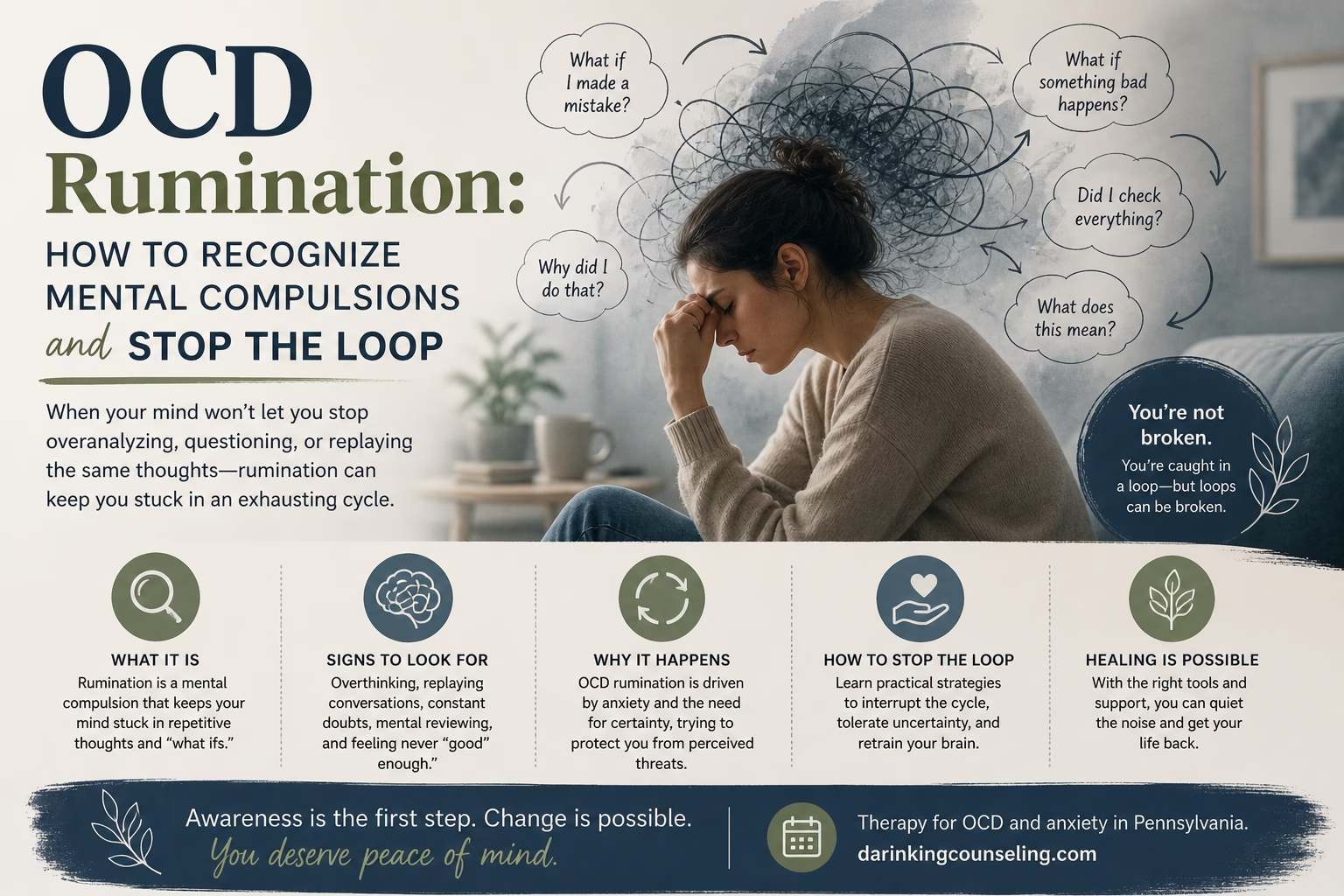
OCD rumination is the part of OCD that lives entirely inside your head — the endless mental review, analysis, checking, and “figuring out” that feels like you’re solving the problem when in fact it’s the engine that keeps the problem going. It’s why so many people with OCD have spent years in therapy that didn’t fully work: rumination is invisible from the outside, often invisible to the person doing it, and frequently mistaken for thoughtful problem-solving rather than what it actually is — a compulsion.
In my work with OCD clients, the moment that often unlocks real progress is when they start recognizing that the mental “working through” they’ve been doing for hours, days, or years is itself the thing keeping them stuck. This piece is a clinical look at what OCD rumination is, why it’s so hard to spot, and what it actually takes to interrupt the cycle.
The OCD Rumination Cycle
Why ‘figuring it out’ makes it worse
- Disturbing or unwanted thought
- Question, image, or doubt
- Triggers anxiety
- Feels urgent to address
- Body activates
- Threat alarm goes off
- “What if this is true?”
- Distress demands resolution
- Reviewing, analyzing, checking
- Trying to “figure it out”
- Reassurance-seeking internally
- Feels like productive thinking
- Anxiety drops momentarily
- Reinforces the compulsion
- Brain learns: rumination = relief
- Cycle starts over
Feel free to share or embed this infographic with credit to darinkingcounselingllc.com
What Is OCD Rumination?
OCD rumination is a mental compulsion in which a person repeatedly reviews, analyzes, debates, or “figures out” intrusive thoughts in an attempt to resolve the anxiety they cause. Unlike the more visible OCD compulsions — handwashing, checking locks, counting — rumination happens entirely in the head, which is why it often goes undiagnosed for years.
The crucial thing to understand: rumination is not problem-solving. It feels like problem-solving. The person doing it usually believes that if they just think hard enough, gather enough evidence, or arrive at the right answer, the anxiety will resolve and they’ll be free. What actually happens is the opposite. The more they ruminate, the stronger the OCD cycle becomes, the more the brain learns to rely on rumination for relief, and the harder the loop gets to break.
OCD rumination is the brain trying to solve a problem that can’t be solved at the level it’s being attempted. The “answer” rumination is searching for doesn’t exist — and the search itself is what keeps the anxiety alive. This is why ERP-based treatment focuses not on finding the right answer, but on stopping the search.
The OCD Cycle: Why Rumination Is So Sticky
OCD operates as a four-step loop: trigger → anxiety → compulsion → temporary relief. Rumination occupies the third position — it’s the compulsion. When an intrusive thought arrives (“Did I leave the stove on?” “What if I’m a bad person?” “What if I don’t actually love my partner?”), it produces an anxiety spike. The brain experiences that spike as a threat that demands resolution.
Rumination is the attempt at resolution. The person reviews the situation, mentally checks, debates the possibilities, searches for certainty. Sometimes this produces a brief drop in anxiety — a moment of “okay, I think I figured it out” — and that brief relief is what cements the compulsion. The brain learns: when you ruminate, you feel better. So next time the intrusive thought arrives, the impulse to ruminate is even stronger.
But the relief doesn’t hold. Within minutes, hours, or days, the doubt returns — sometimes about the same content, sometimes about whether the previous “resolution” was actually correct. Now the person ruminates again. The cycle gets faster, more automatic, and harder to recognize as a compulsion at all.
What OCD Rumination Looks Like
Rumination shows up in many flavors. Some of the most common patterns:
Reviewing past events
“Did I do something wrong yesterday?” The person mentally replays a conversation, action, or interaction over and over, scanning for evidence of harm done. Each replay produces brief reassurance, then the doubt returns and the replay starts again. Common in moral OCD (“scrupulosity”) and harm OCD.
Mental checking
“Did I lock the door? Let me picture myself locking it. Did the lock click? Was the click definite enough?” The person tries to retrieve memory of a recent action, scrutinizing every detail for certainty. Common in checking OCD.
Analyzing meaning
“Why did I have that thought? What does it mean about me? Would a normal person think that?” The person interrogates their own thoughts for evidence of being dangerous, broken, or fundamentally wrong. Common in Pure-O presentations.
Searching for certainty
“Do I really love my partner? How do I know? Let me check how I feel right now. Did I feel love just then? Was that real love or just affection? What if I’ve been faking it this whole time?” The person tries to verify subjective states that don’t admit verification. Common in relationship OCD.
Mental reassurance-seeking
“Statistically, the chance of this is very low. Most people who think this don’t actually do it. The fact that I’m worried about it means I’m probably not actually dangerous.” The person rehearses calming arguments to themselves, often the same ones over and over, attempting to reassure their way out of anxiety.
Why Rumination Is Often Mistaken for Problem-Solving
OCD rumination is unusually deceptive because it has all the surface features of constructive thinking. It feels effortful. It produces conclusions. It generates moments of insight. The person doing it can usually point to specific things they’ve “figured out” through it. From inside the experience, it’s very hard to tell that you’re doing something compulsive rather than something useful.
A few diagnostic questions that help distinguish rumination from real problem-solving:
- Is the question answerable? Real problem-solving works on solvable problems. Rumination tends to focus on unanswerable questions — “do I really love them?”, “could I be a bad person?”, “what if something terrible happens?” These don’t have certain answers, and rumination is the search for certainty where certainty isn’t available.
- Is it ever finished? Real problem-solving reaches a conclusion and moves on. Rumination cycles. The same content gets revisited dozens or hundreds of times. The “conclusion” never holds.
- Does it produce action? Real problem-solving leads to decisions and behavior. Rumination tends to be activity that goes nowhere outside the head.
- Is it driven by anxiety? Real problem-solving can be calm and curious. Rumination is driven by an urgent need to resolve distress, and feels different in the body.
Why “Figuring It Out” Doesn’t Work
The reason rumination feels productive but isn’t is that it’s trying to use cognitive analysis to resolve a nervous system state. Anxiety isn’t a thinking problem — it’s a body-level alarm. You can’t think your way out of an alarm. You can only ride out the alarm long enough for the system to learn the threat isn’t real.
When someone with OCD ruminates, they’re trying to resolve the alarm by finding “the right answer.” But every time the rumination produces brief relief, the brain takes a powerful lesson: this content is dangerous, and rumination is what makes it safe. The next time a similar thought arrives, the alarm is louder and the impulse to ruminate is stronger. The OCD gets worse, not better.
This is why the gold-standard treatment for OCD — Exposure and Response Prevention (ERP) — focuses on stopping the compulsion, not on finding the right answer. From the International OCD Foundation, ERP works by interrupting the cycle that makes rumination feel necessary.
Why Trauma-Informed OCD Work Matters
Standard ERP focuses on the cognitive and behavioral level: identifying compulsions, learning to delay or stop them, sitting with the resulting anxiety. This works — and for many people, it works well. But ERP can feel impossible when the underlying nervous system is in a chronic state of activation that drives the compulsions in the first place.
Trauma-informed OCD work integrates the nervous system layer. It pays attention to whether the person’s system is in dorsal vagal shutdown or sympathetic activation, and works on regulation alongside the behavioral component. This often makes ERP more accessible — the person has more capacity to sit with anxiety because their baseline regulation is improving in parallel.
For people whose OCD developed in the context of trauma — which is many of them — this integrated approach often produces better and more durable results than ERP alone. OCD-informed therapy ideally addresses both layers at once.
Many people with OCD have done years of CBT or ERP that produced partial improvement that didn’t hold. Often the missing piece is the nervous system layer — particularly when there’s underlying trauma. Adding somatic and trauma-informed work to OCD treatment can be the thing that finally allows the gains to stick.
How to Start Breaking the Loop
Severe OCD rumination requires professional treatment — this isn’t something to white-knuckle through alone. That said, a few principles tend to be foundational:
- Recognize rumination as a compulsion, not problem-solving. The reframe alone is significant. Once you can see the pattern as a compulsion, you can start to interrupt it.
- Stop trying to answer the unanswerable question. If the question isn’t resolvable through analysis, no amount of analysis will resolve it. The work is to tolerate the not-knowing.
- Notice the urge without acting on it. When the impulse to ruminate arises, the practice is to notice it (“I’m feeling the pull to ruminate about this”) and not engage with the content.
- Don’t reassure yourself. Mental reassurance is itself a compulsion. “It’s probably fine” is rumination wearing a calming costume.
- Get nervous system regulation in place. The more your baseline is regulated, the more capacity you have to sit with the discomfort of not engaging with the rumination.
- Work with an OCD-trained therapist. ERP delivered by someone with OCD training is one of the most effective treatments in mental health. Combined with trauma-informed nervous system work, it’s often life-changing.
| Real problem-solving | OCD rumination |
|---|---|
| Question is answerable | Question has no certain answer |
| Reaches a conclusion that holds | Conclusions don’t hold; cycle restarts |
| Leads to action or decision | Activity stays inside the head |
| Calm, often curious | Driven by anxiety, urgent |
| Stops when complete | Returns repeatedly to same content |
| Produces forward movement | Produces temporary relief, then more rumination |
Frequently Asked Questions
What is OCD rumination?
OCD rumination is a mental compulsion in which a person repeatedly reviews, analyzes, or “figures out” intrusive thoughts in an attempt to resolve the anxiety they cause. Unlike visible compulsions like handwashing or checking, rumination happens entirely in the head, which is why it’s often undiagnosed. Although it feels like problem-solving, it functions as a compulsion that keeps the OCD cycle going.
How do I know if I’m ruminating or just thinking?
A few questions help distinguish: Is the question answerable, or are you searching for certainty that doesn’t exist? Does the thinking ever reach a conclusion that holds, or does it cycle? Is it driven by anxiety or urgency? Real problem-solving reaches conclusions and moves on. Rumination cycles indefinitely on unanswerable questions, driven by the urgent need to resolve distress.
Why does trying to figure it out make OCD worse?
Each time you ruminate and feel brief relief, your brain learns a powerful lesson: this content is dangerous, and rumination is what makes it safe. The next time the thought arrives, the anxiety is louder and the impulse to ruminate is stronger. Over time, the OCD cycle becomes more automatic and harder to interrupt — the opposite of what the rumination was trying to accomplish.
What’s the difference between rumination and reassurance-seeking?
Reassurance-seeking is asking others (a partner, a therapist, the internet) for confirmation that things are okay. Rumination is the same compulsion done internally — telling yourself the same calming arguments over and over. Both temporarily reduce anxiety and both reinforce the OCD cycle. Mental reassurance is one of the most common forms of OCD rumination.
How is OCD rumination treated?
The gold-standard treatment is Exposure and Response Prevention (ERP), which works by interrupting the compulsion of rumination rather than by finding the “right answer” to the intrusive thought. For many people, particularly those with trauma histories, integrating ERP with nervous system regulation and trauma-informed work produces better and more lasting results than ERP alone.
Ready to step out of the OCD loop?
OCD rumination is one of the most exhausting experiences in mental health — and one of the most treatable when the right approach is used. Effective treatment combines ERP with attention to the underlying nervous system patterns that often drive the compulsions, particularly when there’s trauma history involved.
I work with adults with OCD across Pennsylvania — including Pittsburgh, Greensburg, Irwin, and Ruffsdale — using an integrated approach that addresses both the behavioral and nervous-system layers of OCD.
Schedule an OCD Therapy SessionDarin King is a Licensed Professional Counselor (LPC) in Pennsylvania specializing in trauma, anxiety, and relational healing. Learn more about Darin.
See more from Darin King Counseling on Google