

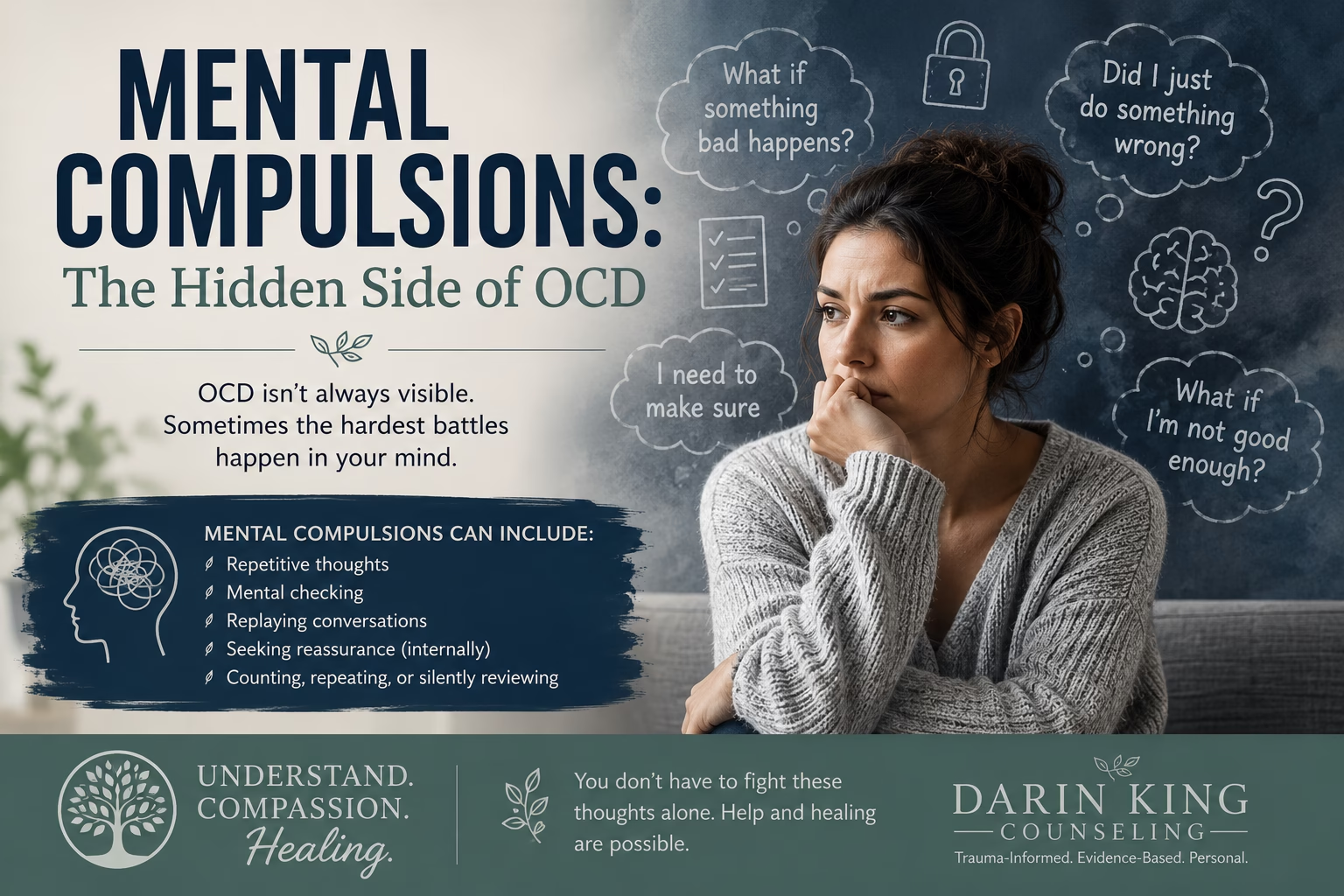
When most people think of OCD, they picture the visible compulsions: handwashing until skin cracks, checking the stove ten times before leaving the house, counting steps, arranging objects with exact precision. These are real and important parts of OCD for many people. But for many others — possibly most — the compulsions happen entirely in the mind, where no one can see them, including the person performing them.
Mental compulsions are one of the most underrecognized aspects of obsessive-compulsive disorder. They are the silent rituals: the checking you do in your head, the mental reviewing, the silent prayers, the internal reassurance-seeking, the cognitive analysis that feels like thinking but is actually a compulsion. People can live for decades with significant OCD entirely in mental compulsions and never realize what they have, because the disorder does not match the picture they have of it.
This article explains what mental compulsions actually are, the most common forms they take, why they often go unrecognized, and what treatment looks like. If you have read about OCD before and thought “that does not sound like me” because you do not do visible rituals, this might be the piece that changes that.
What Mental Compulsions Are
A compulsion in OCD is any deliberate mental or behavioral action performed to reduce the distress caused by an obsession, prevent a feared outcome, or “neutralize” an intrusive thought. The key features: it is intentional, it is repetitive, and it produces temporary relief that reinforces the OCD cycle.
Mental compulsions meet all of these criteria. They just happen invisibly, inside the mind, where no one else can observe them. The person performing them often does not recognize them as compulsions either — they feel like ordinary thinking, problem-solving, or careful reflection.
The Most Common Mental Compulsions
Mental Reviewing or Mental Checking
Replaying past events to confirm something did or did not happen. “Did I lock the door? Let me visualize myself doing it.” “Did I say something offensive at that meeting? Let me replay every interaction.” “Did I respond appropriately to my friend’s text? Let me re-read it in my head.” The brain is essentially performing a check, but mentally.
Mental Rumination
Thinking through an intrusive question or doubt repeatedly in an attempt to resolve it. This is one of the most common mental compulsions and the one that most often gets missed. See our piece on OCD rumination for the full picture of how this compulsion operates.
Silent Counting
Counting silently to a “safe” number, counting actions performed, counting to neutralize a bad thought. Often invisible because it does not involve any external behavior, just internal numerical tracking.
Mental Reassurance-Seeking
Asking yourself reassuring questions and answering them. “Am I a good person? Yes, I am, because I do these things.” “Did I hurt that person? No, because I would remember if I had.” This is reassurance-seeking with yourself as both the asker and the answerer. The same compulsive function as asking others, just internalized.
Silent Praying or Mental Rituals
For people with religious-themed OCD (scrupulosity), silent prayers or mental rituals performed to neutralize feared thoughts. The prayer itself is not the issue — it becomes a compulsion when it is being performed to undo or prevent something rather than as a freely chosen practice.
Thought Replacement
Replacing a “bad” thought with a “good” one to neutralize it. The intrusive thought arrives; you immediately summon a positive thought to cancel it out. This becomes ritualistic and reinforces the idea that the original thought was dangerous.
Mental Comparison
Comparing yourself to a remembered standard to determine whether you are okay. “Am I attracted to my partner? Let me compare how I feel now to how I felt when we first started dating.” “Am I a violent person? Let me compare myself to actual violent people I have read about.”
Mental Argumentation or Self-Debate
Constructing internal arguments for and against a feared possibility, weighing evidence, trying to arrive at the “correct” answer. This feels like rigorous thinking. It is actually a compulsion.
Mental Visualization or Mental Imagery Rituals
Visualizing protective images, replacing intrusive images with safe ones, or mentally constructing scenarios. Often paired with content-specific OCD themes.
Mental Confessing
Mentally rehearsing what you would say to confess something, or mentally confessing to a real or imagined listener. Common in scrupulosity OCD but appears in other themes too.
Why Mental Compulsions Are So Easily Missed
Several reasons people miss their own mental compulsions, sometimes for decades:
They Feel Like Ordinary Thinking
Mental compulsions do not feel different from regular thought. They do not look weird from outside because there is nothing to see. You are just thinking — which is something everyone does. The compulsive quality is invisible until you learn to recognize it.
They Feel Productive
Mental review feels like being thorough. Mental analysis feels like being intelligent. Mental reassurance-seeking feels like checking the facts. The compulsions disguise themselves as cognitive virtues. Smart, conscientious people are especially vulnerable to this misrecognition.
The OCD Picture Most People Have Is Wrong
Cultural representations of OCD focus heavily on visible rituals — washing, checking, arranging. People with mental-only OCD often read about OCD, conclude their experience is different, and never seek the right treatment. They might be diagnosed with generalized anxiety or depression instead, and the underlying OCD goes untreated for years.
Standard Therapists Miss It
Therapists without specific OCD training often miss mental compulsions, especially when the content sounds like ordinary worry. A client describes obsessive rumination about a relationship and the therapist responds by exploring the relationship — which inadvertently reinforces the compulsion. Specialized OCD treatment recognizes the pattern regardless of content.
The Person Doing Them Is Hiding
Many mental compulsions involve content the person finds shameful — taboo intrusive thoughts about sex, violence, religion, identity. People hide these obsessions even from therapists, which means the compulsions performed in response also stay hidden. This is especially common with what is sometimes called Pure-O, or primarily obsessional OCD.
“Pure-O” is a colloquial term for OCD where the compulsions are entirely mental, with no observable behaviors. Despite the name, it is not “purely obsessions” — the person is performing compulsions, just internally. The label is somewhat misleading but it has stuck in OCD communities. If you have heard “Pure-O” described and recognized yourself, you have mental-compulsion OCD.
How Mental Compulsions Maintain OCD
The mechanism is the same as visible compulsions. Each time you perform a compulsion in response to an obsession:
- You get temporary relief from the distress
- Your brain learns that the obsession was important enough to require a response
- The obsession returns more strongly next time
- You perform the compulsion again, more elaborately
- The loop tightens
With visible compulsions, the cost becomes obvious — you are washing your hands for an hour, you are checking the door 30 times. With mental compulsions, the cost is hidden in the form of cognitive exhaustion, lost time, and a mind that cannot rest. Many people with mental-compulsion OCD describe feeling like their brain never stops working, even though from outside they look like they are just sitting quietly.
How Mental Compulsions Differ From Worry, Reflection, and Anxiety
Not all repetitive thinking is OCD. Some distinctions:
Mental Compulsions vs. Worry
Worry is typically about realistic future concerns and feels anticipatory. Mental compulsions are about resolving a doubt or neutralizing a thought that has already arrived. Worry might say “what if I fail this presentation tomorrow.” Mental compulsion-driven thinking says “did I actually want to kill that person who annoyed me, let me figure it out.” Worry is concerning; mental compulsions are stuck.
Mental Compulsions vs. Reflection
Reflection has an endpoint. You think through something, arrive at insight, and move on. Mental compulsions have no endpoint because the doubt is unanswerable in the way OCD demands. You can spend hours in the same mental loop without getting closer to resolution.
Mental Compulsions vs. Trauma Processing
Trauma processing connects to nervous system activation and the body. Mental compulsions are more cognitive and abstract. Trauma processing benefits from somatic and trauma-informed work; mental compulsions benefit from ERP. The treatments differ, so the distinction matters.
Mental Compulsions vs. Depressive Rumination
Depressive rumination is retrospective and self-critical, focused on past failures and what is wrong with you. Mental compulsions are focused on resolving a specific doubt or question, not on self-criticism per se. Both can coexist.
How to Recognize Your Own Mental Compulsions
Some practical signs that what you are doing in your head is a compulsion, not ordinary thinking:
- You return to the same content repeatedly, often many times a day
- The thinking is triggered by anxiety or discomfort rather than chosen freely
- You feel temporary relief when you arrive at a “satisfactory” answer, then doubt returns
- The doubt is unanswerable in the way you are trying to answer it
- You find yourself doing this thinking even when you are trying to do something else
- The content often involves something that feels deeply wrong about you or contrary to your values
- You hide the content from others because it feels shameful
- You have tried to “just stop thinking about it” and it does not work
- The thinking takes more time and energy than the situation warrants
If several of these resonate, mental compulsions are likely operating. The good news: once you can see them, you can work with them differently.
Treatment for Mental Compulsions
Exposure and Response Prevention (ERP)
ERP is the most evidence-based treatment for OCD, including the mental-compulsion forms. For mental compulsions specifically, ERP involves intentionally allowing the obsession to be present without performing the mental response. This is uncomfortable — the whole point of the compulsion was to manage the discomfort, and you are now sitting with it. The discomfort decreases over time with consistent practice. ERP for mental compulsions can be done effectively when guided by an OCD-trained therapist.
Acceptance and Commitment Therapy (ACT)
ACT-flavored ERP often works particularly well for mental compulsions because it explicitly addresses the relationship to thoughts rather than their content. The core skill: noticing the intrusive thought, allowing it to be present, and continuing to act on your values without resolving the thought.
Inference-Based CBT (I-CBT)
I-CBT addresses the reasoning errors that drive OCD doubt. For people whose mental compulsions revolve around obsessive uncertainty, I-CBT can be a useful addition to or alternative for ERP.
Nervous System Work as Adjunct
Many people doing ERP for mental compulsions find that the work goes faster when they also address baseline nervous system activation. Resetting the nervous system creates more capacity to sit with the discomfort that ERP requires. Our approach to OCD often integrates these alongside evidence-based ERP.
Medication When Indicated
SSRIs (a class of antidepressants) are FDA-approved for OCD and produce significant symptom reduction for many people. They can make the work of ERP more accessible by reducing baseline anxiety. A prescriber can help clarify whether this fits your situation.
What Does Not Work for Mental Compulsions
- Thought-stopping. Telling yourself to stop thinking about something backfires. The harder you try not to think about it, the more present it becomes.
- Trying to figure it out. Mental compulsions feel like figuring things out. They are not. They are the compulsion itself. More analysis deepens the loop.
- Talk therapy without OCD training. Standard supportive therapy that explores the content of mental compulsions can inadvertently reinforce them. OCD-trained therapists work with the process, not the content.
- Reassurance from others. If you have noticed yourself asking partners, friends, or Google to confirm you are not the bad thing the OCD says you are, you are performing an external version of the mental compulsion. This produces the same loop maintenance.
When to Seek Specialized Help
Mental compulsions are highly treatable but require specialized work. Consider seeking specifically OCD-trained therapy if:
- You recognize yourself in these patterns and have not had specific OCD treatment
- You have been in therapy for anxiety or depression without significant improvement
- You have intrusive thoughts that feel deeply wrong about who you are
- You spend significant mental energy trying to resolve doubts that never resolve
- You feel exhausted from your own mind
- You hide what is happening inside your head from people who know you
- You have been told you have “Pure-O” or primarily obsessional OCD
Specialized OCD therapy works. People who have spent years lost in mental compulsions often experience substantial change within a few months of correct treatment.
Frequently Asked Questions
What are mental compulsions in OCD?
Mental compulsions are deliberate mental actions performed to reduce the distress caused by an intrusive thought or to neutralize a feared outcome. They include mental reviewing, silent counting, mental reassurance-seeking, rumination, mental imagery rituals, and silent prayer or mental confessing. They look like ordinary thinking from outside, which is why they are often missed by both the person doing them and by therapists who are not OCD-trained.
What is the difference between mental compulsions and overthinking?
Overthinking is general repetitive thought without a specific compulsive function. Mental compulsions are performed specifically in response to an intrusive thought or obsession, with the goal of reducing distress or preventing a feared outcome. The function is the distinguishing feature. Mental compulsions also produce temporary relief that reinforces the OCD cycle, while general overthinking does not have this structure.
Can you have OCD with only mental compulsions?
Yes. This is sometimes called Pure-O or primarily obsessional OCD. The compulsions are entirely mental rather than behavioral. Despite having no visible rituals, the person is still performing compulsions — just internally. Mental-compulsion-only OCD is fully recognized and treated as OCD, with the same effective treatments as other forms (ERP, ACT, sometimes medication).
How do you stop doing mental compulsions?
The evidence-based treatment is Exposure and Response Prevention (ERP), which involves intentionally allowing the intrusive thought to be present without performing the mental response. This is uncomfortable but produces lasting change over weeks to months. Working with an OCD-trained therapist matters because mental-compulsion ERP requires specific guidance — generic talk therapy can inadvertently reinforce the pattern.
Why don’t therapists recognize mental compulsions?
Because they look like ordinary thinking from outside, and many therapists are not trained specifically in OCD. The cultural picture of OCD focuses on visible rituals, so therapists who have not had OCD-specific training often miss mental-compulsion forms. They may diagnose generalized anxiety or depression instead. OCD-specialized treatment recognizes the pattern regardless of whether the compulsions are visible.
Does insurance cover OCD treatment?
Yes. Treatment for obsessive-compulsive disorder, including ERP-based therapy, is covered under behavioral health benefits with most major insurance plans. We accept Highmark, UPMC, Aetna, United Healthcare/Optum, and Cigna/Evernorth. Self-pay sessions are $150. Sliding scale options are available.
Invisible doesn’t mean untreatable. Specialized therapy works.
At Darin King Counseling, we offer ERP and trauma-informed approaches for OCD, including the mental compulsions often missed in standard therapy. Telehealth statewide across Pennsylvania.
See more from Darin King Counseling on Google