
If you grew up in a family where something was off — even something you couldn’t name at the time — and you’re now an adult who feels like you’re working harder than other people just to function, this article is for you.
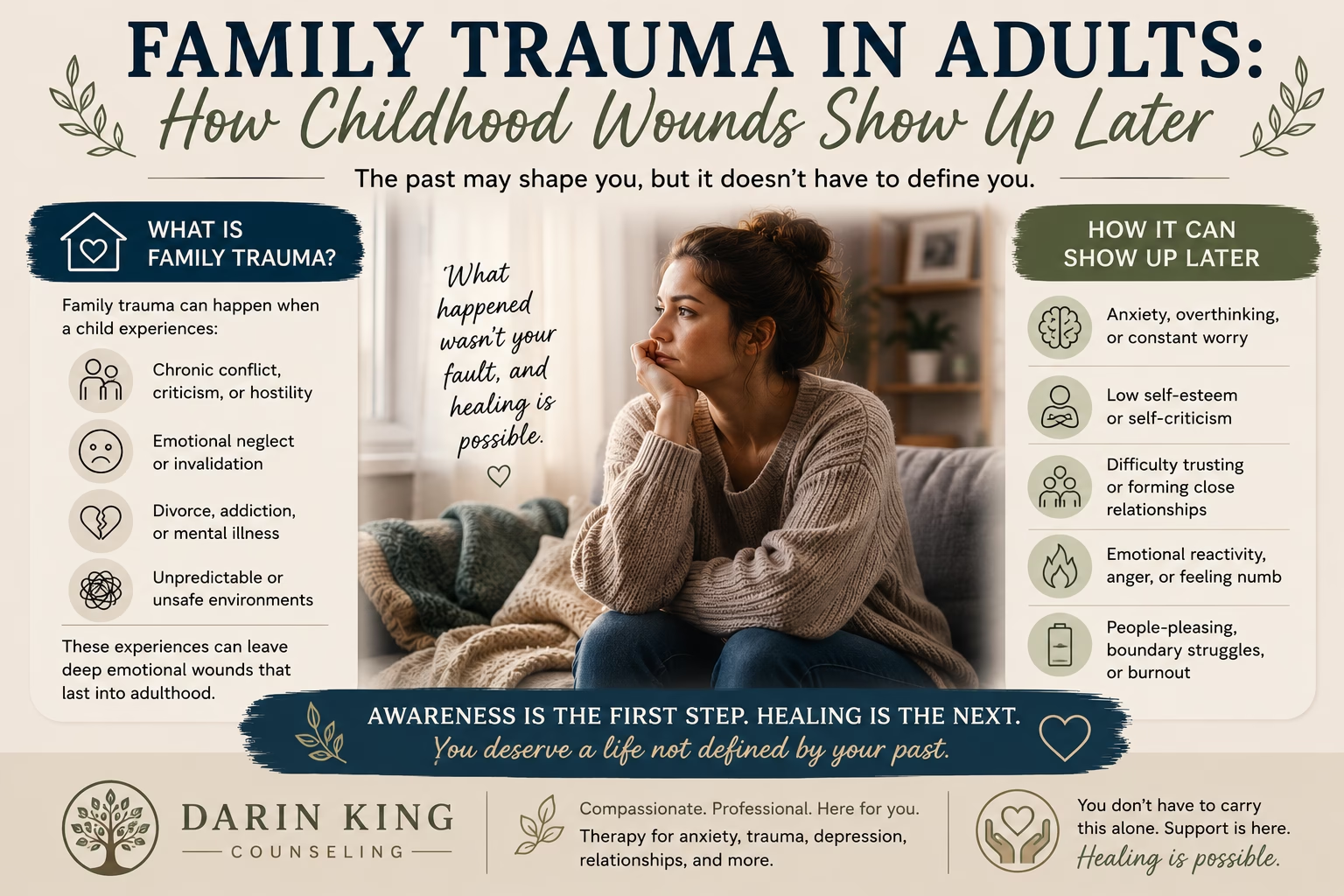
The phrase “family trauma in adults” gets used loosely online, but in clinical practice it points to something specific: the lasting impact on adult life of having grown up in a family environment that was neglectful, abusive, chaotic, emotionally unsafe, or characterized by patterns that overwhelmed your capacity to process them as a child. The trauma happened then. The effects are now.
The good news is that family trauma is genuinely treatable. The work is real and sometimes uncomfortable, but the patterns can shift. People who grew up with significant family trauma can and do go on to build full, connected, regulated adult lives. We see it happen in our practice every week.
What Counts as Family Trauma
One of the most common things we hear from clients is some version of “but I don’t think what happened to me was bad enough to be called trauma.” The bar for family trauma is often much lower than people assume. It includes obvious forms, but it also includes a lot of experiences that get minimized — by the people who lived them and by the culture around them.
Forms of family trauma we work with regularly include:
- Physical abuse — hitting, shaking, restraining, or other physical harm, including discipline that crossed into violence
- Sexual abuse — by family members, household members, or others enabled by family dynamics
- Emotional abuse — verbal cruelty, manipulation, contempt, withholding, threatening, or systematic undermining
- Neglect — physical, emotional, educational, or supervisory needs going chronically unmet
- Witnessing domestic violence — between parents, between parents and other children, or in extended family
- Parental addiction or untreated mental illness — particularly when it shaped the household atmosphere or led to instability
- Parentification — being made responsible for adult emotions, decisions, or care of siblings when you were a child yourself
- Chronic chaos or unpredictability — moving frequently, financial crises, custody battles, household instability that meant you could never quite settle
- Enmeshment or lack of privacy — boundaries between family members so blurred that having a separate self felt unsafe or impossible
- High-control religious or ideological environments — where dissent, questioning, or autonomy were punished
This list isn’t exhaustive. What matters clinically is whether the family environment overwhelmed your capacity, as a child, to process and integrate the experiences happening to you. When that capacity gets overwhelmed, the experiences get stored in ways that continue to affect adult functioning.
How Family Trauma Shows Up in Adult Life
This is where most clients have their “oh” moment in early sessions — when they start recognizing that things they assumed were just personality traits or character flaws are actually adaptations to a childhood environment that asked too much of them. Common ways family trauma shows up in adults:
Chronic Anxiety and Hypervigilance
If you grew up in a family where you had to constantly monitor the emotional weather to stay safe, your nervous system learned to scan for threat at all times. As an adult, this looks like generalized anxiety, difficulty relaxing, exhaustion from being “on” constantly, and an inability to trust that things are okay even when nothing is wrong. Working with a trauma-informed counselor in Pittsburgh can help you understand where the vigilance came from and start building different patterns over time.
Relationship Patterns That Repeat
You keep ending up with partners who mirror something familiar from family of origin — even when you actively don’t want to. You’re drawn to people who treat you the way you were treated, or you find yourself recreating relational dynamics that you said you’d never repeat. This isn’t a character flaw. It’s the brain’s tendency to seek out the familiar, even when familiar isn’t safe.
People-Pleasing and Difficulty Saying No
If your survival as a child depended on managing other people’s emotions or never inconveniencing them, you may have developed what’s called the fawn response — an automatic accommodation pattern that overrides your own needs. As an adult, you say yes when you mean no, take on too much, struggle to identify what you actually want, and feel exhausted by relationships that should feel restorative.
Harsh Inner Critic and Persistent Shame
The voice in your head that tells you you’re not enough, that you’re somehow defective, that you have to earn your place — that voice often originated as the voice of a critical parent or family member, internalized so completely that you can no longer tell where they ended and you began.
Difficulty Identifying or Trusting Your Own Feelings
If your feelings were dismissed, mocked, or treated as inconvenient by the adults around you, you may have learned to override your own emotional experience early. As an adult, you find it hard to know what you’re feeling, struggle to trust your own perceptions, or describe yourself as “out of touch” with emotions.
Dissociation and Disconnection
Some adults from traumatic families describe long stretches of time they don’t remember, or a sense of watching their life from a distance, or going through the motions without feeling present. This is often connected to dorsal vagal shutdown or functional freeze — the nervous system’s protective response to environments that were too much to fully take in.
Family-of-Origin Contact That Activates You
Adult contact with family members — especially around holidays, family events, or moments of stress — triggers reactions that feel disproportionate to what’s actually happening in the conversation. You leave family interactions exhausted, dysregulated, or strangely depressed for days. The body is responding to history, not just the current moment.
Difficulty With Self-Care and Boundaries
If your needs weren’t met or weren’t allowed to be expressed in childhood, you may struggle as an adult to even identify your needs, let alone advocate for them. Self-care feels selfish. Saying no feels dangerous. Rest feels lazy. The wiring that says “your needs matter” never got laid down.
Why Family Trauma Is Particularly Difficult
Family trauma is harder to address than many other forms of trauma for a few specific reasons that are worth naming:
The people who hurt you were also the people who were supposed to care for you. The wiring for attachment and the wiring for survival get tangled together. Your nervous system learned to seek out the people who were unsafe because they were also your source of food, shelter, and connection. This makes adult relationships complicated.
The trauma happened during developmental years. Your sense of self, your understanding of how the world works, your capacity for relationships — all of these were forming while the trauma was happening. The patterns aren’t add-ons. They’re built into the foundation.
The family system often reinforces the trauma into adulthood. Many adult survivors are still in contact with family members who treat them the way they always did. Holidays, family events, parental aging, sibling relationships — these continue to activate the same patterns.
The culture often dismisses what happened. “But they did the best they could.” “It was a different time.” “At least they didn’t…” These messages can leave adult survivors questioning whether their experience even counts as trauma — which keeps them from seeking help.
The patterns are often invisible to outsiders. Many traumatic families look completely normal from the outside. The harm happened in private. There may be no photos of bruises, no records of incidents, no external validation that anything was wrong. This isolation is part of what made it traumatic.
If you’re reading this and second-guessing whether your experience qualifies as family trauma, that doubt itself is often a symptom of what you went through. People who grew up in genuinely healthy families don’t typically wonder if their childhood was traumatic. The very fact that you’re asking the question is meaningful information.
How Family Trauma Differs From Single-Incident Trauma
Single-incident trauma — a car accident, a one-time assault, a natural disaster — typically responds well to focused trauma treatment in a relatively defined timeframe. Family trauma, particularly when it was prolonged or involved attachment relationships, tends to require longer and more complex work. This is sometimes called Complex PTSD or CPTSD.
The differences include:
- Identity effects. CPTSD typically involves disturbances in how you see yourself, not just in how you respond to triggers. Persistent shame, distorted self-image, and difficulty with self-worth are common.
- Relational effects. CPTSD significantly affects relationships — both how you choose them and how you function within them. Attachment patterns laid down in childhood replay in adult partnerships, friendships, and even therapy relationships.
- Affect regulation difficulties. Trouble managing intense emotions, persistent low mood, dissociation, and difficulty returning to baseline after activation are more pronounced.
- Meaning and worldview disruptions. CPTSD often involves persistent beliefs that the world is unsafe, people can’t be trusted, and you’re fundamentally alone — beliefs that started as accurate descriptions of childhood and now operate as default assumptions about adult life.
None of this means recovery isn’t possible. It means the work is typically longer, more relational, and requires therapists trained specifically in complex trauma.
What Healing Family Trauma Actually Looks Like
Real recovery from family trauma is possible, and it doesn’t require either confronting the people who hurt you or pretending nothing happened. Treatment typically involves several interconnected layers of work:
Building Nervous System Regulation
Most family trauma survivors have nervous systems that have been chronically dysregulated since childhood. Before deeper trauma processing can happen safely, the foundation has to be there — the ability to recognize when you’re activated, the skills to return to baseline, and the resources to tolerate intensity without flooding. Resetting the nervous system is often the first piece of substantive work.
Processing Specific Traumatic Memories
Once stability is established, focused work on specific traumatic experiences can begin. Modalities like EMDR allow processing without requiring you to verbally recount every detail. The goal isn’t to erase what happened but to help your brain finish the work of integrating it, so the memories stop hijacking your nervous system in the present.
Addressing the Patterns That Followed
The adaptations you made as a child — fawning, people-pleasing, hypervigilance, perfectionism, dissociation — often need to be worked with directly as adult patterns, not just as historical artifacts. Approaches like Internal Family Systems (IFS) help you understand the protective parts of yourself that developed in response to the trauma, and work with them rather than against them.
Renegotiating Current Family Relationships
This often surprises clients. Treatment doesn’t require cutting contact with your family, though some adult survivors choose to. The work is more about figuring out what kind of contact is sustainable for you, what limits and boundaries make sense, how to manage activation during contact, and how to grieve what your family wasn’t able to give you while still navigating who they actually are now.
Building New Relational Patterns
Healing happens in relationship as much as it happens individually. The therapy relationship itself becomes a place where you practice trust, vulnerability, and being known. Over time, the new patterns generalize to friendships, romantic relationships, and chosen family — but the therapy relationship is often where they start.
When to Seek Help
You don’t need to have all the answers about what counts as trauma or what specifically happened to you to start therapy. Some signs that working with a trauma-informed clinician might help:
- You’re noticing patterns in your adult life that you can trace back to your family of origin — even if you can’t fully articulate the connection
- Specific events, holidays, or interactions with family activate reactions that feel disproportionate
- You’re stuck in relationship patterns that keep recurring despite your best efforts to change them
- You experience persistent anxiety, depression, or dysregulation that hasn’t responded well to other approaches
- You’re working through other life challenges and want a therapist who understands that the present moment is often shaped by historical context
- You’re considering parenthood and want to work on patterns before they get passed on
Therapy for family trauma isn’t a quick process — but it’s a real one. The patterns can shift. The wiring can update. The life you build going forward can be more yours than what you inherited.
Frequently Asked Questions
How do I know if what I went through counts as family trauma?
If you grew up in a family environment that overwhelmed your capacity, as a child, to process what was happening — and you’re noticing patterns in your adult life that trace back to that environment — your experience likely counts clinically. The question isn’t whether what happened was “bad enough” by some external standard. The question is whether it overwhelmed you at the time and whether the effects are showing up now. People who grew up in genuinely healthy families don’t typically wonder whether their childhood was traumatic. The fact that you’re asking is itself meaningful information.
Can I heal from family trauma without cutting off my family?
Yes. Treatment for family trauma doesn’t require you to end relationships with family members, though some adult survivors choose to. The more common work is figuring out what kind of contact is sustainable for you, what limits make sense, how to manage the activation that contact often produces, and how to navigate ongoing relationships while still doing your own healing. We help you find what works for you — there’s no single right answer.
How long does therapy for family trauma typically take?
It varies significantly based on the type and duration of the trauma, your current life stability, and your specific goals. Some clients see meaningful change within 12-20 sessions. Complex family trauma involving prolonged abuse, attachment wounds, or multiple types of harm typically requires longer-term work — often 12-24 months or more. Most clients notice measurable shifts within the first 8-12 sessions even when the full work continues. We’ll have a clearer sense after initial assessment.
What if I don’t remember everything that happened?
Many adult survivors have fragmented or partial memories of childhood, and treatment doesn’t require complete recall to be effective. The body, nervous system, and implicit memory hold the impact of what happened regardless of explicit recall. Approaches like EMDR, somatic work, and Internal Family Systems can work with what’s present clinically without forcing memory recovery. We work with what shows up, not with what we think should be there.
Is family trauma the same as CPTSD?
Family trauma can lead to Complex PTSD (CPTSD), particularly when it was prolonged, occurred during developmental years, and involved attachment relationships. CPTSD is a clinical presentation that includes the standard PTSD symptoms plus disturbances in self-concept, affect regulation, and relationships. Not everyone who experienced family trauma develops CPTSD, but the patterns overlap significantly. A trauma-informed assessment can clarify what specifically fits your experience.
Does insurance cover therapy for family trauma?
Yes. Treatment for trauma, PTSD, CPTSD, anxiety, depression, and adjustment disorders related to family-of-origin issues is covered under behavioral health benefits with most major insurance plans. We accept Highmark, UPMC, Aetna, United Healthcare/Optum, and Cigna/Evernorth. Self-pay sessions are $150. Sliding scale options are available for those who qualify. We verify your specific coverage before your first session.
Healing what your family couldn’t give you is real work — and it’s possible.
Darin King, LPC works with adults navigating family trauma, intergenerational patterns, and the work of becoming who they would have been without the wounds. Telehealth statewide across Pennsylvania.
See more from Darin King Counseling on Google