

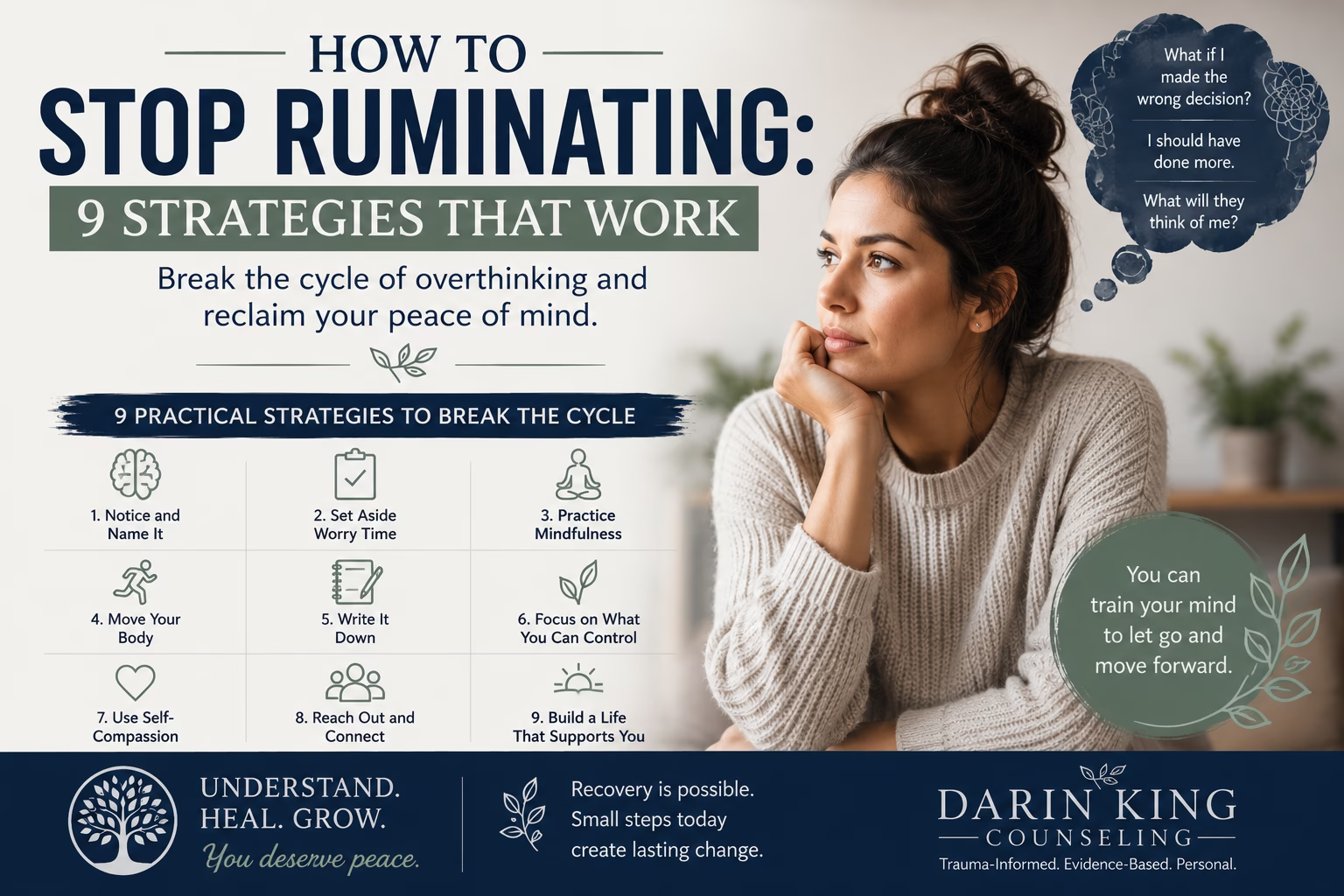
If you are searching for “how to stop ruminating,” your brain is probably running in a loop right now. Maybe a conversation from yesterday that you keep replaying. Maybe a worry about something that has not happened. Maybe a question about yourself that you cannot seem to settle. You know it is not productive. You know you should stop. You cannot.
The cruelest part of rumination is that the strategies you are probably using to try to stop it are the ones keeping it alive. The thinking that feels like progress — figuring it out, reviewing it carefully, working through the logic — is the compulsion that maintains the loop. Stopping rumination requires doing something counterintuitive enough that most people never figure it out on their own, even very smart people, especially very smart people.
This article walks through what rumination actually is, why standard advice fails, and the 9 strategies that genuinely work. Some of them will feel wrong at first. That is part of how you know they are real.
What Rumination Actually Is
Rumination is repetitive, intrusive, often unwelcome thinking about the same content. It can be retrospective (replaying past events, dwelling on what was said or done) or anticipatory (running future scenarios, worrying about what might happen). It can be focused on yourself (what is wrong with me, did I mess that up) or on others (what did they really mean, what are they thinking).
What unites all rumination: it does not resolve. You can spend an hour thinking, two hours, six hours. The content does not get clearer. The question does not get answered. The discomfort does not ease. And yet you keep thinking because some part of your mind believes that the next round will produce the resolution.
Several distinct mental health conditions produce rumination, and the treatment varies by type:
- OCD rumination involves intrusive thoughts the person tries to mentally resolve through review and analysis. See our piece on OCD rumination and on mental compulsions more broadly.
- Depressive rumination involves retrospective dwelling on what is wrong with oneself, past mistakes, and regrets. It tracks with depression severity.
- Anxiety rumination involves anticipatory worry, scanning for threats, running scenarios.
- Trauma-related rumination involves replaying or analyzing past experience as the mind tries to process it.
The strategies below help across types, but for severe or persistent rumination, identifying the underlying driver matters because the targeted treatment is different.
Why Standard Advice About Stopping Rumination Fails
Most internet advice about stopping rumination is either useless or actively harmful. Some of the most common bad advice:
“Just stop thinking about it”
Try not to think about a polar bear. Now you are thinking about a polar bear. The brain cannot deliberately stop thinking about something — attempting to suppress a thought makes it more present. This is one of the most well-documented findings in cognitive psychology and yet remains the most common advice.
“Think positive thoughts”
Forcing positive thoughts on top of intrusive ones produces internal conflict and does not address the underlying mechanism. Sometimes it works briefly. More often it adds shame about why you cannot just be positive.
“Figure out what the rumination is telling you”
This sounds therapeutic and is occasionally useful, but mostly it deepens the loop. Inviting your brain to analyze the rumination is more rumination. The “insight” you arrive at typically lasts about ten minutes before the loop restarts.
“Distract yourself”
Distraction can buy short-term relief but does not change the underlying pattern. The loop returns the moment the distraction ends. Some people end up dependent on constant stimulation (phones, TV, scrolling) just to avoid their own minds, which produces its own problems.
“Talk it out”
Talking through worries with someone trusted is sometimes helpful. But repeatedly talking about the same content can function like external rumination — you are doing the loop out loud. If the conversation does not produce a clear resolution and you return to the same topic next week, talking is not helping.
The 9 Strategies That Actually Work
1. Name What You Are Doing
The first move is simply identifying when rumination is happening. Most people in the loop are unaware they are in it — they think they are thinking productively. Naming the activity creates the first crack: “I notice I am ruminating right now.” This is not the solution but it is the precondition for everything that follows. You cannot work with a pattern you do not see.
Specific markers that what you are doing is rumination: you have been on the same content for more than 10 minutes; you have arrived at the same “conclusion” multiple times today; the content is not approaching resolution; you feel worse, not better, the longer you think.
2. Step Out of the Frame Instead of Pushing Against It
When you notice rumination, do not try to argue with it or stop it. Both engagements maintain the loop. Instead, recognize: “My brain is doing the thing again. It does not need me to participate.” Then turn your attention to something physical — your feet on the floor, the temperature of the air, a sound in the room. Not to distract, but to leave the cognitive loop entirely.
This is a skill, not a one-time event. You will return to the rumination. You step out again. Over weeks, the loop weakens because you are no longer feeding it.
3. Drop From the Head Into the Body
Rumination is a head-based activity. The body has very little to do with it. Bringing attention to bodily sensation interrupts the cognitive loop because attention cannot fully be in both places at once.
Specific techniques: scan the body slowly from feet to head, noticing temperature and texture without judgment. Place a hand on your chest or stomach and feel the breath moving. Press your feet firmly into the floor. Five minutes of this is often more effective than five hours of thinking. The technique works best when practiced regularly, not only during acute rumination.
4. Use Slow Exhalation to Down-Regulate
Rumination usually rides on sympathetic nervous system activation — the body is mildly mobilized, even if you are sitting still. Down-regulating the body interrupts the cognitive pattern.
The simplest version: inhale through the nose for 4 counts, exhale through pursed lips or nose for 6-8 counts. Repeat for 3-5 minutes. Longer exhales activate the parasympathetic system through the vagus nerve. This is one of the few techniques with consistent research support. For more on the broader practice, see how to reset your nervous system.
5. Schedule Worry Time (Counterintuitive but Effective)
Set aside a specific time each day — say 15-20 minutes — where you allow yourself to ruminate. Outside that window, when rumination arises, you tell yourself “I will think about this during worry time,” and then redirect.
Two things happen. First, you stop the constant low-grade rumination because you have a designated container for it. Second, when worry time arrives, you often find you do not want to think about it as much as the loop suggested. The container takes power away from the pattern. Research on this technique (sometimes called “stimulus control” for worry) shows substantial benefits for chronic ruminators.
6. Move Your Body
Walking, especially walking outside, is one of the most consistently effective rumination interrupters. The physical movement, the sensory input, the rhythmic activity all interrupt the loop. Twenty minutes is enough; thirty is better. This is not metaphorical “movement helps mental health” advice — there is robust research on movement specifically reducing rumination.
If walking is not accessible, any rhythmic physical activity works: stretching, gentle yoga, household tasks done mindfully, dancing in your living room. The activity matters less than the movement.
7. Write It Down Once, Then Stop
If a thought keeps returning because it feels important, write it down. One time. Briefly. The writing acts as an external file — your brain no longer has to hold the thought because there is a record. After writing, you do not engage further. The point is not to journal extensively about the content; the point is to give the looping thought a place to live outside your head.
This works because much of rumination is the brain refusing to drop something it considers unresolved. Externalizing it satisfies that function without continued mental work.
8. Address the Underlying Driver
If your rumination is severe, persistent, or themed around taboo content (intrusive thoughts about harm, sexuality, identity, morality), the underlying driver is likely OCD. Generic anti-rumination techniques will help less than specialized OCD treatment. The same is true if the rumination is driven by depression (where treatment of the depression reduces the rumination) or trauma (where trauma-informed work addresses the underlying nervous system pattern).
Identifying the driver shapes treatment. Many people work on rumination for years using surface techniques without ever addressing what is actually generating it. Specialized assessment is often the difference between managing rumination and resolving it.
9. Stop Performing the Compulsions (For OCD-Type Rumination)
If your rumination is the OCD type — characterized by intrusive thoughts you mentally analyze in an attempt to resolve — the most powerful intervention is Exposure and Response Prevention (ERP). You intentionally allow the intrusive thought to be present without performing the mental analysis. This is uncomfortable. It produces lasting change.
ERP for mental rumination is best done with an OCD-trained therapist who can guide the process. Trying to do it alone is possible but harder. See our piece on mental compulsions for the underlying mechanism.
Most people try to stop ruminating by thinking differently or more. Stopping rumination actually requires thinking less — disengaging from the loop rather than trying to resolve it. This is profoundly counterintuitive, which is why generic advice rarely works and why specialized help often does.
What If You Cannot Stop on Your Own
Some rumination is mild enough that self-led strategies work. Some is severe enough that they do not. Signs that working with a therapist would help:
- Rumination is consuming hours of your day
- You have tried multiple self-help strategies without lasting change
- The content is themed around intrusive thoughts that feel deeply wrong about you
- The rumination is paired with significant anxiety or depression
- It is affecting sleep, relationships, or work
- You feel exhausted by your own mind
- There may be trauma history that has not been addressed
Specialized therapy works. Most people who get correct treatment for chronic rumination notice substantial change within a few months. The right therapy depends on what is driving the rumination — OCD-focused ERP, trauma work, depression treatment, or some combination. Initial assessment clarifies which approach fits.
What Recovery Actually Looks Like
People often imagine recovery from rumination means never having a repetitive thought again. That is not what recovery is. Everyone has occasional mental loops. What changes:
- You notice the loop sooner
- You step out of it faster
- The content has less grip when it does arrive
- You spend dramatically less total time in rumination
- You stop performing the compulsions that maintained it
- Your mind has space for things other than the same content
- You are not exhausted by your own brain
This is achievable. It is real. People do this.
Frequently Asked Questions
How do I stop ruminating?
The most effective strategies are: noticing when rumination is happening, stepping out of the cognitive loop rather than trying to resolve it, bringing attention to the body, using slow exhalation breathing, scheduling worry time as a container, physical movement, writing the thought down once and stopping, and addressing the underlying driver (OCD, depression, trauma) when self-led strategies are not enough. The key insight is that rumination requires disengaging from the loop, not thinking more.
Why can I not stop ruminating no matter what I do?
Because the strategies that feel productive — figuring it out, analyzing, resolving — are actually compulsions that maintain the loop. The harder you try to think your way out of rumination, the more entrenched it becomes. This is especially true when the underlying driver is OCD, where the mental analysis is itself the compulsion. Specialized treatment recognizes this and works differently than generic anti-rumination advice.
Is rumination a sign of OCD?
It can be. OCD rumination involves intrusive thoughts that the person tries to mentally resolve through review, analysis, or reassurance-seeking. It is one of the most common but least recognized forms of OCD. Rumination can also come from depression, anxiety, or trauma — the treatment varies by source. If your rumination focuses on taboo content (intrusive thoughts about harm, sexuality, identity) or has a ‘figuring it out’ quality, OCD is likely.
How long does it take to stop ruminating?
Mild rumination often responds to consistent practice with the strategies above within 4 to 8 weeks. Severe rumination, especially OCD-driven, typically requires specialized therapy and produces meaningful change within 3 to 6 months. Full reduction takes longer. The goal is not to never ruminate again but to spend dramatically less time in the loop and to step out of it quickly when it arises.
Should I see a therapist for rumination?
If rumination is consuming hours of your day, affecting sleep or relationships, paired with significant anxiety or depression, or focused on intrusive thoughts that feel deeply wrong about you — yes, professional help would likely be valuable. Specialized treatment (especially for OCD-type rumination) is significantly more effective than self-led work. Initial assessment clarifies what is driving the rumination and what treatment fits.
Does insurance cover therapy for rumination?
Yes. Treatment for the conditions that drive rumination — OCD, anxiety, depression, trauma — is covered under behavioral health benefits with most major insurance plans. We accept Highmark, UPMC, Aetna, United Healthcare/Optum, and Cigna/Evernorth. Self-pay sessions are $150. Sliding scale options are available.
Rumination is treatable. The loop can break.
Darin King, LPC works with rumination, anxiety, and the nervous system patterns underneath them. Telehealth statewide across Pennsylvania.
See more from Darin King Counseling on Google