

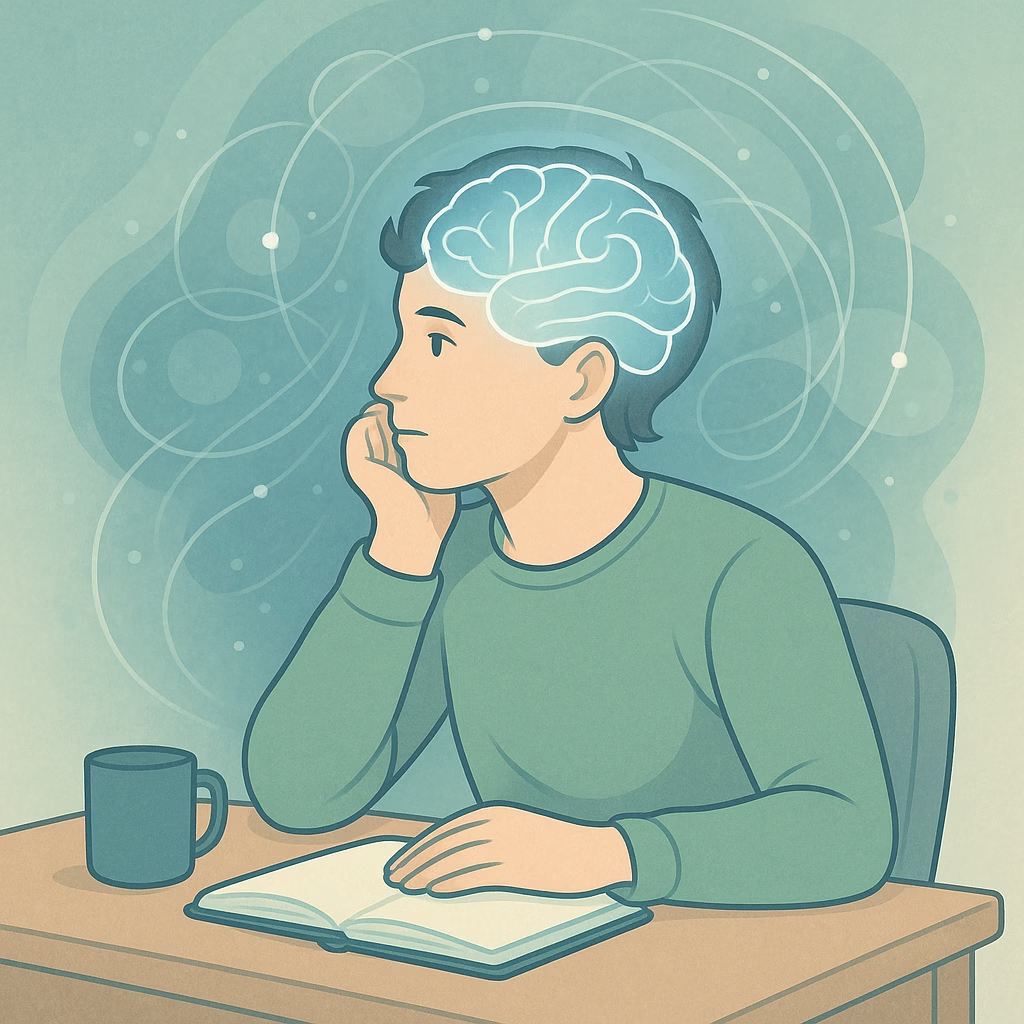
ADHD is one of the most misunderstood conditions in mental health — partly because it doesn’t look like a brain disorder from the outside. From the outside it can look like laziness, carelessness, poor discipline, or immaturity. But the neuroscience of ADHD tells a completely different story. ADHD is a brain-based condition with measurable, documented differences in brain structure, function, and neurochemistry — differences that have nothing to do with effort, intelligence, or character.
Understanding how ADHD affects the brain is not just intellectually interesting — it is practically transformative. It replaces shame with understanding, reframes struggles as neurological differences rather than personal failures, and points directly toward the most effective treatment approaches.
How ADHD Affects the Brain: Key Differences at a Glance
✓ Striatum — reward and motivation
✓ Cerebellum — timing and coordination
✓ Limbic system — emotional regulation
✓ Default mode network — mind-wandering
✓ Norepinephrine — attention and alertness
✓ Reduced availability in key circuits
✓ Affects filtering, focus, and follow-through
✓ Target of most ADHD medications
Feel free to share or embed this infographic with credit to darinkingcounselingllc.com
What Is ADHD? A Brain-Based Overview
Attention Deficit Hyperactivity Disorder (ADHD) is a neurodevelopmental condition characterized by persistent patterns of inattention, hyperactivity, and impulsivity that interfere with functioning and development. The Centers for Disease Control and Prevention estimates that ADHD affects approximately 4.4% of American adults and 9.4% of children — making it one of the most common neurodevelopmental conditions worldwide.
ADHD is not a single symptom or a simple deficit of attention — it is a complex pattern of neurological differences that affects multiple brain systems simultaneously. Understanding which systems are affected, and how, explains why ADHD produces such a diverse range of challenges — and why the same person can hyperfocus intensely on one thing while struggling to sustain attention on another.
Key reframe: ADHD is not a deficit of attention — it is a deficit of regulation of attention. The ADHD brain can pay intense, sustained attention to things that are novel, interesting, or emotionally engaging. The challenge is regulating where that attention goes — particularly in the direction of things that are necessary but not intrinsically stimulating.
How ADHD Affects Specific Brain Regions
The Prefrontal Cortex — Executive Function Central
The prefrontal cortex is the most affected brain region in ADHD. It is responsible for executive functions — the set of higher-order cognitive skills that allow people to plan, prioritize, initiate tasks, sustain effort, regulate impulses, manage time, and shift flexibly between demands. In ADHD, the prefrontal cortex shows reduced activity and delayed development — typically running 2-3 years behind neurotypical peers in maturation.
This explains why ADHD produces challenges with:
- Starting tasks — particularly ones that aren’t immediately rewarding
- Sustaining effort through long or repetitive tasks
- Managing time — the ADHD brain often has poor time perception
- Shifting between tasks — transitions are cognitively costly
- Regulating impulses — the brake on immediate urges is less effective
- Working memory — holding information in mind while using it
The Striatum — Reward and Motivation
The striatum — particularly the nucleus accumbens — plays a central role in reward processing and motivation. In ADHD, the striatum shows reduced dopamine activity, which significantly affects the brain’s ability to anticipate rewards from future outcomes and sustain motivation toward long-term goals.
This is why ADHD is not simply about attention — it is fundamentally about motivation and reward. Tasks that offer immediate, clear reward are approached with ease. Tasks that offer delayed or abstract reward — studying for an exam, completing a report, saving for the future — are neurologically unrewarding in the ADHD brain, making them genuinely difficult to sustain rather than simply a matter of willpower.
The Limbic System — Emotional Regulation
The limbic system — including the amygdala and related structures — is involved in emotional processing and regulation. Many people with ADHD experience significant emotional dysregulation: intense emotional responses, difficulty managing frustration, sensitivity to rejection (Rejection Sensitive Dysphoria), and rapid mood shifts. These are not personality traits — they are neurological features of ADHD that are often undertreated and underrecognized.
The emotional regulation challenges of ADHD interact significantly with trauma and anxiety. Many adults with ADHD also have trauma histories — and the two conditions compound each other in ways that require integrated treatment. Read more about anxiety counseling and trauma counseling.
The Default Mode Network — The Mind-Wandering System
The default mode network (DMN) is a set of brain regions that activates during rest and mind-wandering — when the brain is not focused on an external task. In neurotypical brains, the DMN quiets when focused attention is required. In ADHD, the DMN remains active during tasks — meaning the “mind-wandering” network is competing with the focused attention network rather than standing down. This is the neurological basis of the distractibility characteristic of ADHD.
The Cerebellum — Timing and Coordination
The cerebellum — traditionally associated with motor coordination — also plays a role in timing, rhythm, and the coordination of cognitive processes. ADHD is associated with reduced cerebellar activity, contributing to difficulties with time management, sense of timing, and the coordination of complex sequences of behavior.
The Neurotransmitter Story: Dopamine and Norepinephrine
At the neurochemical level, ADHD involves reduced availability and signaling of two key neurotransmitters:
| Neurotransmitter | Normal Function | Effect of Reduced Availability in ADHD |
|---|---|---|
| Dopamine | Motivation, reward, attention focus, working memory | Difficulty sustaining motivation, reduced reward from delayed outcomes, attention dysregulation |
| Norepinephrine | Alertness, attention, signal-to-noise filtering in prefrontal cortex | Difficulty filtering irrelevant stimuli, poor sustained attention, distractibility |
Both stimulant medications (which increase dopamine and norepinephrine availability) and non-stimulant medications (which target norepinephrine specifically) work by addressing these neurochemical differences — which is why medication can be so effective for many people with ADHD when properly prescribed and monitored.
ADHD, the Brain, and Overstimulation
One of the most direct practical consequences of the ADHD brain’s neurological differences is its vulnerability to overstimulation. Because the prefrontal cortex’s filtering function is less effective, the ADHD brain receives sensory and cognitive input at roughly equal intensity — background noise, visual clutter, and competing demands all arrive simultaneously without the normal automatic filtering. Read more about ADHD and overstimulation in adults and how to calm overstimulation quickly.
ADHD and Trauma: An Important Connection
Many adults with ADHD also carry trauma histories — and the two conditions interact in important ways. Trauma affects many of the same brain regions that ADHD affects, including the prefrontal cortex, amygdala, and stress response systems. This means that trauma can significantly worsen ADHD symptoms — and that ADHD can increase vulnerability to trauma by affecting emotional regulation and impulse control.
Effective treatment for adults with both ADHD and trauma requires addressing both — not just one or the other. Read more about how childhood trauma changes the brain and how it interacts with neurodevelopmental differences like ADHD.
Note: The National Institute of Mental Health recognizes ADHD as a complex neurodevelopmental condition with significant neurological underpinnings. Understanding these neurological differences — rather than attributing ADHD challenges to character or effort — is essential to both self-compassion and effective treatment.
What This Means for Treatment
Understanding how ADHD affects the brain points directly toward the most effective treatment approaches:
- ADHD counseling — builds strategies tailored to the specific neurological profile of the individual. ADHD counseling in Pittsburgh available via telehealth.
- Nervous system regulation — building a more regulated baseline supports prefrontal function. See our guide on nervous system reset techniques.
- Trauma treatment — when trauma is co-occurring, addressing it directly is essential. EMDR therapy addresses both trauma and its amplifying effects on ADHD symptoms.
- Environmental modifications — structuring the environment to reduce the filtering demands on an already-challenged prefrontal cortex
Related reading: Our guides on ADHD and overstimulation in adults, how to calm overstimulation quickly, signs of overstimulation in adults, and the sympathetic and parasympathetic nervous systems complete the ADHD and nervous system picture.
Frequently Asked Questions
How does ADHD affect the brain differently?
ADHD involves measurable differences in the prefrontal cortex (executive function), striatum (reward and motivation), limbic system (emotional regulation), and default mode network. Neurochemically, it involves reduced dopamine and norepinephrine availability. These differences affect attention regulation, impulse control, working memory, motivation, and sensory filtering.
Is ADHD a real brain condition?
Yes — ADHD is a well-documented neurobiological condition with decades of research support. Neuroimaging studies consistently show measurable differences in brain structure and function. These are observable in brain scans and correlate directly with the functional challenges ADHD produces.
Can ADHD get worse with stress or trauma?
Yes — significantly. Both stress and trauma affect many of the same brain systems involved in ADHD, particularly the prefrontal cortex. Chronic stress reduces prefrontal function, directly worsening executive function. Addressing co-occurring trauma through EMDR therapy alongside ADHD counseling is essential for comprehensive treatment.
Why can people with ADHD hyperfocus on some things but not others?
Hyperfocus occurs because the dopamine system responds strongly to novel, interesting, or emotionally engaging activities — providing enough neurological reward to sustain attention. Tasks that are necessary but not intrinsically stimulating don’t activate this system sufficiently. ADHD is better understood as a dysregulation of attention rather than a simple deficit.
Can therapy help with the brain-based challenges of ADHD?
Yes — ADHD counseling builds strategies tailored to your neurological profile. When trauma is also present, EMDR therapy addresses the nervous system dysregulation that compounds ADHD symptoms. Telehealth therapy makes these supports accessible from anywhere in Pennsylvania.
ADHD is not a character flaw — it’s a brain difference. And the right support changes everything.
Darin King, LPC specializes in ADHD, trauma, and nervous system regulation in Pennsylvania. Telehealth available statewide.
See more from Darin King Counseling on Google