

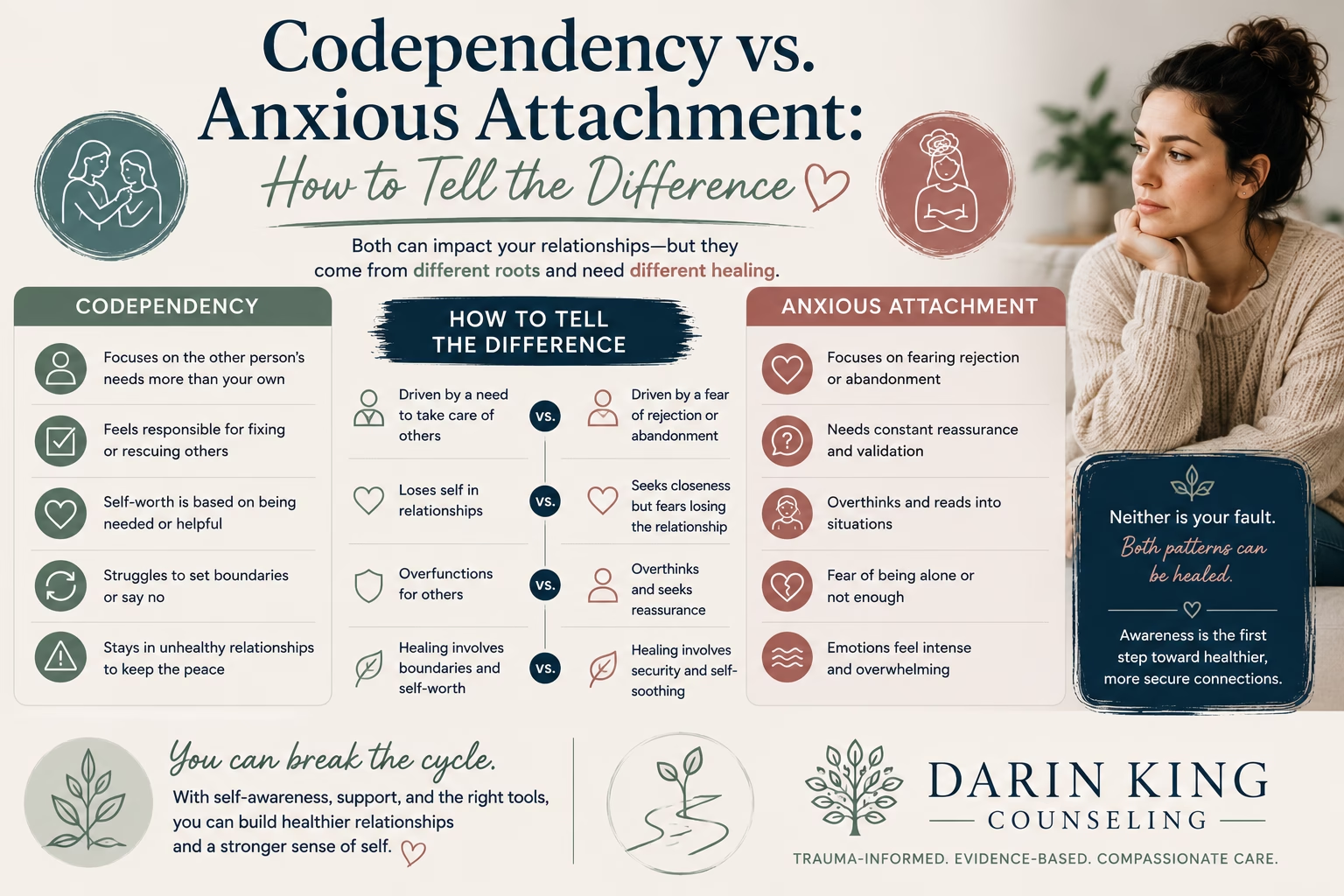
Codependency and anxious attachment look so similar from the outside that even experienced clinicians sometimes use the words interchangeably. They are not the same. They overlap heavily, they often appear together in the same person, and they respond to overlapping therapeutic approaches — but they describe different things, and the distinction matters when you are trying to figure out what is actually happening in your relationships.
In my work with clients, the moment of sorting out which pattern is driving the distress is often clarifying in a way that broad self-help language is not. A person can read articles about both for years and still feel stuck. Naming the actual mechanism — and which one applies in a given relationship — opens a door that vague self-diagnosis closes.
Codependency vs. Anxious Attachment
Overlapping but distinct relational patterns
Anxious Attachment
- Rooted in early caregiver inconsistency
- Core fear: abandonment
- Driven by attachment-system activation
- Hypervigilance to partner’s mood and tone
- Protest behaviors, pursuit, self-silencing
- Can occur in any relationship type
Codependency
- Rooted in family system dysfunction
- Core pattern: identity through caretaking
- Driven by enmeshment and lost self
- Overresponsibility for others’ feelings
- Self-worth tied to being needed
- Often shaped by addiction or chronic illness in family
Where they overlap
- Difficulty with healthy boundaries
- Self-silencing to maintain connection
- Anxiety when others pull away
- Tendency to suppress own needs
- Choosing emotionally unavailable partners
- Both can exist in the same person
Where they differ
- Anxious attachment is reactive; codependency is organized
- Attachment is a nervous-system pattern; codependency is a role
- Anxious attachment fears losing love; codependency fears losing purpose
- Different origins, different therapeutic emphasis
Feel free to share or embed this infographic with credit to darinkingcounselingllc.com
The Short Answer
Anxious attachment is a nervous-system pattern that develops in response to inconsistent caregiving, organized around the fear of losing connection. Codependency is a relational identity that develops in response to family-system dysfunction (often involving addiction, chronic illness, or emotional immaturity), organized around the role of caretaker. The two patterns share a great deal of surface behavior — self-silencing, anxiety about others’ moods, difficulty with healthy boundaries — but they have different origins, different inner experiences, and somewhat different paths to healing.
What Is Anxious Attachment?
Anxious attachment style — sometimes called anxious-preoccupied attachment — is one of the four primary attachment patterns identified in adult attachment research. People with anxious attachment tend to want closeness intensely, fear losing it, and develop unconscious strategies for monitoring and maintaining connection. The pattern develops early, typically in response to a caregiver whose emotional availability was inconsistent — warm sometimes, withdrawn other times — and it carries forward into adult relationships.
The hallmark of anxious attachment is hypervigilance to relational threat. A delayed text, a partner’s distracted dinner, a slight change in tone — any of these can activate the attachment system and produce real physiological distress. The body reads disconnection before the conscious mind names what is happening. For a full picture of the pattern, see our post on anxious attachment style.
The original attachment framework came from John Bowlby and Mary Ainsworth’s work in the 1960s and 70s. Anxious attachment in this framework is a coherent strategy: a child whose caregiver is sometimes available and sometimes not learns to stay alert to availability, work to maintain it, and protest when it slips. The strategy was adaptive in the original environment. In adult relationships, it tends to create the very disconnection it fears.
What Is Codependency?
Codependency is a relational pattern in which a person’s sense of identity, self-worth, and emotional regulation become organized around taking care of someone else — usually someone whose behavior or condition demands a great deal of caretaking. The term originated in the 1970s and 80s in the context of families affected by alcoholism, where the spouse or children of an addicted person often developed a recognizable set of patterns: overresponsibility for the addicted person’s choices, suppression of their own needs, difficulty knowing what they wanted independent of the relationship, and a felt sense that their value depended on being needed.
The concept has since expanded beyond addiction to include any family system where one person’s dysfunction — chronic illness, mental illness, emotional immaturity, narcissism — organizes the relational world around their needs. The codependent person, often a child or partner, develops a self that exists in service of the other.
Common features of codependency include:
- Self-worth tied to being needed or useful to others
- Difficulty identifying or naming one’s own needs and preferences
- Chronic overresponsibility for other people’s feelings and behaviors
- Trouble saying no without intense guilt
- A felt loss of identity when not in a caretaking role
- Pattern of attracting or being attracted to people who require significant caretaking
- Tendency to enable behaviors that ultimately harm the person being cared for
Where the Two Overlap
The reason anxious attachment and codependency get confused is that they produce a great deal of overlapping behavior. Both patterns commonly involve:
- Self-silencing — suppressing your own needs or opinions to maintain connection
- Difficulty with boundaries — saying yes when you mean no, accepting treatment that does not feel okay
- Anxiety about others’ moods — feeling responsible for or destabilized by what other people are feeling
- Choosing unavailable partners — being drawn to people who cannot fully show up
- Difficulty self-soothing — needing the other person’s regulation to feel okay
- Pattern of overgiving — extending energy and care that is not reciprocated
Both patterns also commonly co-occur with people-pleasing behaviors and the fawn trauma response. They tend to appear in the same kinds of childhood environments, and they often exist together in the same person. This is part of why the language gets blurred — in practice, you frequently see both, and it can be hard to tell what is driving what.
Where the Two Differ
The distinction matters because the underlying mechanism is different, which means the work of changing the pattern emphasizes different things.
Origin
Anxious attachment develops from inconsistent caregiving — a caregiver who was sometimes warm and sometimes withdrawn, leaving the child uncertain about whether closeness would be available. Codependency develops from dysfunctional family systems — most often involving addiction, chronic illness, mental illness, or severe emotional immaturity that requires the child to caretake an adult.
The two can overlap in the original family environment (a parent with addiction is often also inconsistent), which is part of why the patterns co-occur in adulthood. But they describe different aspects of the early environment.
Core fear or organizing principle
Anxious attachment is organized around the fear of abandonment. The nervous system is tracking: is the connection still here? Codependency is organized around the role of caretaker. The identity is structured: I exist to take care of others. Strip the caretaking role away from a codependent person and they often feel lost in a way that goes beyond loneliness. Strip secure connection away from an anxiously attached person and they feel abandoned — but they still know who they are.
Inner experience
Anxious attachment is largely reactive — the pattern activates strongly in moments of perceived threat to connection and quiets when reassurance is available. Codependency is more chronic and organized — it shows up across relationships, not just romantic ones, and operates even when no immediate threat is present. A codependent person at work is often still overresponsible, still self-silencing, still oriented around others’ needs. The pattern is the default mode.
What changes with healing
Healing anxious attachment focuses primarily on the nervous system — building tolerance for relational space, learning to self-soothe, updating internal models about whether love is conditional. Healing codependency focuses primarily on identity — reclaiming a self that exists independently of caretaking, learning what you want when no one is asking, and tolerating the discomfort of not being needed in the old ways.
Both involve attachment-informed work, both involve nervous-system regulation, both involve learning to express needs directly. The emphasis differs.
How They Show Up Together
In clinical practice, the two patterns commonly co-occur. A typical presentation: a person grew up with a parent who had untreated mental illness or addiction. That parent’s emotional availability was inconsistent (producing anxious attachment) and the child took on a caretaking role within the family (producing codependency). The two patterns developed in tandem and reinforced each other.
In adulthood, this person may:
- Become anxiously activated when a partner pulls back, scanning for signs of withdrawal
- Respond to that anxiety by intensifying caretaking, hoping it will restore connection
- Choose partners whose distress invites caretaking, ensuring the role stays available
- Feel deeply unseen when their own needs surface, because they have no template for being on the receiving end
- Burn out, then feel guilty about burning out, then re-double the caretaking
When both patterns are present, healing usually requires addressing both. Working on the attachment piece without the codependency piece can produce someone who is less reactive to perceived withdrawal but still organized around caretaking. Working on codependency without the attachment piece can produce someone who can recognize the caretaking pattern intellectually but still gets hijacked by attachment anxiety in close relationships.
How to Tell Which One Is Driving the Pattern
If you are trying to figure out whether what you are experiencing is more anxious attachment, more codependency, or both, a few questions help:
Pointing more toward anxious attachment
- The pattern shows up primarily in romantic relationships
- You feel reasonably solid in yourself when not in a relationship, but anxious when in one
- Your distress tracks closely with your partner’s perceived availability
- You can identify what you want; you just have trouble asking for it when scared
- The activation feels physical — racing heart, gut tension, urgency
Pointing more toward codependency
- The pattern shows up across many relationships, not just romantic ones
- You feel disoriented or empty when not actively caretaking someone
- You grew up with a parent who had addiction, mental illness, chronic illness, or severe emotional immaturity
- You have trouble identifying what you want, separate from what others need
- Your self-worth is closely tied to being useful to others
Pointing toward both
- You see yourself in both lists
- Your early environment involved both inconsistency and dysfunction
- You feel both anxious about losing connection and lost when not caretaking
If you see yourself across all three lists, that is common and not a sign you are getting it wrong. Most people who recognize either pattern in themselves recognize both.
The Nervous-System Layer
Both anxious attachment and codependency live, in part, in the body. Both involve a nervous system that learned early to track other people’s states more closely than its own. Both produce real physiological responses — racing heart, gut tension, sleep disruption — that are not under conscious control.
This is part of why neither pattern responds well to advice. Telling an anxiously attached person not to read into the text is like telling someone with chronic pain to stop noticing it. Telling a codependent person to just take care of themselves is like telling someone whose entire identity is built on caretaking to suddenly be someone else. The body needs new experiences over time, in safe enough relationships, for the patterns to shift.
For the broader context, see how trauma affects the nervous system and the role of the sympathetic and parasympathetic nervous systems in mental health.
How Therapy Helps With Both
Several approaches address these patterns well, often in combination.
Attachment-based and IFS work
For the attachment layer, approaches like Emotionally Focused Therapy (EFT), attachment-informed individual therapy, and Internal Family Systems (IFS) get directly at the pattern. IFS in particular is useful for both anxious attachment and codependency, because both involve recognizable inner parts — the caretaker part, the anxious part, the part that suppresses needs, the part that hides the self. Getting to know these parts changes the inner conversation. See our IFS therapy page for more.
EMDR therapy
For people whose patterns are rooted in identifiable early experiences — inconsistent caregivers, a parent with addiction, early parentification — EMDR can help process the original experiences so they exert less force in the present. See our EMDR therapy in Pennsylvania page for more.
Somatic and nervous-system work
Because both patterns live in the body, body-based and nervous-system-informed approaches are often essential. The goal is to build the felt sense of being in one’s own body, separate from the other person’s state, and to develop the capacity to settle without external reassurance.
Couples therapy
For people in committed relationships, couples work that addresses both the attachment dynamics and the codependent patterns can be transformative. The familiar caretaking-and-anxiety cycle becomes visible, and both partners can develop different responses. See marriage and relationship counseling in Pennsylvania for more.
What Doesn’t Work
- Trying to suppress the responses. Telling yourself to stop being anxious or to stop caretaking does not shift the underlying pattern. It just adds shame.
- Lumping the two together and addressing only one. If both patterns are present, working on one without recognizing the other often leaves the deeper structure intact.
- Cutting off all relationships to “work on yourself.” Both patterns change in relationship, not in isolation. Solo work is part of healing — it is not the whole.
- Generic self-help without addressing the early environment. Both patterns have roots that need to be understood, not just managed in the present.
- Switching to an opposite extreme. A codependent person who suddenly becomes hyper-independent or an anxiously attached person who shuts down is not healing — they are flipping into a different defense.
What Recovery Looks Like
Healing either pattern, or both, is gradual. What changes:
- You can recognize when the old pattern activates and choose differently in real time
- Your self-worth uncouples from the partner’s mood or from being needed
- Caretaking becomes a choice rather than a compulsion
- You can tolerate relational space without spiraling
- Needs become expressible rather than suppressed
- You begin to feel drawn to relationships that have room for you in them
- The chronic background activation softens
This is achievable. People develop earned secure attachment and recover from codependency with appropriate work, often over a period of two to five years of consistent inner and relational effort. The change is real and durable.
Frequently Asked Questions
What is the difference between codependency and anxious attachment?
Anxious attachment is a nervous-system pattern shaped by inconsistent caregiving in childhood, organized around the fear of losing connection. Codependency is a relational identity shaped by family-system dysfunction (often involving addiction, chronic illness, or emotional immaturity), organized around the role of caretaker. The two share a great deal of surface behavior, but they have different origins, different inner experiences, and somewhat different therapeutic emphases. Anxious attachment is largely reactive; codependency is more chronically organized into the structure of identity.
Can a person have both codependency and anxious attachment?
Yes, and the combination is common. The early environments that produce one often produce the other — a parent with addiction, for example, tends to be both inconsistently available (producing anxious attachment) and to require caretaking (producing codependency). When both are present, healing usually requires addressing both. Working on one without the other can leave the deeper structure intact.
Is codependency the same as being a caring person?
No. The distinguishing feature of codependency is that the caretaking role becomes the organizing principle of identity. Without it, the codependent person does not have a clear sense of who they are or what they want. A caring person who has a strong sense of self, can say no when needed, and feels solid when not actively helping someone is not codependent. The pattern is specifically about the loss of self in the caretaking role.
Did codependency only refer to alcoholism originally?
The term came out of work with families affected by alcoholism in the 1970s and 80s, but it expanded beyond addiction to cover any family system where one person’s dysfunction organizes the relational world around their needs. Chronic mental illness, severe emotional immaturity, narcissism, and chronic physical illness can all produce family environments in which a child or partner develops codependent patterns. The mechanism is similar even when the trigger is different.
Can codependency be healed?
Yes. Recovery from codependency involves reclaiming a self that exists independently of the caretaking role — learning what you want when no one is asking, developing self-worth that does not depend on being needed, and tolerating the discomfort of not being indispensable. The work usually involves a combination of individual therapy, often attachment-informed and trauma-informed, and may include peer support groups oriented around codependency recovery. Change is gradual but real and durable.
What kind of therapy works best for codependency and anxious attachment together?
The most effective work usually integrates several approaches. Attachment-informed individual therapy addresses the relational template directly. Internal Family Systems (IFS) is particularly useful because both patterns involve recognizable inner parts that benefit from being known. EMDR can process the early experiences that shaped the patterns. Somatic and nervous-system-informed approaches address the body-based component. For people in committed relationships, couples therapy that addresses both layers can be transformative. A therapist trained in attachment-informed and trauma-informed clinical work is well positioned to support healing across both patterns.
How long does it take to heal codependency and anxious attachment?
Meaningful change typically begins within the first several months of focused work. Substantial change — where the nervous system actually settles, identity uncouples from caretaking, and relationships can be entered from a steadier place — typically takes two to five years of consistent work. The pace depends on the depth of the original patterns, the quality of current relationships, and whether co-occurring conditions like trauma, depression, or anxiety also need attention. Both patterns are highly workable with appropriate clinical support.
You can build a relationship with yourself that holds steady
Codependency and anxious attachment both teach a person to live with one eye constantly on someone else’s state. The work of healing involves bringing that eye home — building a self that can stand in its own weather, attend to its own needs, and offer care from choice rather than from compulsion.
I work with adults across Pennsylvania — including Pittsburgh, Greensburg, Irwin, and Ruffsdale — using an integrated approach that addresses both attachment and identity patterns at the relational and nervous-system levels. EMDR, IFS, and attachment-informed individual and couples work are central to how I practice.
See more from Darin King Counseling on Google