

If you’ve been researching the roots of your anxiety, depression, or difficulty with stress, you may have come across MTHFR and COMT — two genetic variants that have attracted significant attention in both the functional medicine world and mental health communities. The science here is genuinely interesting and worth understanding — but it’s also frequently overstated, oversimplified, and commercially exploited in ways that don’t serve people who are struggling.
This guide explains what MTHFR and COMT actually are, what the research does and doesn’t say about their relationship to mental health, and — most importantly — what actually helps people who carry these variants and experience mental health challenges.
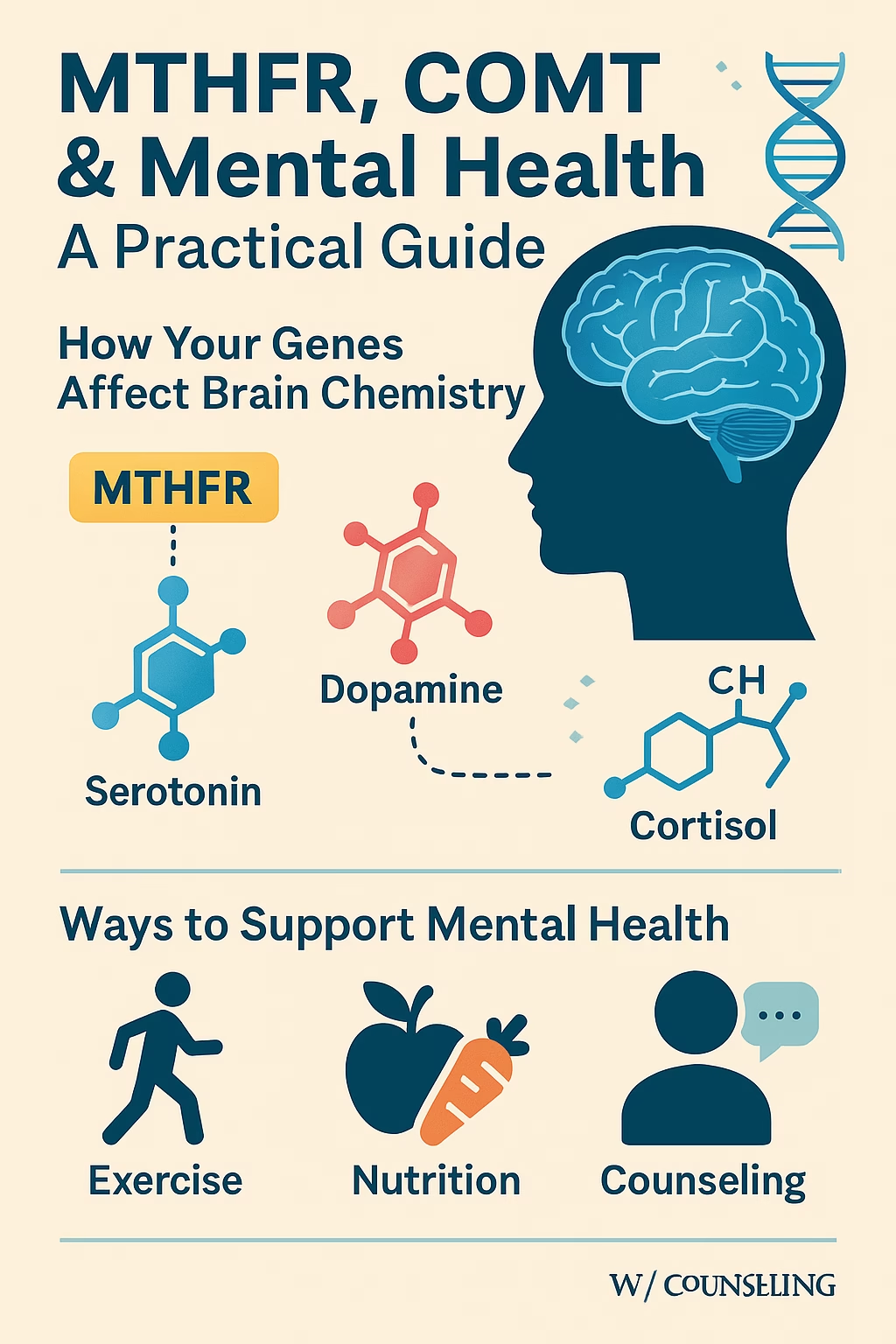
MTHFR and COMT: What They Do and How They Affect Mental Health
✓ Supports serotonin and dopamine production
✓ Variants may reduce this conversion efficiency
✓ Associated with depression and anxiety
✓ Relevant to B12 and folate metabolism
✓ Affects stress response and emotional regulation
✓ Slow variant = higher dopamine, more stress sensitivity
✓ Fast variant = lower dopamine, less stress sensitivity
✓ Both variants have tradeoffs — neither is simply “bad”
Feel free to share or embed this infographic with credit to darinkingcounselingllc.com
What Is MTHFR and How Does It Affect Mental Health?
MTHFR — methylenetetrahydrofolate reductase — is an enzyme encoded by the MTHFR gene. Its primary role is to convert dietary folate (vitamin B9) into its active form, methylfolate (5-MTHF), which is used in a critical biochemical process called methylation.
Methylation is involved in hundreds of processes throughout the body, including:
- The production of serotonin, dopamine, and norepinephrine — neurotransmitters central to mood, motivation, and stress response
- DNA synthesis and repair
- Detoxification processes in the liver
- Regulation of gene expression (epigenetics)
- Processing of homocysteine — an amino acid that becomes elevated when methylation is impaired
Certain variants of the MTHFR gene — particularly C677T and A1298C — reduce the enzyme’s efficiency, potentially impairing methylation and the downstream processes it supports.
Important context: MTHFR variants are extremely common — the C677T variant is present in an estimated 10-15% of people of European descent and higher percentages in some other populations. Having an MTHFR variant does not mean you will develop mental health problems. It is one factor among many — genetic, environmental, and experiential — that may influence mental health vulnerability.
MTHFR and Mental Health: What the Research Says
The relationship between MTHFR variants and mental health has been studied extensively, with mixed results. Here is an honest summary of what the research does and doesn’t show:
Depression
Some studies have found associations between MTHFR variants (particularly C677T) and increased risk of depression. The proposed mechanism is that impaired methylation reduces the production of neurotransmitters like serotonin and dopamine. However, the effect size is modest and the relationship is not deterministic — many people with MTHFR variants never experience depression, and most depression occurs in people without these variants.
Anxiety
Some research suggests MTHFR variants may increase vulnerability to anxiety, potentially through their effects on neurotransmitter metabolism and the stress response system. The evidence is suggestive rather than conclusive.
Bipolar Disorder and Schizophrenia
Some meta-analyses have found modest associations between MTHFR variants and bipolar disorder and schizophrenia, though again the relationships are complex and influenced by many other factors.
The Honest Bottom Line
MTHFR variants are a risk factor, not a destiny. They interact with dozens of other genetic variants, with environmental factors, with diet and lifestyle, and — critically — with life experiences including trauma. The National Institute of Mental Health emphasizes that mental health conditions are complex, multifactorial conditions that cannot be reduced to a single gene.
What Is COMT and How Does It Affect Mental Health?
COMT — catechol-O-methyltransferase — is an enzyme that breaks down catecholamines, including dopamine, epinephrine (adrenaline), and norepinephrine. These neurotransmitters are central to motivation, reward, stress response, attention, and emotional regulation.
The COMT gene has a well-studied variant (Val158Met) that significantly affects enzyme activity:
| COMT “Slow” Variant (Met/Met) | COMT “Fast” Variant (Val/Val) | |
|---|---|---|
| Enzyme activity | Lower — breaks down dopamine more slowly | Higher — breaks down dopamine more quickly |
| Dopamine levels | Higher baseline dopamine (especially prefrontal cortex) | Lower baseline dopamine |
| Under normal conditions | Better cognitive function, mood stability, focus | Lower baseline mood and motivation in some |
| Under stress | Dopamine spikes and takes longer to clear — more stress sensitivity, anxiety, rumination | Dopamine clears quickly — often more resilient under acute stress |
| Nicknamed | “Worrier” — more prone to anxiety under stress | “Warrior” — more resilient under acute stress |
Important nuance: Neither the “worrier” nor the “warrior” variant is simply better or worse. The slow COMT variant is associated with better cognitive performance and mood under low-stress conditions, while the fast variant confers advantages under high-stress acute conditions. Both variants have real tradeoffs, and the impact of either depends heavily on environment, other genetic factors, and life experiences — particularly trauma history.
COMT, Trauma, and Stress Sensitivity
One of the most clinically relevant findings in COMT research is its interaction with stress and trauma. People with the slow COMT variant (higher dopamine) appear to be more sensitive to the effects of stress and trauma — both in terms of immediate impact and in terms of vulnerability to PTSD, anxiety, and depression following traumatic experiences.
This is not because they are weaker. It is because their dopamine system responds more intensely to threat and takes longer to return to baseline — which, in a chronically stressful or traumatic environment, creates conditions for ongoing dysregulation.
Understanding this interaction can be enormously validating for people who have experienced trauma and also carry the slow COMT variant — it helps explain why their stress response may be more intense and more persistent than others who experienced similar events. Read more about how trauma affects the nervous system and cortisol and trauma.
MTHFR, COMT, and Trauma: The Interaction
MTHFR and COMT don’t operate in isolation from each other or from life experience. They interact in meaningful ways:
- MTHFR impairment can affect methylation of COMT — potentially affecting how efficiently dopamine is broken down
- Both variants interact with trauma history — meaning that having these variants in the context of adverse childhood experiences may compound vulnerability more than either factor alone
- Both are influenced by nutrition, lifestyle, and environmental factors that can be modified
The CDC’s ACE research and emerging epigenetics research together suggest that genetic vulnerability and early adverse experience interact in complex ways — with trauma potentially amplifying genetic vulnerabilities that might otherwise have had minimal clinical impact. This is why both genetic factors and trauma history deserve attention in treatment.
What Actually Helps: Treatment and Support
Understanding MTHFR and COMT variants is useful — but the most important thing to understand is that genes are not destiny, and that both of these variants respond to the same interventions that support mental health more broadly.
Trauma Therapy
If trauma is part of the picture — and for many people with MTHFR and COMT variants who struggle with anxiety, depression, or stress sensitivity, it is — addressing the trauma directly is the highest-leverage intervention. Trauma counseling in Pennsylvania, EMDR therapy, and IFS therapy all address the nervous system dysregulation that compounds genetic vulnerability.
Nutritional Support
For MTHFR variants, ensuring adequate intake of active folate (methylfolate rather than folic acid) and methylcobalamin (active B12) is often recommended by functional medicine practitioners. This should be done in consultation with a knowledgeable healthcare provider, as over-supplementation can be counterproductive in some presentations.
Lifestyle Factors
Consistent sleep, regular moderate exercise, stress management, and anti-inflammatory nutrition all support neurotransmitter production and methylation — benefiting both MTHFR and COMT function. See our guide on nervous system reset techniques for practical approaches to nervous system regulation.
Anxiety and Depression Treatment
Whether or not genetic variants are identified, anxiety counseling and depression counseling address the symptoms directly — with evidence-based approaches that work regardless of genetic background.
Related reading: Our guides on how PTSD affects GABA in the brain, cortisol and trauma, and how childhood abuse changes the brain provide important context for understanding the neuroscience of mental health and trauma recovery.
Frequently Asked Questions
Does MTHFR cause anxiety and depression?
MTHFR variants are associated with modestly increased vulnerability to anxiety and depression in some research — not because they directly cause these conditions, but because impaired methylation can affect neurotransmitter production. They are extremely common and most people who carry them do not develop anxiety or depression. They are one factor among many, heavily influenced by environment, lifestyle, and trauma history.
What is the difference between MTHFR and COMT?
MTHFR is an enzyme involved in folate metabolism and methylation — affecting neurotransmitter production. COMT is an enzyme that breaks down catecholamine neurotransmitters including dopamine and adrenaline. Both have common variants that affect their efficiency and have been studied in relation to mental health vulnerability — with COMT particularly associated with stress sensitivity and dopamine regulation.
Should I get tested for MTHFR and COMT?
Testing is available through genetic testing services. However, knowing your variant status rarely changes the fundamentals of good mental health treatment. If you’re interested, discuss it with a healthcare provider who can help you interpret results in context. Trauma therapy remains the highest-leverage intervention regardless of genetic background.
Can trauma make MTHFR and COMT variants worse?
Yes — trauma and genetic variants interact. People with certain MTHFR and COMT variants may be more sensitive to the effects of stress and trauma. This means that in the presence of these variants, addressing trauma through EMDR therapy or other trauma-focused approaches is particularly important.
What supplements help with MTHFR?
Functional medicine practitioners often recommend active folate (methylfolate) rather than synthetic folic acid, along with methylcobalamin (active B12). However, supplementation should be done in consultation with a healthcare provider — over-supplementation can be counterproductive in some presentations, particularly with slow COMT variants. Lifestyle and nervous system regulation are equally important complements.
Genes load the gun. Environment and experience pull the trigger. Therapy helps you put it down.
Darin King, LPC specializes in trauma, anxiety, depression, and nervous system healing in Pennsylvania. Telehealth available statewide.
See more from Darin King Counseling on Google