

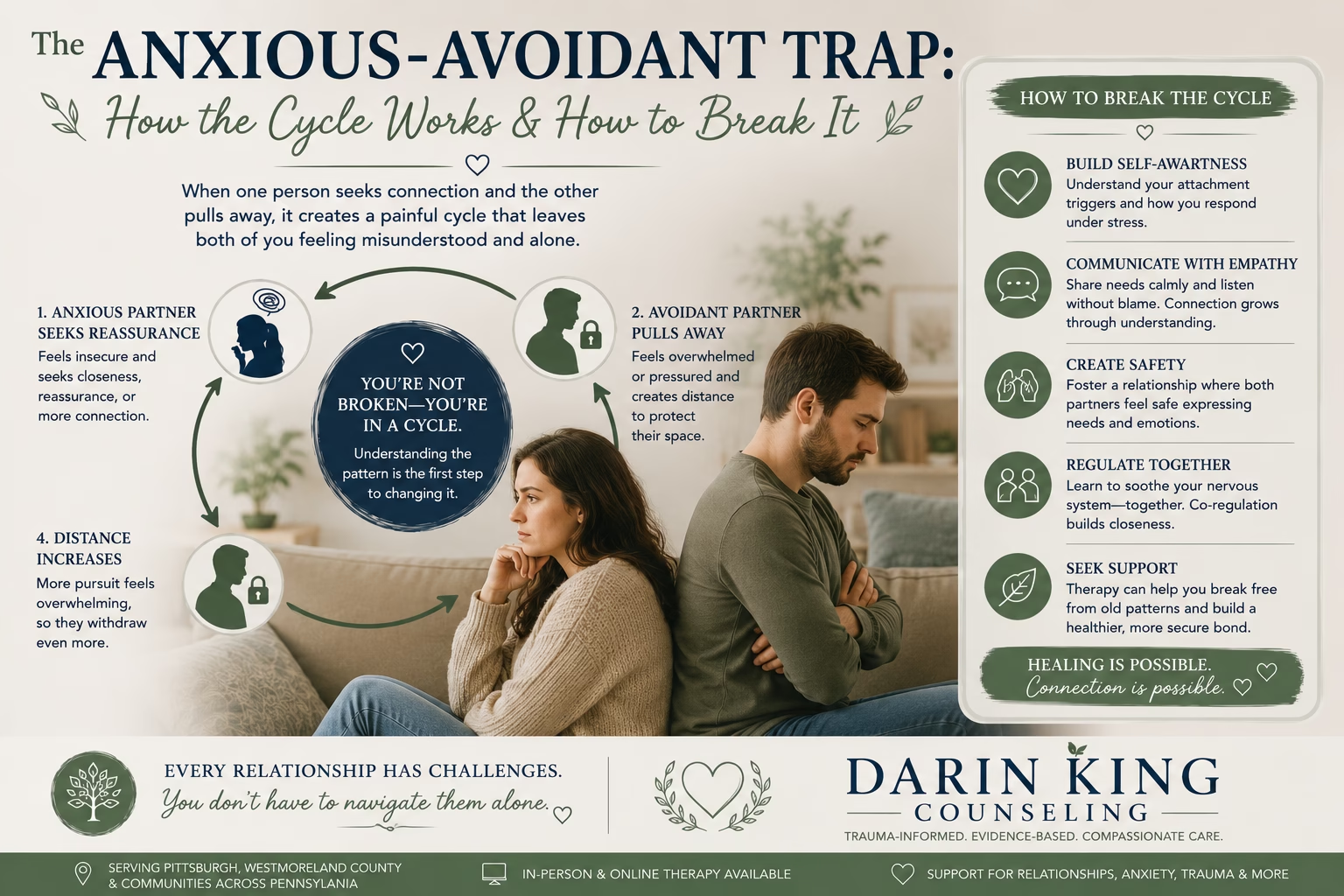
The anxious-avoidant trap is the painful, self-reinforcing dynamic that develops when an anxiously attached person partners with an avoidantly attached person. The anxious partner senses distance and moves closer; the avoidant partner experiences the closeness as pressure and moves away; the anxious partner reads the distance as confirmation of the original fear and moves closer still. Both nervous systems are doing what they were shaped to do. Neither is failing on purpose. The trap is real, but it is not permanent — and naming it is the first step out.
In my work with couples, this dynamic is one of the most common presentations. Two people who genuinely love each other, both confused, both feeling unloved, both convinced the other person is the problem. What changes the trajectory is rarely insight alone. It is the slow process of recognizing the pattern in real time, regulating the nervous system before responding, and developing a different way of meeting each other in the moments when the trap usually springs.
The Anxious-Avoidant Trap at a Glance
How the cycle works and why it intensifies over time
What the anxious partner does
- Senses distance and feels alarm
- Moves toward the partner — text, call, ask, pursue
- Seeks reassurance that the relationship is okay
- Reads withdrawal as rejection
- Activates harder when the response is muted
What the avoidant partner does
- Senses pursuit and feels pressure
- Moves away — emotionally, physically, or both
- Needs space to regulate the rising sense of suffocation
- Reads pursuit as demand
- Shuts down further when the pursuit intensifies
Why it intensifies
- Each response confirms the other’s worst fear
- The system has no built-in stopping point
- Both nervous systems get more dysregulated, not less
- Verbal arguments mask the deeper nervous-system collision
- Repetition deepens the groove of the pattern
What breaks the cycle
- Recognition of the pattern in real time
- Each partner regulating their own nervous system first
- Slowed pace and shared language
- Attachment-informed couples therapy
- Individual work on the underlying attachment patterns
Feel free to share or embed this infographic with credit to darinkingcounselingllc.com
What Is the Anxious-Avoidant Trap?
The anxious-avoidant trap is what attachment researchers call the pursuit-distance cycle. It is the most common painful pattern in adult romantic relationships, and it produces a recognizable kind of suffering: two partners who love each other deeply, both feeling unloved, both blaming the other for the disconnection. The dynamic is structurally self-reinforcing — each partner’s attempt to feel safer actually triggers the other partner’s defensive response, which loops back as confirmation of the original fear.
Understanding the trap requires understanding both attachment patterns individually. For the foundation, see our posts on anxious attachment style and avoidant attachment style. The trap emerges when these two patterns meet in the same relationship — which is more common than chance would predict. Each nervous system recognizes the dynamic from earlier life and is drawn to it.
How the Cycle Works
The pattern typically unfolds in a recognizable sequence. Different couples will recognize their own version of these steps, but the structure is remarkably consistent across relationships.
Step 1: The trigger
Something happens that activates one partner’s attachment system. For the anxious partner, this is often a sense of distance — a delayed text, a distracted dinner, a tone shift, a missed bid for connection. For the avoidant partner, it is often a sense of pressure — a demand for emotional availability, an intense conversation, an expectation of closeness. The trigger does not have to be objectively significant. It just has to register, at the nervous-system level, as a familiar threat.
Step 2: The defensive response
Each partner responds in the way their attachment system learned to respond, decades before this relationship began.
The anxious partner moves toward the avoidant partner — texting again, asking what is wrong, escalating the bid for connection, sometimes through protest behaviors (criticism, accusation, withdrawal-then-return). The intention is usually some version of “I need to know we’re okay.”
The avoidant partner moves away — going quiet, ending the conversation early, getting busy with something else, retreating physically, sometimes through criticism of the anxious partner’s intensity. The intention is usually some version of “I need space to regulate.”
Step 3: Each response confirms the other’s worst fear
This is where the trap becomes a trap. The anxious partner’s pursuit reads, to the avoidant partner, as exactly the suffocating pressure they were trying to escape — confirming the unconscious belief that closeness becomes demand. The avoidant partner’s withdrawal reads, to the anxious partner, as exactly the abandonment they were trying to prevent — confirming the unconscious belief that love disappears when really needed.
Both partners are now responding to the present moment with the full weight of their original attachment wounds. The conversation is no longer about the dinner, the text, or the schedule. It is about whether love is safe.
Step 4: Escalation
Without a different intervention, the pattern intensifies. The anxious partner, increasingly dysregulated, pursues harder. The avoidant partner, increasingly dysregulated, withdraws further. The anxious partner’s protest behaviors escalate. The avoidant partner’s shutdown deepens. Both nervous systems are now well outside the window of tolerance — see our post on the window of tolerance for the broader nervous-system framework.
By this point, productive conversation is not possible. The brain regions required for empathy, perspective-taking, and clear thinking are offline. Words exchanged at this stage tend to be the words people most regret.
Step 5: Eventual reset (and the seeds of the next cycle)
Eventually, exhaustion, time, or some external event interrupts the cycle. Both partners’ nervous systems begin to settle. Reconciliation happens, sometimes through apology, sometimes through silent return to normalcy. The relationship continues — until the next trigger activates the pattern again, often more easily than the time before.
This is what makes the anxious-avoidant trap so corrosive over time. The pattern repeats. The grooves deepen. Each iteration takes more out of the relationship than it puts back.
Why This Particular Pairing Is So Common
The anxious-avoidant pairing happens more often than chance would predict — and the reason is structural. Each attachment system finds the other familiar.
The anxious partner is drawn to the avoidant partner’s apparent self-sufficiency, mystery, and emotional containment. These qualities mirror the inconsistent caregiver who shaped the anxious pattern in the first place. The pursuit-distance dynamic feels like home, even when home was hard.
The avoidant partner is drawn to the anxious partner’s warmth, attentiveness, and willingness to do the relational work. These qualities provide the connection the avoidant person genuinely wants but cannot generate alone. The pursuit also confirms — at a level beneath awareness — that this person will work hard to maintain closeness, which paradoxically allows the avoidant partner to relax their own efforts.
Both partners initially experience the other as exciting, comforting, or some combination. The trap typically surfaces later, often months into the relationship, as the attachment system fully activates and the defensive patterns begin to play out.
What Each Partner Is Actually Feeling
One of the most painful features of the trap is that each partner is convinced the other has a fundamentally different inner experience. The truth is that both partners are usually feeling some version of the same thing — unloved, unseen, and frightened — through opposite expressions.
The anxious partner’s inner experience
- A persistent background sense that the relationship is about to end
- Physical activation — racing heart, gut tension, urgency
- A felt need to do something, anything, to restore connection
- Shame about the intensity of the response
- The painful sense that love is conditional and they are losing it
- An inability to settle until the partner is fully re-engaged
The avoidant partner’s inner experience
- A vague sense of pressure, suffocation, or being trapped
- Physical activation that gets quickly muted into numbness
- A felt need for space, distance, time alone
- Confusion about why the partner is so upset
- The painful sense that they will never be enough for the partner
- An inability to feel love clearly when the partner is in pursuit mode
Both partners, underneath the surface behavior, are responding to genuine attachment fear. Neither is the villain. Both are doing what their nervous system learned, long ago, was necessary for survival. For more on what each pattern feels like from the inside, see our posts on anxious attachment and avoidant attachment.
The Costs of Living in the Trap
Couples can live inside the anxious-avoidant trap for years, sometimes decades. The relationship persists — sometimes through external structure (children, finances, shared history) and sometimes through the periodic reconciliations that keep enough good moments alive. But the cumulative cost is real.
- Erosion of trust. Each cycle deposits a residue. Over time, partners stop trusting that good moments will hold.
- Decreased physical intimacy. Both partners become wary of vulnerability with each other.
- Loss of self. The anxious partner often gives more and more of themselves to maintain the relationship; the avoidant partner often retreats further into work, hobbies, or isolation.
- Mental health impact. Anxiety, depression, and chronic stress symptoms commonly increase in both partners.
- Effect on children. Children growing up in homes with the anxious-avoidant dynamic often develop their own attachment patterns shaped by the parents’.
- Resignation. Many couples reach a point of low-grade resignation — neither happy nor ready to leave, just existing in a relationship that never quite reaches the closeness either of them wants.
What Does Not Work to Break the Cycle
- Trying harder at what you are already doing. The anxious partner’s instinct is to communicate more clearly, ask better questions, make more bids. The avoidant partner’s instinct is to give more space, ask for less, contain feelings further. Both intensifications make the trap tighter.
- Reading articles about attachment without doing the work. Both anxious and avoidant partners are often well-read on the topic. Knowing the framework does not change the nervous-system response.
- Trying to change the other partner. Asking the avoidant partner to “open up more” or the anxious partner to “be less needy” almost never works. It typically intensifies the original pattern.
- Generic couples therapy that does not address attachment. Communication skills are useful but insufficient. The trap operates at the nervous-system level, beneath the words.
- Threatening to leave. For an anxious partner, this dysregulates them further. For an avoidant partner, it can produce temporary engagement followed by deeper withdrawal once the threat passes.
- Outside affairs. Affairs typically deepen the trap rather than escape it. The same nervous-system patterns play out in the new relationship.
What Actually Breaks the Cycle
The work of breaking the anxious-avoidant trap is real, and it is doable. It is rarely fast, and it is rarely linear. The most reliable path involves several elements working together over time.
Naming the pattern as a pattern
One of the most useful interventions is the simple recognition that the cycle is happening. When both partners can say, mid-conflict, “we are in the cycle,” the conversation changes. It is no longer about who is right. It is about getting out of the trap together.
This is not as easy as it sounds. The pattern usually feels, from the inside, like a specific problem about a specific issue. Learning to see it as a structural dynamic — and to name it without using the language as a weapon — takes practice.
Each partner regulating their own nervous system first
The single most important shift is that both partners learn to regulate their own nervous systems before trying to address the relational content. This means pausing conversations when either person is outside the window of tolerance, taking deliberate time to settle, and only returning to the conversation when both nervous systems are regulated enough for actual communication.
For the anxious partner, this often means tolerating the discomfort of not immediately resolving the disconnection. For the avoidant partner, this often means actually doing regulation work during the space, not just escaping into distraction.
Underneath-the-behavior conversations
When both partners are regulated, they can start having a different kind of conversation. Instead of “you didn’t text me back,” the anxious partner can say “I felt scared and alone when I didn’t hear from you.” Instead of “you’re being too needy,” the avoidant partner can say “I felt suffocated and I needed space, but I see how that landed.”
These conversations require both partners to be willing to name what is happening underneath the surface — the attachment fear, the felt experience, the actual need. This is hard. It is also what changes the dynamic.
Attachment-informed couples therapy
For most couples, doing this work alone is extremely difficult. The pattern is too well-grooved, the nervous-system reactions too automatic, the moments when intervention is needed too charged. Couples therapy with a therapist trained in attachment dynamics provides a structured container in which the work can happen.
Approaches like Emotionally Focused Therapy (EFT), developed by Sue Johnson, are particularly well-suited to anxious-avoidant work because they target the attachment cycle directly. For more on couples work, see our page on marriage and relationship counseling in Pennsylvania.
Individual work on the underlying attachment patterns
Some of the most lasting change comes from individual therapy in which each partner addresses the attachment pattern they brought to the relationship. For the anxious partner, this means building the capacity to self-soothe and tolerate relational space. For the avoidant partner, this means restoring access to inner emotional life and learning to tolerate closeness without shutdown.
EMDR, IFS, and somatic approaches all address attachment patterns at the nervous-system level. See our pages on EMDR therapy in Pennsylvania, IFS therapy, and somatic therapy for more.
The Role of Codependency in the Trap
Many couples in the anxious-avoidant trap also have codependent dynamics layered on top. The anxious partner often becomes overresponsible for the avoidant partner’s emotional state, and the avoidant partner often allows the anxious partner to do all the relational labor. Recognizing this is part of the work. For more on the distinction between anxious attachment and codependency, see our post on codependency vs. anxious attachment.
What Recovery Looks Like
People often imagine that breaking the anxious-avoidant trap means reaching a state where neither partner ever activates the old patterns. That is not what changes. What changes is the relationship to the activation, and the capacity to interrupt the cycle before it consumes the conversation.
- Both partners can recognize the cycle as it begins
- The pause point — the place where either partner can step out of the dynamic — becomes earlier and more available
- The anxious partner can tolerate brief relational space without spiraling
- The avoidant partner can return to connection after needing space, rather than disappearing further
- Conflicts resolve in hours instead of days
- Both partners begin to feel like teammates against the pattern, rather than opponents in it
- Physical and emotional intimacy gradually return
- The shared sense that the relationship is workable becomes durable
This is achievable. Most couples who do focused attachment-informed work over a period of one to three years experience significant shift in the cycle, even when both partners’ underlying attachment patterns remain identifiable. The pattern weakens. The relationship can hold what it could not hold before.
When One Partner Is Doing the Work and the Other Is Not
A common painful situation: one partner has read everything, started therapy, can name the pattern, and is genuinely trying to do the work. The other partner is either uninterested or actively resistant. This is more common when the anxious partner is the one engaging with the work, but it goes the other direction too.
The honest answer is that the trap usually requires both partners to engage at some level for the cycle to genuinely change. Individual work helps, and one partner’s change does produce some shift in the relational dynamic. But the pattern is mutual by definition, and one partner alone cannot resolve a mutual pattern.
What is often most useful in this situation is for the engaged partner to focus on their own work, set realistic expectations about the pace of change, and let the work itself be its own indicator of what is and is not possible in the relationship. Many partners who initially resist eventually come to the work — sometimes after seeing the change in their spouse. Some do not. Either outcome is information about what is possible.
Frequently Asked Questions
What is the anxious-avoidant trap?
The anxious-avoidant trap is the self-reinforcing cycle that develops when an anxiously attached person partners with an avoidantly attached person. The anxious partner senses distance and pursues; the avoidant partner experiences the pursuit as pressure and withdraws; the withdrawal triggers more pursuit; the pursuit triggers more withdrawal. Both partners’ attachment systems activate each other in ways that confirm each one’s worst fear. The trap is structural, not a failure of love or communication, and it can intensify dramatically over time without intervention.
Why do anxious and avoidant people end up together so often?
The pairing happens more often than chance would predict because each attachment system finds the other familiar. The anxious partner is drawn to the avoidant partner’s apparent self-sufficiency, which mirrors the inconsistent caregiver who shaped the anxious pattern. The avoidant partner is drawn to the anxious partner’s warmth and willingness to do relational work, which provides connection the avoidant person wants but cannot generate alone. Both nervous systems recognize the dynamic from earlier life, and the early phase of the relationship usually feels exciting before the defensive patterns fully activate.
Can the anxious-avoidant trap actually be fixed?
Yes, but the work is substantial. Breaking the cycle requires several elements working together over time: naming the pattern as a pattern, each partner regulating their own nervous system before engaging, learning to have underneath-the-behavior conversations, attachment-informed couples therapy, and individual work on each partner’s underlying attachment style. Couples who engage in this work consistently over one to three years typically experience significant shift in the dynamic. The original patterns may remain identifiable, but they no longer dominate the relationship.
Whose responsibility is it to fix the cycle?
Both partners’ — the cycle is structurally mutual and cannot be fully resolved by one partner alone. That said, individual work on either side does produce some shift in the relational dynamic. The anxious partner’s work to self-soothe and tolerate relational space changes what the avoidant partner experiences. The avoidant partner’s work to restore access to emotion and tolerate closeness changes what the anxious partner experiences. The most durable change happens when both partners engage at some level.
What if my partner won’t go to therapy?
Individual work on your own attachment pattern is still valuable and still produces some shift in the relationship dynamic. Many partners who initially resist therapy eventually engage, sometimes after seeing meaningful change in their spouse. Some do not. Doing your own work is worth doing regardless — both because it improves the current relationship at least somewhat, and because it shapes future relationships if the current one does not last. The clarity that comes from individual work also helps you make an informed decision about what is possible in the current relationship.
How long does it take to break the anxious-avoidant cycle?
Meaningful change usually begins within the first three to six months of focused work. Couples often start noticing the cycle as it begins, catching themselves sooner, and recovering from activated states faster. Substantial change — where the cycle no longer dominates the relationship and both partners can stay connected through difficult conversations — typically takes one to three years of consistent work. The pace depends on the severity of each partner’s underlying attachment patterns, the length of time the cycle has been operating, and whether co-occurring issues like trauma, addiction, or untreated mental-health conditions also need attention.
Is the anxious-avoidant trap a sign that the relationship is doomed?
No. The trap is one of the most common painful patterns in adult relationships, and it is workable when both partners are willing to engage. The presence of the dynamic is not, by itself, a reason to end the relationship. What matters more is whether both partners can develop the capacity to recognize the cycle, regulate their own nervous systems, and meet each other in a different way over time. Many couples who initially feel hopeless in the trap go on to build durable, connected relationships through the work.
The cycle is real. So is the way out.
The anxious-avoidant trap is one of the most painful dynamics in adult relationships — and one of the most workable when both partners are willing to engage. The work involves more than communication skills. It involves understanding what is happening at the nervous-system level, regulating before responding, and meeting each other in a different way in the moments where the trap usually springs.
I work with couples across Pennsylvania — including Pittsburgh, Greensburg, Irwin, and Ruffsdale — using an integrated approach that addresses attachment dynamics, nervous-system regulation, and the specific patterns that show up between partners. EMDR, IFS, and attachment-informed individual and couples work are central to how I practice.
See more from Darin King Counseling on Google