

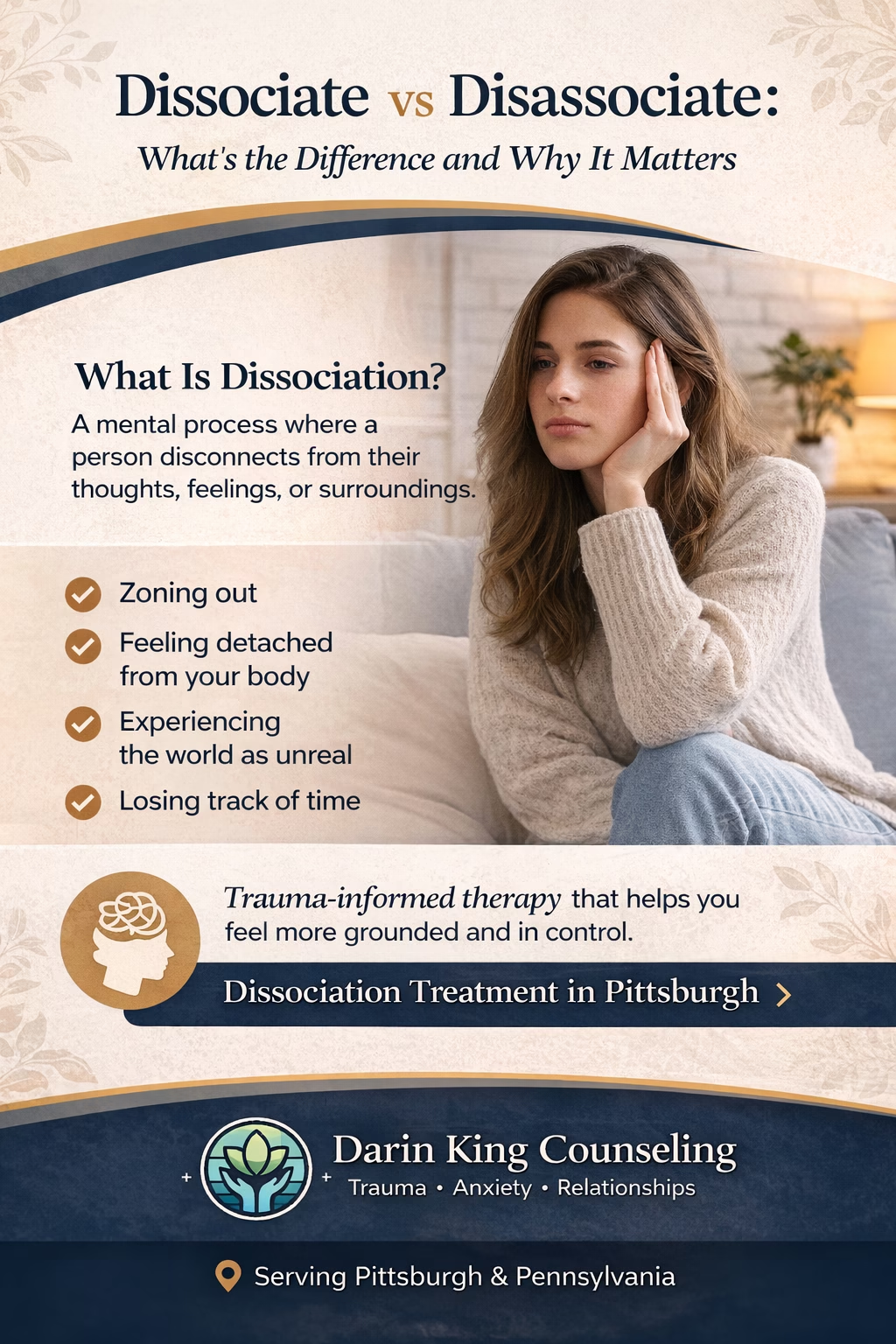
If you’ve ever searched for information about a trauma response and found yourself unsure whether to type “dissociate” or “disassociate,” you’re not alone. These two words are often used interchangeably — but only one of them is the clinically accurate term. Understanding the difference matters, especially if you’re trying to make sense of your own experiences or find the right kind of support.
This guide will clarify the language, explain what dissociation actually is, and help you recognize whether what you’re experiencing might be worth exploring with a therapist.
Could this be you? Take 30 seconds and check how many feel familiar:
- You “lose time” — minutes or hours pass and you can’t remember what happened
- You feel like you’re watching yourself from outside your body
- The world around you sometimes feels foggy, dreamlike, or unreal
- You go emotionally numb when things get overwhelming, even when you “should” feel something
- You drive familiar routes or do daily tasks on autopilot with no memory of doing them
- People tell you that you “checked out” during a conversation you don’t remember
If two or more sound like a regular experience, the rest of this guide isn’t just about spelling — it’s about understanding something your nervous system has been doing to protect you.
Dissociate vs Disassociate: Which Is Correct?
Feel free to share or embed this infographic with credit to darinkingcounselingllc.com
The Short Answer: “Dissociate” Is the Correct Term
In psychology and mental health, the correct word is dissociate. The clinical condition is called dissociation, and the experience is described as dissociating. The Diagnostic and Statistical Manual of Mental Disorders (DSM-5) — the standard reference used by mental health professionals — uses “dissociation” throughout, never “disassociation.” According to the American Psychiatric Association, dissociative disorders are defined by disruptions in consciousness, memory, identity, emotion, perception, behavior, and sense of self.
“Disassociate” is a common variant that has drifted into everyday usage, and it’s not technically wrong in general English — but if you’re reading mental health content, looking for a therapist, or trying to understand a diagnosis, you’ll want to use the clinical term: dissociate.
Quick memory trick: Think of “dis-” as meaning “apart” — dissociation means your mind is separating from the present moment. There’s no extra “a” needed. It’s dissociate, not disassociate.
What Does It Mean to Dissociate?
Dissociation is a disconnection between a person’s thoughts, feelings, surroundings, behavior, or sense of identity. It exists on a spectrum — from the mild, everyday kind (like zoning out during a boring meeting) to more significant experiences that can interfere with daily life.
Most people experience mild dissociation regularly. That familiar feeling of “where did the last hour go?” while driving a familiar route, or getting so absorbed in a book that you don’t hear your name called — these are normal, healthy forms of dissociation.
But for people who have experienced trauma, dissociation can become more intense and disruptive. It’s often the mind’s way of protecting itself from overwhelming experiences it couldn’t process at the time. Research published by the National Institute of Mental Health confirms that dissociative symptoms are strongly associated with trauma and stress-related conditions.
Common Signs of Dissociation
- Feeling detached from your body, as if watching yourself from a distance
- Emotional numbness or feeling “flat”
- Memory gaps or losing time
- Feeling like the world around you isn’t real (derealization)
- Feeling like you aren’t real (depersonalization)
- Difficulty concentrating or feeling “foggy”
- Doing things on “autopilot” without awareness
| Type of Dissociation | What It Feels Like | Common In |
|---|---|---|
| Mild / Everyday | Zoning out, daydreaming, highway hypnosis | Everyone — completely normal |
| Depersonalization | Feeling detached from your own body or thoughts | Anxiety, trauma, PTSD |
| Derealization | The world feels unreal, foggy, or distant | Trauma, panic attacks, PTSD |
| Dissociative Amnesia | Memory gaps, especially around traumatic events | Childhood trauma, complex PTSD |
| Dissociative Identity | Distinct identity states or “parts” | Severe early childhood trauma |
Why Do People Dissociate?
Dissociation is most commonly linked to trauma. When something overwhelming happens — especially in childhood when the brain is still developing — the nervous system sometimes responds by mentally “leaving” the situation. This protective response can become automatic over time, triggering even in situations that feel only vaguely unsafe.
For some people, dissociation appears alongside other nervous system responses like dorsal vagal shutdown — a state of numbness, fog, or collapse that the body uses when fight or flight isn’t an option. Others experience it as part of a fawn response, where the mind goes elsewhere while the body stays compliant. These responses aren’t weakness — they’re survival.
Research shows that dissociation is strongly associated with:
- Childhood abuse or neglect — physical, emotional, or sexual
- Complex PTSD (CPTSD) — repeated trauma over time, often in childhood
- Single-incident trauma — accidents, assault, medical emergencies
- Dysfunctional family systems — chaotic or unpredictable home environments
- Anxiety and panic disorders
If you grew up in an environment where it wasn’t safe to be fully present — emotionally, physically, or psychologically — dissociation may have been one of the most important survival tools you had. It protected you. The problem is that it can linger long after the danger has passed.
Important: Dissociation by itself is not a diagnosis. It’s a symptom that can appear across many different conditions. If you’re experiencing significant dissociation, a licensed therapist can help you understand what’s driving it and how to work through it safely.
Dissociation vs Disassociation: A Breakdown by Context
| Context | Word Used | Example |
|---|---|---|
| Clinical / Medical | Dissociate / Dissociation | “The patient reports dissociative episodes.” |
| DSM-5 Diagnosis | Dissociation | Dissociative Identity Disorder, Dissociative Amnesia |
| Academic research | Dissociation | Used in all peer-reviewed psychology literature |
| Casual / Everyday speech | Either (dissociate more common) | “I totally disassociated during that meeting.” |
| Non-psychology contexts | Disassociate | “She chose to disassociate herself from the group.” |
How Is Dissociation Treated?
The good news is that dissociation — especially when it’s rooted in trauma — responds well to therapy. The World Health Organization recommends trauma-focused psychological therapies as the first-line treatment for trauma-related conditions including dissociation. Several evidence-based approaches can help:
EMDR Therapy
Eye Movement Desensitization and Reprocessing (EMDR therapy) is one of the most well-researched treatments for trauma-related dissociation. It helps the brain reprocess traumatic memories so they lose their overwhelming charge — which reduces the need for dissociation as a coping mechanism.
Trauma-Focused Therapy
Trauma counseling addresses the underlying experiences that taught your nervous system to disconnect in the first place. Working with a trauma-informed therapist helps you build the safety and stability needed to process difficult experiences without flooding.
Internal Family Systems (IFS)
IFS therapy is particularly helpful for dissociation because it works directly with the different “parts” of yourself — including the parts that learned to disappear as a way of staying safe.
Somatic and Body-Based Approaches
Because dissociation often involves disconnection from the body, approaches that gently bring awareness back to physical sensations can be powerful. These are often integrated into trauma therapy alongside other modalities.
When Should You Talk to a Therapist About Dissociation?
Mild dissociation is a normal part of human experience. But it may be worth exploring with a professional if:
- You frequently “lose time” or come back to awareness in the middle of something with no memory of starting it
- You feel detached from your body or emotions on a regular basis
- Dissociation is affecting your relationships, work, or daily functioning
- You’ve experienced trauma and notice that certain triggers cause you to “check out”
- You feel like you’re living on autopilot and don’t know how to be more present
Related reading: If dissociation is connected to your trauma history, you may also find it helpful to read about what dissociation feels like, dorsal vagal shutdown, or how CPTSD therapy addresses dissociation as part of a broader pattern of trauma responses.
Living in Pennsylvania and Wondering If This Is Happening to You?
If dissociation is showing up in your life — losing time, going numb, feeling detached, or just realizing you’ve been living on autopilot for years — you don’t have to figure it out alone. And you don’t need to be in crisis to deserve support.
I’m Darin King, a licensed professional counselor based in Pennsylvania. My team specializes in trauma, EMDR, and the kinds of dissociative experiences that often come from childhood adversity, complex PTSD, or chronic stress. We meet clients in person at our Ruffsdale and Pittsburgh offices, and via secure telehealth from anywhere in Pennsylvania.
You can:
- Schedule a free 15-minute consultation to talk through what you’re experiencing — no commitment
- Learn about our statewide telehealth therapy if getting to an office isn’t realistic
- Read more about trauma counseling, EMDR therapy, or PTSD counseling across Pennsylvania
If you’re closer to one of our offices, you can also explore counseling in Pittsburgh or counseling in Westmoreland County.
Frequently Asked Questions
Is “disassociation” a real word?
It exists in general English usage as a variant, but it is not a clinical or psychological term. The correct term in mental health contexts is “dissociation.” If you see “disassociation” in medical or therapeutic writing, it’s likely an error.
Can dissociation happen without trauma?
Yes — mild dissociation (daydreaming, zoning out) is universal. More significant dissociation can also occur with severe sleep deprivation, certain medications, and anxiety disorders. However, clinically significant dissociation is most commonly associated with trauma.
Is dissociation the same as derealization?
Derealization is a type of dissociation. It refers specifically to the experience of the external world feeling unreal or distant. Depersonalization is another type, referring to feeling detached from yourself. Both fall under the umbrella of dissociative experiences.
Can dissociation be treated with telehealth?
Yes. Telehealth therapy is an effective way to work on dissociation and trauma with a licensed professional. Many clients find that the comfort of their own environment actually helps them feel safer during sessions.
How do I find a trauma therapist in Pennsylvania?
Look for a licensed therapist who specializes in trauma and uses evidence-based approaches like EMDR, IFS, or trauma-focused CBT. At Darin King Counseling, we serve clients across Pennsylvania via telehealth and in-person at our Pittsburgh and Ruffsdale offices. You can schedule a free 15-minute consultation to see if we’re a good fit.
Ready to understand your experiences — and start healing?
Darin King, LPC specializes in trauma, EMDR, and dissociation in Pennsylvania. Telehealth available statewide.
See more from Darin King Counseling on Google