

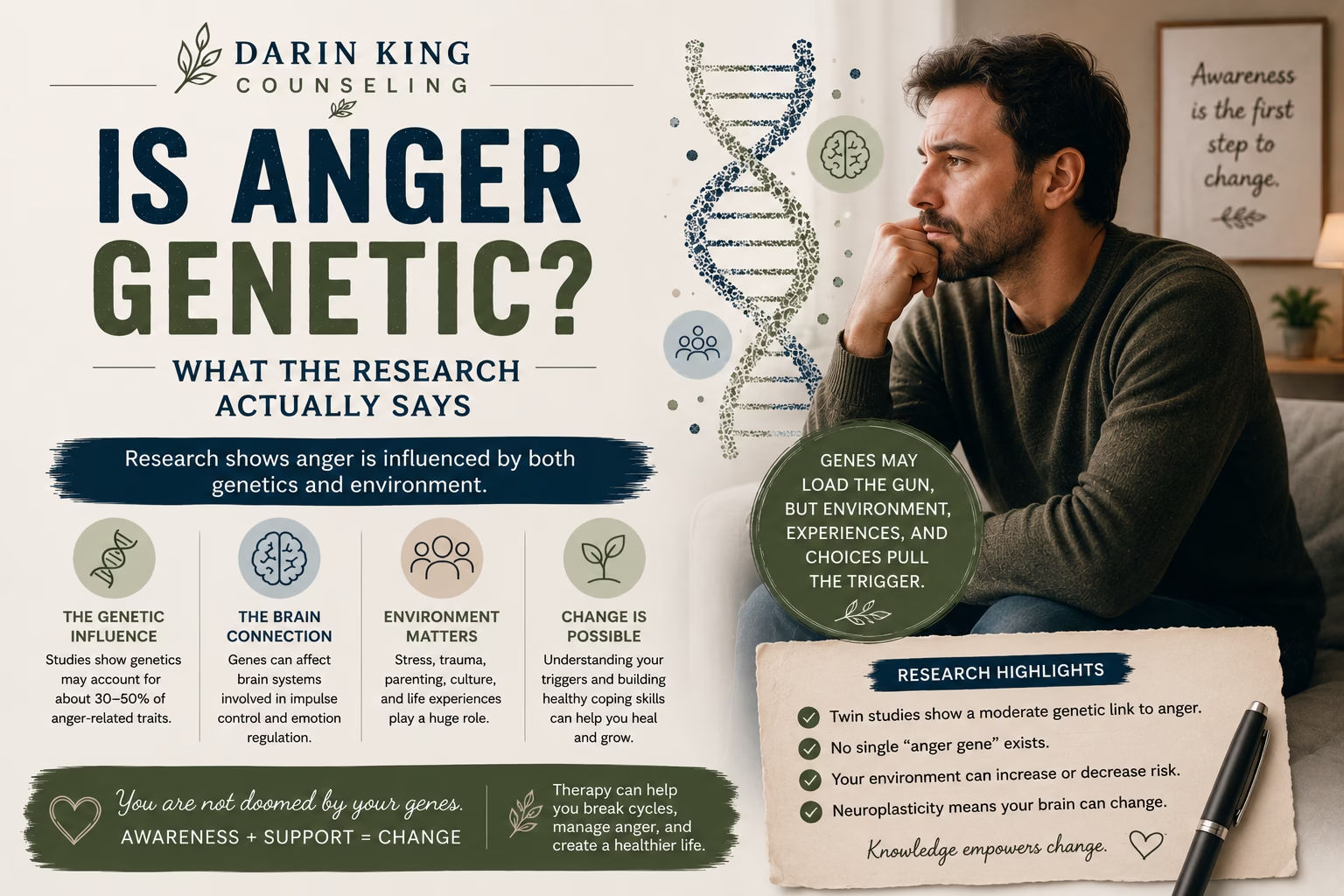
Anger can run in families, and the question of whether it is genetic is a good one — both for understanding yourself and for considering what your children might be inheriting. The honest answer is: anger has measurable genetic components, but those components describe a baseline of reactivity, not a destiny. The much bigger drivers of how anger shows up in adult life are family environment, modeling, attachment patterns, trauma, and the regulation skills you did or did not develop in childhood.
This article walks through what research actually shows about the heritability of anger, why that does not mean you are stuck with the patterns you grew up with, and how the family-of-origin component often gets confused for genetics. Both matter, but they are not the same thing.
What the Research Actually Shows About Anger and Genetics
Behavioral genetics research, mostly from twin studies, suggests that personality traits associated with anger have a genetic heritability of roughly 30 to 50 percent. This includes traits like:
- Trait anger — baseline tendency to experience anger more easily and intensely
- Irritability — sensitivity to frustration
- Aggression — tendency to respond to anger with aggressive behavior
- Emotional reactivity — how quickly and intensely emotions are experienced
That heritability number is important to understand correctly. It does not mean 30 to 50 percent of your anger is genetic. It means that in a population, about 30 to 50 percent of the variation in anger traits between individuals can be attributed to genetic differences. The rest — 50 to 70 percent — is environment, experience, learning, trauma, and other non-genetic factors.
For any individual person, genetics provides a temperamental baseline. How that baseline develops into actual anger patterns in adult life depends overwhelmingly on what happened around that baseline during development.
What Genetics Actually Influences
The genetic contribution to anger is not a “rage gene.” It is a constellation of small influences on:
Temperament
Some children are born more emotionally reactive than others. Their nervous systems respond more strongly to stimuli, including frustration. This shows up in infancy, well before environment has had time to shape much.
Neurotransmitter Sensitivity
Variations in serotonin, dopamine, and norepinephrine systems affect how quickly the brain processes threat, frustration, and reward. Some variations make anger responses more easily triggered.
Stress Response Wiring
The HPA axis (the body’s stress response system) shows genetic variation that affects how strongly and how quickly stress activates anger and aggression responses.
Executive Function Capacity
The prefrontal cortex regulates impulses, including angry impulses. Genetic variation contributes to executive function capacity, which affects how easily anger gets translated into action versus regulated.
None of these are deterministic. They describe baselines that interact with environment over a lifetime to produce the actual anger patterns we see in adults.
The Much Bigger Factor: Family of Origin
When people say “anger runs in my family,” they are usually correct — and they are usually attributing more of it to genetics than the evidence supports. The bigger contributor is what happened in childhood. Specifically:
Modeling
Children learn how to be angry from the angry adults around them. They learn whether anger gets expressed at all, how it gets expressed, what it looks like in the body, who is allowed to be angry, what anger means, and what the consequences are. A child raised by a parent who erupts in shouting learns that anger means shouting. A child raised by a parent who goes silent and cold learns that anger means withdrawal. The genetic baseline is being shaped into a specific cultural pattern.
Attachment and Safety
Children whose attachment was disrupted or unsafe develop more reactive nervous systems. A nervous system that was on high alert for years runs hotter as an adult. This is not genetic in the strict sense — it is the development of a stress response that got tuned to a particular environment.
Trauma
Childhood trauma significantly shapes adult anger. Sometimes it produces explosive anger (the person never developed the regulation tools); sometimes it produces deeply suppressed anger that comes out sideways. Family trauma in adults shows up frequently as adult anger problems whose roots are not genetic at all.
What Was and Was Not Allowed
Many people have anger patterns that look like inheritance but are actually about what was permitted in childhood. A daughter who was punished for any anger may grow up unable to access her own anger, then explode when it finally surfaces. A son who was praised for “being tough” may grow up using anger as his primary emotional expression. These are not genetic. They are family rules internalized.
Lack of Regulation Skills
Emotional regulation is a learned skill. Children who grew up in dysregulated households often did not learn it. As adults, they have intense emotional responses (sometimes genetic, sometimes situational) without the tools to regulate them. The lack of skill looks like inherited temperament but is actually unlearned skill.
How to Tell What Is Yours and What Is Inherited
You can roughly distinguish genetic temperament from family-of-origin patterning with some honest reflection:
- Likely temperamental: emotional reactivity that was visible in early childhood, consistent across very different environments, present even when no one was modeling it for you
- Likely family of origin: specific anger expressions that mirror a parent’s exactly (same words, same physical patterns, same triggers), patterns that emerge in your own adult home that look like the home you grew up in, anger that activates around the same themes as your family’s
- Likely trauma-related: anger that is disproportionate to current trigger, anger that shows up as part of a broader pattern of nervous system dysregulation, anger paired with hypervigilance or shutdown
In practice, most adult anger is some combination of all three. The good news: all three are workable.
What Can Change
If anger is partially genetic, can you actually change it? Yes, in meaningful ways. What changes:
The Regulation Skills You Did Not Get
Emotional regulation can be learned at any age. Specific therapeutic approaches teach the skills: dialectical behavior therapy, mindfulness-based interventions, somatic approaches. The genetic baseline does not change but the capacity to manage it does, sometimes dramatically.
The Family-of-Origin Patterns
Patterns learned in childhood can be unlearned in adulthood. This is what most therapy is — bringing inherited family patterns into conscious awareness so they can be modified. The patterns are persistent but not permanent.
The Trauma Underneath
If anger has trauma roots, treating the trauma often changes the anger more than any anger-management intervention. EMDR, somatic experiencing, and trauma-focused approaches address the underlying dysregulation that is producing the surface anger.
The Stories You Tell About Anger
“I have my father’s temper” is a story. It is sometimes accurate and sometimes a way of resigning yourself to patterns you could change. Examining the story honestly is part of the work.
What Does Not Change (Much)
The underlying temperamental baseline tends to be relatively stable. A naturally more emotionally reactive person will probably always be more reactive than a naturally calmer person — but with regulation skills, that reactivity does not have to produce the same outcomes it once did. The instrument stays the same; the music changes.
Many adults with significant anger seek help specifically because they do not want to pass it on to their children. This is a healthy motivation and the work is genuinely effective. Children of parents who learn to regulate anger do not just inherit calmer responses — they learn from the modeling. The intergenerational transmission of anger patterns can be interrupted.
When Anger Warrants Professional Support
Some signs that anger is worth working on with a therapist:
- Your anger is hurting relationships you care about
- You feel out of control during angry episodes
- You are scared of yourself when angry
- You have hurt people physically, even occasionally
- You feel constant low-grade irritation or rage
- Family members are scared of you
- You drink or use substances to manage anger
- Your anger has trauma roots that have never been addressed
- You feel ashamed of your anger but cannot change it on your own
Anger work in therapy is not about suppressing anger — anger is a legitimate and useful emotion. It is about understanding where your anger comes from, what it is signaling, and developing the regulation that lets you respond rather than react.
Frequently Asked Questions
Is anger genetic?
Anger has measurable genetic components — twin studies suggest about 30 to 50 percent heritability for traits like trait anger, irritability, and emotional reactivity. But that means 50 to 70 percent comes from environment, experience, and learning. Genetics provides a temperamental baseline; family, attachment, trauma, and learned regulation skills determine how that baseline develops into adult anger patterns. Anger runs in families partly through genes and largely through learned patterns.
Why is my anger like my parent’s anger?
Some of it is shared temperamental genetics. Most of it is modeling — you learned how to be angry from how the angry adults in your home expressed it. The specific words, physical patterns, triggers, and meanings of anger are usually learned, not inherited. This is good news: learned patterns can be unlearned, often more readily than people expect.
Can I change my anger if it is partly genetic?
Yes, in meaningful ways. The underlying temperamental baseline (how reactive your nervous system is) tends to stay relatively stable, but the regulation skills, family-of-origin patterns, trauma responses, and stories you tell about your anger are all changeable. Therapy that addresses both the surface behavior and the underlying patterns produces real and lasting change.
What therapy is best for anger management?
It depends on what is driving the anger. Cognitive-behavioral therapy works well for surface-level anger patterns. Dialectical behavior therapy is particularly good for emotional regulation skills. For anger rooted in family-of-origin patterns or trauma, deeper work including EMDR, somatic therapy, or Internal Family Systems is often more effective. A good assessment helps identify which approach fits your situation.
Can children inherit anger problems from their parents?
They can inherit the genetic temperamental component, yes. But they inherit much more through modeling — observing how the adults around them experience and express anger. Children of parents who do their own anger work do not just inherit calmer responses; they learn different patterns. Intergenerational transmission of anger is real but is not inevitable when adults work on themselves.
Does insurance cover therapy for anger?
Yes. Treatment for anger, irritability, and the underlying conditions that often drive them (depression, anxiety, trauma, adjustment disorders) is covered under behavioral health benefits with most major insurance plans. We accept Highmark, UPMC, Aetna, United Healthcare/Optum, and Cigna/Evernorth. Self-pay sessions are $150. Sliding scale options are available.
Inherited patterns are not destiny. Change is possible.
Darin King, LPC works with anger, emotional regulation, and the family-of-origin patterns that shape adult reactivity. Telehealth statewide across Pennsylvania.
See more from Darin King Counseling on Google